
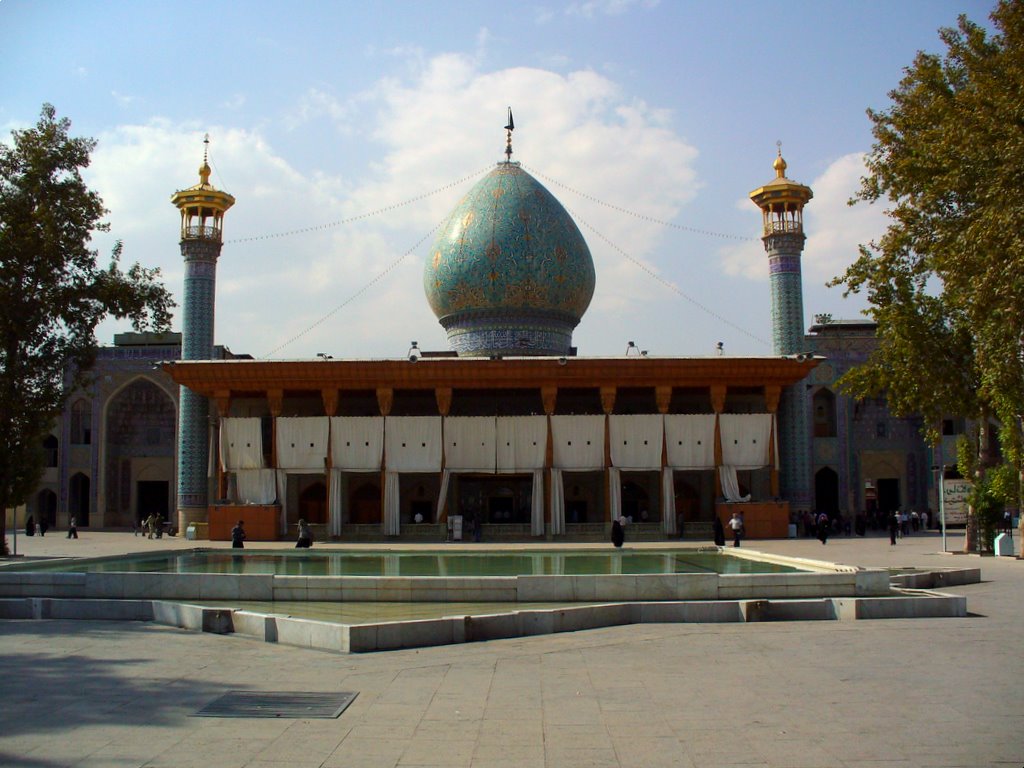
Photo: dynamosquito · CC BY-SA 2.0 · Wikimedia Commons
Nasir-ol-Molk Mosque is a mosque in Shiraz, Iranian national heritage site. Built in the Qajar era, roughly 1876 to 1888. The free Lokali audio guide runs 7 minutes.
✓ Published October 2026 · how we write these guides
Visitor facts
| Lokali audio guide | 7 min · free |
|---|---|
| Type | Mosque |
| Location | Shiraz, Iran |
| Coordinates | 29.6086, 52.5485 |
| Official website | nasiralmulk.ir |
| Languages | 50+, in the Lokali app |
The story
Stand still for a moment and look down at the carpet. Patches of colour lie across it. They are red, amber, blue and green, and they move slowly as the sun climbs. You are standing inside light that has passed through glass. Around you, other visitors speak in low voices, and many hold their phones up at the windows. Before any history, this is the first thing the Nasir-ol-Molk Mosque gives you. It is a room where the floor changes colour while you watch.
This mosque stands in the old heart of Shiraz, in southern Iran. Shiraz is a city of poets, gardens and orange trees. Outside these walls, the streets of the old quarter are narrow and lined with brick. Small shops sell spices, fabric and household goods. Then the high gate opens onto a quiet courtyard. Moving from a busy alley into calm air and soft tile happens in only a few steps. That contrast is part of the design.
Most travellers know this building by a nickname: the Pink Mosque. The name comes from the tiles. Look at the walls of the courtyard and the arches. Pink and rose tones appear again and again, mixed with deep blue, yellow and white. Many older Persian mosques use mostly blue and turquoise. Here, warm pinks lead the palette. That is one reason the mosque looks so different in photographs from the great blue domes of other Iranian cities.
The building dates from the Qajar period. The Qajar dynasty ruled Persia through most of the nineteenth century and into the early twentieth. Construction is usually dated to roughly 1876 through 1888, so the work took about twelve years. The patron was a wealthy Shiraz nobleman known by the title Nasir-ol-Molk. His title gave the mosque its name. The building is still linked to a family endowment, a religious trust that pays for its care.
Here is the first surprise for many visitors. This is not an ancient building by Iranian standards. Iran has mosques that are many centuries older. Nasir-ol-Molk is quite young, built in the same decades that railways and telegraph lines were spreading across the world. The Qajar court had close contact with Europe in this period. You can see that contact in the art. Look closely at the tiles and you will find roses, bouquets and plant shapes that feel almost European, set inside traditional Persian frames.
Walk to the centre of the courtyard. A long rectangular pool runs through it. On a calm day the water holds a reflection of the tiled arches. Trees and small planted beds sit near the pool. This layout is very old in Persian architecture. Water and greenery in a closed courtyard echo the idea of the Persian garden, a walled place of shade and order. It brings that idea into a house of prayer.
Now turn toward the porches at the ends of the courtyard. Above the openings you will see muqarnas. Muqarnas is a type of ceiling decoration made of many small, stacked niches, like a honeycomb carved into the vault. From below, it seems to drip down from the arch. Each small cell is covered with tile. Stand under one and look straight up. The pattern pulls the eye inward toward a single point at the top.
The most famous space is the winter prayer hall, on one side of the courtyard. Its outer wall is a row of tall wooden windows filled with coloured glass. In Persian these are called orosi. They are wooden lattice windows set with small panes of glass. When morning sun hits them, the colour pours across the floor and the columns. That is the scene you have probably seen in photographs. It is real, and it depends entirely on the weather and the hour.
Inside the hall, look at the columns. They are made of stone, and many of them are carved in a twisting spiral, like rope. The ceiling above them is a series of small domes and arches. Persian carpets cover the floor. This hall was designed for cold months, when people needed a closed, sheltered space to pray. Today the light show is the attraction, but the room was built for comfort and worship first.
Here is the second surprise. That coloured light was not only for beauty. Glass windows of this kind let the room stay bright while keeping out the worst of the wind and dust. The colours softened the strong southern sun. So what feels like pure decoration is also a practical answer to the climate of Shiraz. Beauty and function were working together.
Remember that this is a working mosque. People still come here to pray, and the space has rules. Visitors are expected to dress modestly. Women usually cover their hair, and a loose outer garment may be offered at the entrance. Shoes come off before you step onto the carpets of the prayer hall. Keep your voice low, and give room to anyone who is praying. A little patience here makes the visit better for everyone.
The light changes through the year. In the colder months, the sun sits lower in the sky, and it reaches deeper into the hall. Many visitors arrive early in the morning for this reason. Later in the day, the strong colour fades from the floor. The tiles in the courtyard then become the main event, warm and pink in the afternoon light. If you can, sit for a while and watch the room change.
As you prepare to leave, step back into the courtyard one more time. Look up at the sky above the walls. Then look down at the pool and the reflected arches. Notice the small details you may have passed on the way in. A single painted rose. A line of calligraphy. A worn edge on a step, smoothed by many feet.
When you walk back through the gate, the noise of the old quarter returns. Shop doors, motorbikes, voices, the smell of bread or tea from somewhere nearby. Carry the colours with you for a moment. A wealthy man paid for this building, and craftsmen spent years on it. But today it belongs to everyone who stops, takes off their shoes, and waits for the light.
Key facts
What to look for
Practical tips
Common questions
Is there a free audio guide to Nasir-ol-Molk Mosque?
Yes — the Lokali app narrates Nasir-ol-Molk Mosque free of charge in 50+ languages. The guide runs about 7 minutes, covers the history, what to look for on site and practical tips, and works offline once downloaded.
Where is Nasir-ol-Molk Mosque?
Nasir-ol-Molk Mosque is in Shiraz, Iran, at 29.6086, 52.5485. Tap the map link on this page for directions from where you are.
What is Nasir-ol-Molk Mosque known for?
Built in the Qajar era, roughly 1876 to 1888. Named after the nobleman patron titled Nasir-ol-Molk.
What should you look for at Nasir-ol-Molk Mosque?
Spiral rope-like carvings on the winter hall columns. Honeycomb muqarnas vaults above the courtyard porches. European-style rose bouquets painted on the tiles.
What should you know before visiting Nasir-ol-Molk Mosque?
Arrive early morning for the strongest coloured light. Visit in colder months when sunlight reaches deeper inside.
When is the best time to visit Nasir-ol-Molk Mosque?
Arrive early morning for the strongest coloured light.
On the map
Opens directions to Nasir-ol-Molk Mosque from your location.
More to see in Shiraz


Hear Nasir-ol-Molk Mosque in your language
The full story, narrated, in 50+ languages. Download it before you go and it plays offline, at your own pace, with no ticket and no tour group.