
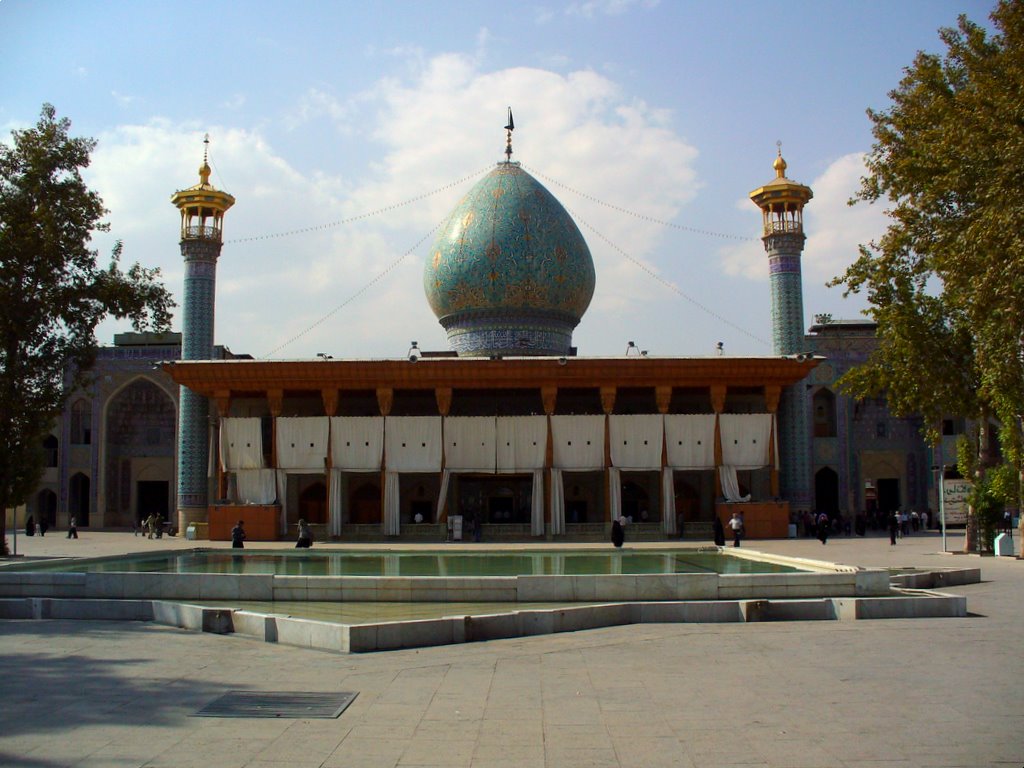
Photo: Omid Hatami · Public domain · Wikimedia Commons
Tomb of Saadi is a mausoleum in Shiraz, Iranian national heritage site. Saadi was born in Shiraz in the early thirteenth century. The free Lokali audio guide runs 7 minutes.
✓ Published October 2026 · how we write these guides
Visitor facts
| Lokali audio guide | 7 min · free |
|---|---|
| Type | Monument |
| Location | Shiraz County, Iran |
| Coordinates | 29.6225, 52.5832 |
| Languages | 50+, in the Lokali app |
The story
Listen first. Water runs somewhere below your feet, and the air smells of orange leaves and warm stone. Cypress trees stand in tall, dark rows. Small groups of visitors speak in low voices, and every so often someone recites a line of poetry from memory. You are at the Tomb of Saadi, in the northeast of Shiraz, near the foot of the hills. For many Iranians, this is not a museum visit. It is closer to visiting a respected elder.
So who was Saadi? He was a poet and writer born in Shiraz in the early thirteenth century. He is known by his pen name, Saadi, and Iranians often call him simply the Master of Speech. His prose and verse shaped the Persian language for centuries. Schoolchildren still learn his lines by heart. When an older relative quotes a proverb at the dinner table, there is a fair chance the words belong to the man buried here.
Saadi lived through a hard century. The Mongol invasions broke cities across the region, and he left Shiraz as a young man. He studied in Baghdad and then spent many years on the road. His own writings describe journeys through the Middle East and beyond. One famous story in his work tells of being captured and forced to dig trenches. Scholars debate how much of his travel writing is literal and how much is a teaching tale. Either way, he came home with a lifetime of stories.
When Saadi returned to Shiraz, the city was a calmer place. A local dynasty had kept it safer than many of its neighbours. Here he finished his two great books. The first is the Bustan, which means The Orchard. It is written in verse. The second is the Gulistan, or The Rose Garden, which mixes prose and short poems. Both books are full of practical wisdom, humour, and sharp observations about kings, beggars, and everyone in between.
Now look at the building in front of you. What you see is not the original tomb. Saadi died near the end of the thirteenth century, and simpler structures marked his grave for generations. In the eighteenth century, Karim Khan Zand — the ruler who made Shiraz his capital — built a mausoleum here. The present building dates from the twentieth century, when it was rebuilt in a modern form. So you are looking at a twentieth-century tribute to a medieval poet.
The design borrows from the past. Notice the tall, slender columns at the front. They recall the open porches of Persian palaces and, further back, the column halls of ancient Persepolis, not far from Shiraz. Above the tomb chamber rises a dome covered in turquoise tile. In bright sun, the blue looks almost cool against the pale stone. Take a moment to compare the clean, modern lines with the traditional colours. The building tries to speak in two periods at once.
Step closer to the walls. Lines of Saadi's poetry run across the stone and tile in flowing Persian calligraphy. The style is called nastaliq — a graceful script with long, sloping strokes that is used often for Persian poetry. Even if you cannot read it, watch how local visitors stop in front of a panel. Many of them read the words aloud, quietly, under their breath. In this garden, the text is not decoration. It is the reason people come.
Here is a surprise for many visitors. One of Saadi's short poems is known far outside Iran. It begins with the idea that all human beings are members of one body, made from the same essence. If one part suffers, the others cannot rest. These lines are often quoted at international gatherings, and a version of them is associated with the United Nations in New York. A poem written in medieval Shiraz now travels as a message about shared humanity.
Now follow the sound of water. Below the garden, steps lead down to a small underground pool. The water comes from an old underground channel. Persians call this kind of channel a qanat — a tunnel that carries groundwater over long distances without pumps. In the pool, you can see small fish moving in the shade. The cool air down here is a real relief on a hot afternoon.
This pool has its own folklore. Locals say the fish are blessed, and for a long time people believed the water could bring good fortune or healing. Many visitors drop coins into the pool and make a quiet wish. Treat this as a tradition rather than history — but it is a living one. Watch the families who come down the steps. You will often see a child pressing a coin into a parent's hand, then leaning over the edge to look.
Back in the garden, notice the rhythm of the place. Paths run between beds of flowers and lines of cypress. The cypress is a very old symbol in Persian art. It stands for dignity and for life that continues. In spring, the garden fills with colour and the scent of blossom. Iranians mark a day in Saadi's honour in the spring, and the garden often feels especially full around that time.
It is worth comparing this place with the other famous poet's tomb in Shiraz — the tomb of Hafez, in another part of the city. Hafez is the poet of mystery and longing. Saadi is the poet of experience and good sense. Many Iranians say you read Hafez to understand your heart, and Saadi to understand people. Visiting both in one day gives you a clear picture of why Shiraz is often called the city of poets.
Before you leave, find a quiet bench in the shade. Listen again for the water under the garden, and for the soft voices around the tomb. Look up at the turquoise dome, and then at the hills behind it. Saadi spent much of his life far from home, collecting stories. He chose to return here, and he rests here still. As you walk back toward the gate, you may hear someone quoting him one more time.
Key facts
What to look for
Practical tips
Common questions
Is there a free audio guide to Tomb of Saadi?
Yes — the Lokali app narrates Tomb of Saadi free of charge in 50+ languages. The guide runs about 7 minutes, covers the history, what to look for on site and practical tips, and works offline once downloaded.
Where is Tomb of Saadi?
Tomb of Saadi is near Shiraz County, Iran, at 29.6225, 52.5832. Tap the map link on this page for directions from where you are.
What is Tomb of Saadi known for?
Saadi was born in Shiraz in the early thirteenth century. His best-known books are the Bustan and the Gulistan.
What should you look for at Tomb of Saadi?
Turquoise tile dome rising above the tomb chamber. Slender columns echoing old Persian palace porches. Saadi's verses carved in flowing nastaliq calligraphy.
What should you know before visiting Tomb of Saadi?
Visit in late afternoon when the garden is cooler. Bring a few coins to join the wishing tradition.
When is the best time to visit Tomb of Saadi?
Visit in late afternoon when the garden is cooler.
On the map
Opens directions to Tomb of Saadi from your location.
More to see near Tomb of Saadi


Hear Tomb of Saadi in your language
The full story, narrated, in 50+ languages. Download it before you go and it plays offline, at your own pace, with no ticket and no tour group.