
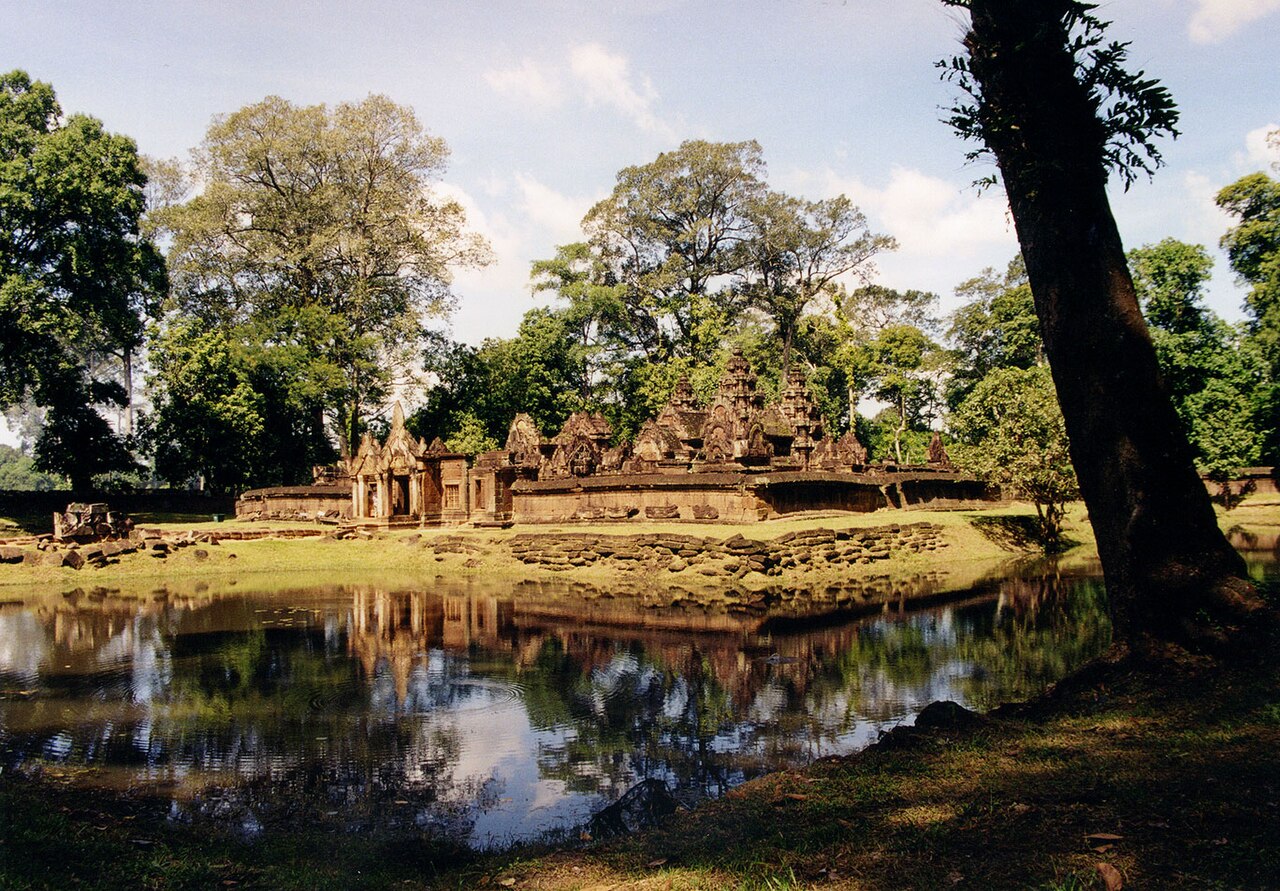
Photo: Culexx · CC BY-SA 3.0 · Wikimedia Commons
Bakong is a temple mountain of sandstone near Siem Reap, Cambodia. An inscription dates the temple's dedication to 881. The free Lokali audio guide runs 6 minutes.
✓ Published October 2026 · how we write these guides
Visitor facts
| Lokali audio guide | 6 min · free |
|---|---|
| Type | Archaeological Site |
| Location | Siem Reap, Cambodia |
| Coordinates | 13.3360, 103.9741 |
| Languages | 50+, in the Lokali app |
The story
Before you see the temple, you hear the water. A wide moat circles this place, and on a still morning the surface holds the sky like a sheet of grey glass. Frogs call from the reeds. Somewhere nearby, a temple bell rings from the modern monastery. Under your feet, the earth path turns to old stone as you walk toward the causeway.
You are standing at Bakong, about fifteen kilometres southeast of central Siem Reap, in the area known today as Roluos. Most visitors head straight for Angkor Wat and never come here. That is a pity. This quiet pyramid came first. In many ways, it is the ancestor of the more famous temples you may already have seen.
A thousand years ago, this area was not a village among rice fields. It was a royal capital called Hariharalaya. The name joins two Hindu gods. Hari is another name for Vishnu, and Hara is another name for Shiva. Long before the city of Angkor existed, Khmer kings ruled from here, and they built their temples to match their ambitions.
The king most closely linked to Bakong is Indravarman the First. An inscription found at the site records its dedication in the year 881. The temple was dedicated to Shiva, the Hindu god of destruction and renewal. At the top, a sacred object representing the god once stood at the centre of the kingdom. The king's power and the god's power were meant to be seen as one.
Now look at the shape in front of you. Bakong is a temple-mountain. That means it is built as a model of Mount Meru, the home of the gods in Hindu belief. The moat stands for the ocean around the world. The pyramid of five stepped terraces stands for the mountain itself. This was one of the first times the Khmer built this idea so large and so fully in stone.
Here is something many visitors miss. Earlier Khmer temples were mostly built in brick. Bakong used sandstone for its great pyramid, on a scale that was new at the time. Builders had to quarry the stone, move it, and fit the heavy blocks without mortar. When you climb, touch the edges of the blocks. You can feel how closely they sit against each other.
As you cross the causeway, look at the low stone railings on either side. These are nagas — sacred serpents from Hindu and Buddhist stories. They guard the threshold between the human world and the world of the gods. Compared with the elaborate nagas at later temples, these feel simple and heavy. You are looking at an early version of a form that Khmer sculptors would refine for centuries.
Around the base of the pyramid, you will find the remains of brick towers. There were once eight of them, set in a ring around the central mountain. Some still stand. Others are reduced to low walls and scattered bricks. On the surviving towers, look closely above the doorways. The carved stone lintels and the patches of old decoration show how much colour and detail once covered these walls.
Now begin to climb. On the corners of the terraces, large stone elephants stand guard. Notice something about them as you go up. The elephants become smaller on each higher level. This is a deliberate trick of perspective. From the ground, it makes the pyramid look taller than it really is. The builders were thinking about the eye of the person standing exactly where you stood a few minutes ago.
At the very top sits the central tower. Here is the second surprise. This tower is not original to the ninth century. Its style matches a much later period, close to the age of Angkor Wat, so historians believe it was rebuilt or added roughly two or three centuries after the first dedication. So when you look at the summit, you are seeing two eras of Khmer building at once — an early base and a later crown.
The temple you see today also owes a great deal to modern restorers. In the 1930s and 1940s, French archaeologists from the French School of the Far East worked here. They used a method called anastylosis. In simple terms, they took parts of the structure apart, numbered the stones, strengthened the foundations, and put the original blocks back in their places. Where a stone was missing, new material was added carefully. Look for blocks that seem slightly different in colour or texture.
Bakong did not stay the centre of power for long. Within a generation, a later king moved the capital northwest to the area of Angkor itself. Yet the idea born here travelled with him. The moat, the stepped mountain, the guardians on the stairs — you will find these ideas again, larger and more complex, at the temples around Angkor. Nearby, the brick towers of Preah Ko and Lolei belong to this same early capital and make a good pair with this visit.
Before you leave, stand on the top terrace and turn slowly in a circle. Look down at the moat, the sugar palms, the orange robes of monks moving near the monastery. Listen for children, motorbikes, and birds in the trees. More than eleven centuries after its dedication, this mountain of stone still sits in a living village. As you walk back across the causeway, notice the serpent railings once more... and the water, still holding the sky.
Key facts
What to look for
Practical tips
Common questions
Is there a free audio guide to Bakong?
Yes — the Lokali app narrates Bakong free of charge in 50+ languages. The guide runs about 6 minutes, covers the history, what to look for on site and practical tips, and works offline once downloaded.
Where is Bakong?
Bakong is in Siem Reap, Cambodia, at 13.3360, 103.9741. Tap the map link on this page for directions from where you are.
What is Bakong known for?
An inscription dates the temple's dedication to 881. Built under King Indravarman the First, ruler of Hariharalaya.
What should you look for at Bakong?
Stone elephants shrinking in size on higher terraces. Early, simple naga serpent railings along the causeway. Ruined brick towers ringing the base of the pyramid.
What should you know before visiting Bakong?
Combine your visit with nearby Preah Ko and Lolei. Arrive early morning for softer light and fewer people.
When is the best time to visit Bakong?
Arrive early morning for softer light and fewer people.
On the map
Opens directions to Bakong from your location.
More to see in Siem Reap


Hear Bakong in your language
The full story, narrated, in 50+ languages. Download it before you go and it plays offline, at your own pace, with no ticket and no tour group.