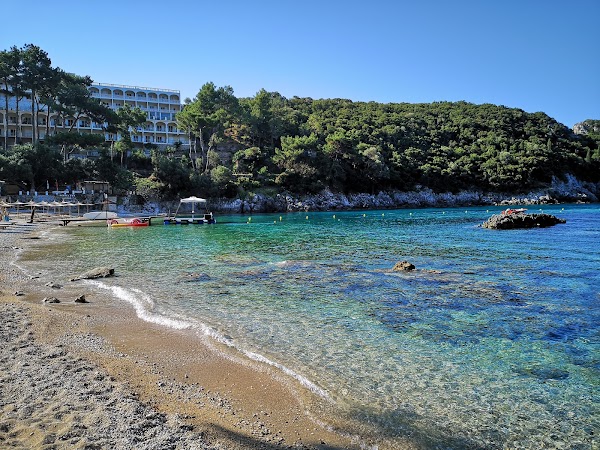
Agia Triada Beach is a sheltered sandy cove on Crete's northern coast near Chania, framed by rocky headlands and shallow turquoise water. It is in Crete, Greece. Most visitors spend 2–4 hours here. The free Lokali audio guide runs 9 minutes.
✓ Verified August 2026 · how we write these guides
Visitor facts
| Time needed | 2–4 hours |
|---|---|
| Lokali audio guide | 9 min · free |
| Type | Beach |
| Best for | Family |
| Location | Crete, Greece |
| Coordinates | 35.5167, 24.0333 |
| Languages | 45, in the Lokali app |
The story
The sand here is coarser than you might expect — small pebbles mixed with golden grains that shift and click underfoot as the waves pull back. Agia Triada sits on the northern coast of Crete, tucked into a curve of shoreline where the Aegean meets rocky headlands dotted with wild thyme and oregano. The water is startlingly clear, that particular shade of turquoise that only happens where limestone shelves drop away cleanly beneath the surface.
The beach takes its name from the Holy Trinity — Agia Triada in Greek — though the chapel you might expect to find here is actually a small roadside shrine further inland, its blue-painted dome visible from the coastal road. This stretch of sand has been a quiet fishing spot for centuries, long before tourism arrived on Crete's northern shores. Local families still come here in the early mornings, casting lines from the rocks at either end of the bay.
What makes Agia Triada different from the more famous beaches further west is its relative seclusion. No large resorts crowd the shoreline, no rows of identical sun loungers march down to the water. A handful of tavernas sit back from the sand, their tables shaded by bamboo roofs and grapevines heavy with fruit in late summer. The road down from the main highway is narrow and winding, which keeps the crowds manageable even in July and August.
The seabed here slopes gently for the first twenty metres, making it a favourite with families, then drops more steeply where the limestone shelf ends. Snorkellers often work the eastern edge of the bay, where rock formations create small caves and overhangs. The water stays calm most days — the headlands shelter the beach from the prevailing northwesterly winds that batter other parts of the coast.
Look closely at the cliffs framing the western side of the beach and you will notice horizontal striations in the rock, layers of sediment compressed over millions of years when this entire region lay beneath a shallow sea. Fossilised shells still appear in the stone, small spiral patterns pressed into the pale grey limestone. Geologists come here to study the layers, reading the history of the Mediterranean basin in the rock face.
The light changes dramatically through the day. Morning sun hits the beach from the east, turning the water a pale, almost milky blue. By afternoon, the angle shifts and the sea deepens to cobalt, shadows from the cliffs stretching across the sand. Late afternoon is when the locals arrive, after the heat has softened and the water holds the warmth of the day. You will see older men swimming far out, moving with the slow, steady strokes of people who have swum this bay their entire lives.
In spring, wildflowers cover the slopes above the beach — poppies, chamomile, and the bright yellow blooms of Cretan ebony. The scent of herbs drifts down on warm air, mixing with the salt and the faint smell of grilled fish from the tavernas. By midsummer, the vegetation dries to straw-gold, and the landscape takes on the bleached, sun-beaten quality that defines the Greek islands in high season.
Agia Triada remains one of those places where the rhythm of the day follows the sun and the tide rather than any schedule. Fishing boats come and go, their engines puttering softly across the bay. A few cats sleep in the shade of the tamarisk trees that line the back of the beach, waiting for scraps from the tavernas. The beach empties by early evening, leaving just the sound of the waves and the occasional clatter of plates being cleared from the outdoor tables.
If you wade out to where the sand gives way to rock, you can look back and see the whole curve of the bay, the way the cliffs frame the beach like parentheses, the road climbing steeply inland toward the villages perched on the hillsides. It is a view that has not changed much in decades — the same small tavernas, the same fishing boats, the same quality of light on the water.
The name Holy Trinity feels appropriate here, not because of any grand religious monument, but because of the way three elements — land, sea, and sky — meet so cleanly at this edge of the island. Stand at the waterline and you can feel the pull of the tide, the coolness of the Aegean against your ankles, the warmth of the sand already starting to fade as the sun drops lower. This is Crete at its quietest, a beach that asks nothing of you except to notice the small details: the click of pebbles, the scent of thyme, the way the light shifts on the water.
Key facts
What to look for
Practical tips
Common questions
How long do you need at Agia Triada Beach?
Plan 2–4 hours. That is the time most visitors spend at Agia Triada Beach. The free Lokali audio guide adds about 9 minutes of narration you can listen to as you walk, so it fits inside your visit rather than adding to it.
Is there a free audio guide to Agia Triada Beach?
Yes — the Lokali app narrates Agia Triada Beach free of charge in 50+ languages. It covers the history, what to look for on site and practical tips, and it works offline once downloaded.
Where is Agia Triada Beach?
Agia Triada Beach is in Crete, Greece, at 35.5167, 24.0333. Tap the map link on this page for directions from where you are.
What should you know before visiting Agia Triada Beach?
Arrive early morning for calm water and fewer people.
What is Agia Triada Beach known for?
Named after the Holy Trinity in Greek.
What is the best time to visit Agia Triada Beach?
Arrive before 10am to claim a spot under the tamarisks — by midday the sand fills quickly.
On the map
Opens directions to Agia Triada Beach from your location.
More to see in Crete



Hear Agia Triada Beach in your language
The full story, narrated, in 50+ languages. Download it before you go and it plays offline, at your own pace, with no ticket and no tour group.