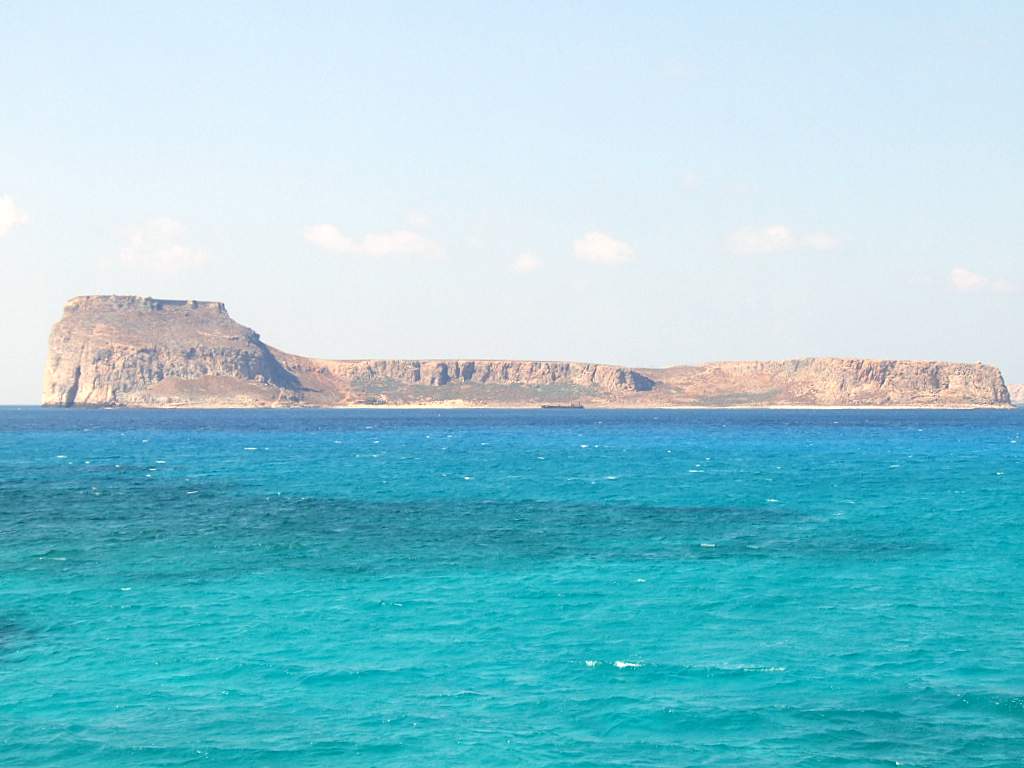
Balos Lagoon is a shallow lagoon where three seas meet at the tip of the Gramvousa peninsula, northwest Crete. It is in Crete, Greece. Most visitors spend 2–4 hours here. The free Lokali audio guide runs 9 minutes.
✓ Verified August 2026 · how we write these guides
Visitor facts
| Time needed | 2–4 hours |
|---|---|
| Lokali audio guide | 9 min · free |
| Type | Beach |
| Best for | Photography |
| Location | Crete, Greece |
| Coordinates | 35.5833, 23.5833 |
| Languages | 45, in the Lokali app |
The story
The water here shifts from milky turquoise to cobalt blue in bands so distinct they look painted. Stand at the edge where the sand meets the shallows and you can see straight through to the bottom — the lagoon rarely runs deeper than a metre across most of its span, and the seabed glows white beneath the surface.
Balos sits at the northwestern tip of Crete, where the small rocky peninsula of Gramvousa curls around to shelter this crescent of sand and shallow water. The lagoon forms in the gap between the peninsula and the tiny islet of Imeri Gramvousa just offshore. Tides and currents push fine white sand and crushed shells into the basin, and because the water is so shallow and so still, it warms quickly under the sun. On summer mornings the temperature can climb past twenty-five degrees.
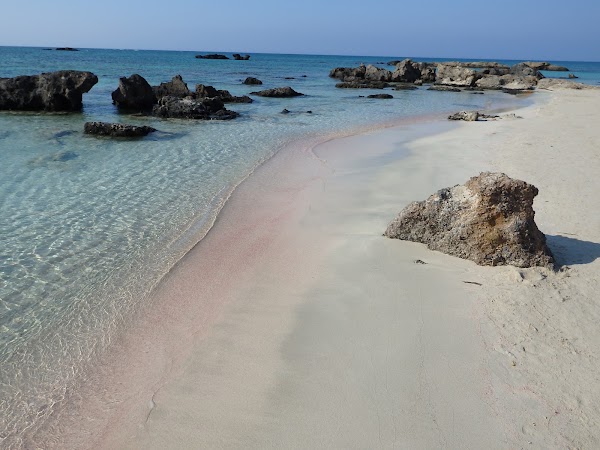
The pale sand is not pure quartz — it is ground seashell, coral fragments, and limestone, which gives it that bone-white colour. Walk along the beach and you will see pink streaks running through the white. Those are tiny shell fragments from a species of foraminifera, single-celled organisms whose pink shells wash ashore by the thousands. The mix of white and pink sand is rare in the Mediterranean and it gives Balos its distinctive pastel palette.
The Gramvousa peninsula rises steeply behind the lagoon, a spine of limestone and scrub that blocks the northern wind. Venetian engineers built a fortress on the summit of Imeri Gramvousa in the late fifteen-nineties, and for two centuries it guarded the sea lanes between Crete and the Peloponnese. After Crete fell to the Ottomans in the sixteen-sixties, the fortress changed hands several times. In the early eighteen-hundreds it became a base for Cretan rebels and later for pirates who raided merchant ships in the channel. The ruins are still visible on the island's peak, though most visitors stay on the beach.
Balos became famous outside Greece in the nineteen-seventies when images of the lagoon began appearing in travel magazines. By the nineteen-nineties it was one of the most photographed beaches in the Mediterranean. The Greek government designated the area a protected Natura 2000 site in the early two-thousands, which limits development and restricts boat traffic during nesting season for the loggerhead sea turtle and the Mediterranean monk seal, both of which use the nearby coves.
Most people reach Balos by boat from Kissamos, a thirty-minute crossing that lands you directly on the beach. The alternative is a dirt road that climbs over the Gramvousa ridge — eight kilometres of switchbacks and loose gravel that ends at a clifftop parking area. From there a steep footpath drops two hundred metres to the sand. The walk down takes about twenty minutes, longer on the way back up. Early morning is the best time to arrive, before the tour boats. By mid-morning in summer the beach can hold several hundred people, though the lagoon is large enough that it never feels truly crowded.
The water stays shallow for at least fifty metres out from the beach, which makes Balos popular with families. You can wade across most of the lagoon without the water reaching your waist. The deepest channel runs along the western edge where the open sea pushes in through the gap between the peninsula and the islet. That is where the colour shifts from pale aqua to dark blue, and the current picks up slightly.
Bring shoes you can wear in the water — the sand is soft near the shore but the seabed turns rocky and uneven as you move toward the channel. The sun is intense here with almost no shade on the beach, so a hat and sunscreen are necessary if you plan to stay more than an hour. There are no facilities at Balos, no cafes or toilets, so carry water and anything else you will need for the day.
The light changes constantly depending on the angle of the sun. Mid-morning the lagoon glows bright turquoise, almost artificial in its intensity. By late afternoon the colours deepen and the water takes on a glassy, golden cast. If you are walking back up the cliff path at sunset, turn around halfway up — the view over the lagoon at that hour, with the mountains of western Crete dark against the sky, is one of the finest coastal prospects in Greece.
As you leave, notice the way the wind picks up in the late afternoon, ruffling the surface of the lagoon into small ripples that catch the light. The shallow water cools quickly once the sun drops behind the ridge, and the beach empties. By evening Balos returns to the quiet it must have held for centuries before the boats began arriving — just the sound of the tide moving through the channel and the occasional cry of a gull overhead.
Key facts
What to look for
Practical tips
Common questions
How long do you need at Balos Lagoon?
Plan 2–4 hours. That is the time most visitors spend at Balos Lagoon. The free Lokali audio guide adds about 9 minutes of narration you can listen to as you walk, so it fits inside your visit rather than adding to it.
Is there a free audio guide to Balos Lagoon?
Yes — the Lokali app narrates Balos Lagoon free of charge in 50+ languages. It covers the history, what to look for on site and practical tips, and it works offline once downloaded.
Where is Balos Lagoon?
Balos Lagoon is in Crete, Greece, at 35.5833, 23.5833. Tap the map link on this page for directions from where you are.
What should you know before visiting Balos Lagoon?
Arrive early morning before tour boats.
What is Balos Lagoon known for?
Pink sand comes from crushed foraminifera shells.
What is the best time to visit Balos Lagoon?
Arrive before 11am or after 4pm to avoid the tour-boat rush.
On the map
Opens directions to Balos Lagoon from your location.
More to see in Crete



Hear Balos Lagoon in your language
The full story, narrated, in 50+ languages. Download it before you go and it plays offline, at your own pace, with no ticket and no tour group.