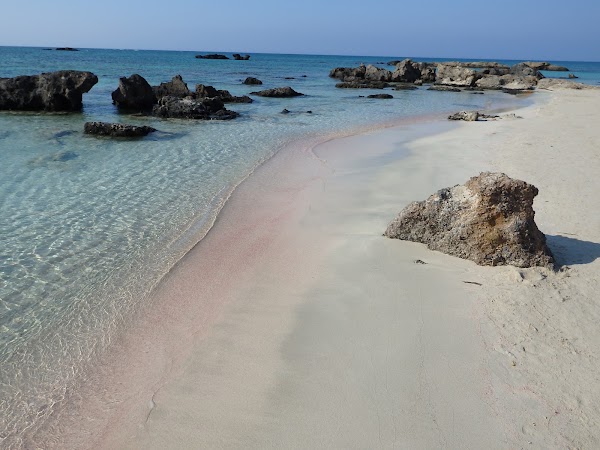
Elafonissi Beach is a shallow lagoon beach on Crete's southwestern tip, famous for its pink-tinged sand created by crushed seashells. It is in Crete, Greece. Most visitors spend 2–4 hours here. The free Lokali audio guide runs 8 minutes.
✓ Verified August 2026 · how we write these guides
Visitor facts
| Time needed | 2–4 hours |
|---|---|
| Lokali audio guide | 8 min · free |
| Type | Beach |
| Best for | Photography |
| Location | Crete, Greece |
| Coordinates | 35.2714, 23.5383 |
| Languages | 45, in the Lokali app |
The story
The sand here shifts from white to pink under your feet — crushed seashells mixed with coral fragments, glinting in the Mediterranean light. The water is so shallow you can walk a hundred metres out before it reaches your waist, and the colour changes as you go: turquoise near shore, deepening to cobalt where the seabed drops away. On calm days, the lagoon between the beach and the offshore islet becomes a mirror.
Elafonissi sits at the southwestern tip of Crete, where the island tapers into the Libyan Sea. The name means Deer Island in Greek, though no deer live here now. Local stories say the name comes from a ship that wrecked offshore centuries ago, carrying deer as cargo. What is certain is the geography: a low sandy islet lies two hundred metres from the mainland beach, and at low tide you can wade across the shallow channel between them.
The pink tint in the sand comes from millions of tiny shell fragments — the remains of foraminifera and other marine organisms with reddish pigments in their calcium structures. When the light hits at certain angles, especially late afternoon, whole stretches of shoreline glow rose. Not every patch shows the colour; you will find it most vividly along the southern curves of the beach, where currents deposit the finest sediment.
This coast has always been remote. The nearest village, Chrysoskalitissa, sits six kilometres inland, and until the nineteen-eighties the road here was unpaved. Shepherds grazed their flocks on the scrubland behind the dunes, and fishermen launched small boats from the cove. The beach remained largely unknown outside Crete until the early two-thousands, when travel guides began listing it among Europe's finest stretches of sand.
In April of eighteen-twenty-four, during the Greek War of Independence, an Ottoman force landed near here and marched inland. A small monastery on the cliffs above — Panagia Chrysoskalitissa, the Virgin of the Golden Step — sheltered refugees fleeing the violence. The monks hid families in the storage cellars, and some accounts say villagers buried valuables in the dunes, though none of those caches have been confirmed. The monastery still stands, its whitewashed walls visible from the southern end of the beach.
The water stays warm from May through October, and the seabed is sandy with no rocks or urchins. Families wade out with children; the depth increases so gradually that even toddlers can splash safely near shore. On the islet side, the water is slightly cooler and clearer — fewer swimmers stir up the sand there. Snorkelers sometimes spot small fish darting through the eel grass beds.
Cedars and junipers grow in twisted shapes behind the dunes, bent by the prevailing wind. In spring, the low shrubs bloom with yellow and purple wildflowers — rock roses, thyme, and sea daffodils. The scent of wild herbs mixes with salt air. Lizards bask on the warm stones along the footpaths, and in early morning you might see a hoopoe bird probing the sand for insects.
The beach has no buildings on it, only a small parking area and a seasonal snack bar at the access point. A wooden boardwalk crosses the dunes to protect the fragile vegetation. In summer, umbrellas and sunbeds line the main stretch, but if you walk south toward the islet or north along the less-visited sections, you will find open sand. The islet itself remains undeveloped — just dunes, low scrub, and a few rocky outcrops on its seaward side.
Sunset here is a slow affair. The sun drops toward the horizon over open water, and the light turns everything amber — the pink sand deepens to coral, the white foam on the waves glows gold. Swimmers leave the water as the air cools, and the beach empties. By dusk, only a few people remain, watching the last light fade over the Libyan Sea.
Wind patterns shift through the day. Mornings are often still, the lagoon glassy. By afternoon, a steady breeze picks up from the west, ruffling the water and keeping the temperature comfortable even in July. On rare days, a southern wind brings haze and the smell of distant Africa — dust carried across the sea from the Sahara, tinting the sky a milky white.
Stand at the water's edge now and look south. There is nothing between you and the coast of Libya except two hundred kilometres of open sea. The waves lap gently at your ankles, warm and clear. The sand beneath your feet holds the crushed remnants of a thousand generations of sea creatures, their colours still visible after all this time.
Key facts
What to look for
Practical tips
Common questions
How long do you need at Elafonissi Beach?
Plan 2–4 hours. That is the time most visitors spend at Elafonissi Beach. The free Lokali audio guide adds about 8 minutes of narration you can listen to as you walk, so it fits inside your visit rather than adding to it.
Is there a free audio guide to Elafonissi Beach?
Yes — the Lokali app narrates Elafonissi Beach free of charge in 50+ languages. It covers the history, what to look for on site and practical tips, and it works offline once downloaded.
Where is Elafonissi Beach?
Elafonissi Beach is in Crete, Greece, at 35.2714, 23.5383. Tap the map link on this page for directions from where you are.
What should you know before visiting Elafonissi Beach?
Walk south toward islet for less crowded stretches.
What is Elafonissi Beach known for?
Pink sand comes from crushed shells and coral fragments.
What is the best time to visit Elafonissi Beach?
Arrive before 10am or after 4pm to avoid the tour-bus crowds.
On the map
Opens directions to Elafonissi Beach from your location.
More to see in Crete



Hear Elafonissi Beach in your language
The full story, narrated, in 50+ languages. Download it before you go and it plays offline, at your own pace, with no ticket and no tour group.