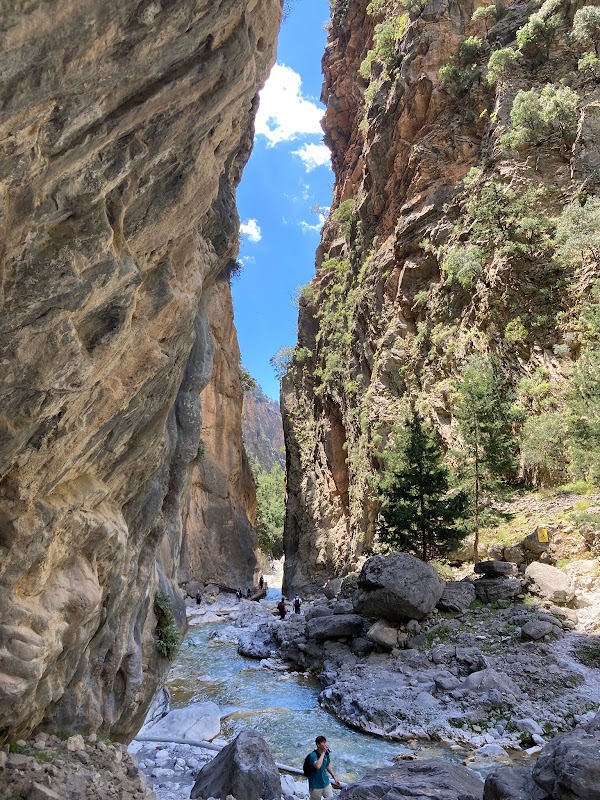
Samaria Gorge National Park Visitor Centre
35.2500° N · 24.0167° E · Museum
Samaria Gorge National Park Visitor Centre is a museum in Crete, Greece. Located at Xyloskalo (the gorge's northern entrance), this small facility explains the geology, flora, and endemic species of the gorge. Most visitors spend 20–30 min here. The free Lokali audio guide runs 8 minutes.
✓ Verified August 2026 · how we write these guides
Visitor facts
| Time needed | 20–30 min |
|---|---|
| Lokali audio guide | 8 min · free |
| Type | Museum |
| Best for | Family |
| Location | Crete, Greece |
| Coordinates | 35.2500, 24.0167 |
| Languages | 45, in the Lokali app |
The story
The air here smells of pine and wild thyme, carried down from the White Mountains on a breeze that never quite stops moving. You are standing at the threshold of one of Europe's longest gorges, and this modest stone building is where thousands of hikers each year gather their nerve, check their boots, and step into sixteen kilometres of raw Cretan wilderness.
The visitor centre sits at Xyloskalo, the wooden staircase, perched at an elevation of twelve hundred metres on the northern edge of the gorge. It was built in the nineteen-sixties, not long after the Greek government declared Samaria a national park to protect the endangered Cretan wild goat, the kri-kri, and the ancient forests of Cretan cypress that cling to these cliffs. The architecture is deliberate in its plainness — stone walls, timber beams, a low profile that does not compete with the mountains behind it.
Inside, maps and photographs line the walls, showing the gorge in every season. Winter floods turn the streambed into a torrent. Spring carpets the canyon floor with wildflowers. Summer bakes the rock white. The displays explain the geology — limestone carved over millions of years by snowmelt and rain, leaving vertical walls that narrow in places to just three metres wide. That famous pinch point, the Iron Gates, lies roughly eleven kilometres downstream from here.
The park rangers here are serious about timing. The gorge opens at dawn in the hiking season, May through October, and closes by mid-afternoon. They count every person in and every person out at the far end in Agia Roumeli, a coastal village reachable only by boat or on foot. If the numbers do not match, search teams go back up the trail. It is not theatre — people get hurt, twist ankles, run out of water, misjudge the descent.
Before you start down, the centre stocks drinking water, walking sticks for hire, and basic first aid supplies. There are toilets here, the last proper facilities until you reach the abandoned village of Samaria halfway through the gorge. The rangers will check your footwear — flip-flops and sandals are turned away. The descent is steep, the rocks are loose in places, and the trail drops six hundred metres in the first two kilometres alone.
The kri-kri, the wild goat that gave this park its protected status, is shy and mostly nocturnal. You are more likely to see its tracks in the dust than the animal itself. But the gorge holds other wildlife — griffon vultures circle the cliffs, Cretan martens slip through the underbrush, and in spring the canyon echoes with the calls of dozens of bird species migrating north across the Mediterranean.
Historically, Samaria was never empty. The village inside the gorge was inhabited until nineteen-sixty-two, when the last families were relocated to make way for the park. Before that, shepherds and their flocks moved through these mountains for centuries, using the gorge as a route between the highlands and the Libyan Sea. During the Second World War, resistance fighters hid in the caves along the cliffs, and Allied soldiers evacuated through the gorge to waiting boats on the southern coast.
The hike itself takes most people between five and seven hours, though fit walkers can manage it faster. The trail is one-way only, downhill all the way, and ends at the sea. From Agia Roumeli, ferries run east and west along the coast to larger towns. There is no road back up, no shortcut. Once you commit to the descent, you finish at the water.
Stand here at the top for a moment before you go. Look south, where the gorge cuts a pale scar through the dark green forest. The sound you hear is not wind alone — it is water, far below, working its way down through the stone. The mountains behind you are the Lefka Ori, the White Mountains, named for the pale limestone that glows at dawn and dusk. In a few hours, you will be walking beneath walls taller than any building in this part of Crete, in a silence broken only by your own footsteps and the occasional cry of a bird circling overhead.
Key facts
What to look for
Practical tips
Common questions
How long do you need at Samaria Gorge National Park Visitor Centre?
Plan 20–30 min. That is the time most visitors spend at Samaria Gorge National Park Visitor Centre. The free Lokali audio guide adds about 8 minutes of narration you can listen to as you walk, so it fits inside your visit rather than adding to it.
Is there a free audio guide to Samaria Gorge National Park Visitor Centre?
Yes — the Lokali app narrates Samaria Gorge National Park Visitor Centre free of charge in 50+ languages. It covers the history, what to look for on site and practical tips, and it works offline once downloaded.
Where is Samaria Gorge National Park Visitor Centre?
Samaria Gorge National Park Visitor Centre is in Crete, Greece, at 35.2500, 24.0167. Tap the map link on this page for directions from where you are.
What should you know before visiting Samaria Gorge National Park Visitor Centre?
Wear sturdy hiking boots, sandals turned away by rangers.
What is Samaria Gorge National Park Visitor Centre known for?
Gorge stretches sixteen kilometres through the White Mountains.
What is the best time to visit Samaria Gorge National Park Visitor Centre?
Stop here before descending—the 10-minute orientation clarifies what you'll see.
On the map
Opens directions to Samaria Gorge National Park Visitor Centre from your location.
More to see in Crete



Hear Samaria Gorge National Park Visitor Centre in your language
The full story, narrated, in 50+ languages. Download it before you go and it plays offline, at your own pace, with no ticket and no tour group.