
Samaria Gorge is a canyon in Crete, Greece. Europe's longest gorge cuts 16 kilometers through the White Mountains of Crete, dropping from 1,250 meters to sea level. Most visitors spend 5–7 hours here. The free Lokali audio guide runs 9 minutes.
✓ Verified August 2026 · how we write these guides
Visitor facts
| Time needed | 5–7 hours |
|---|---|
| Lokali audio guide | 9 min · free |
| Type | Canyon |
| Best for | Photography |
| Location | Crete, Greece |
| Coordinates | 35.2969, 23.9653 |
| Languages | 45, in the Lokali app |
The story
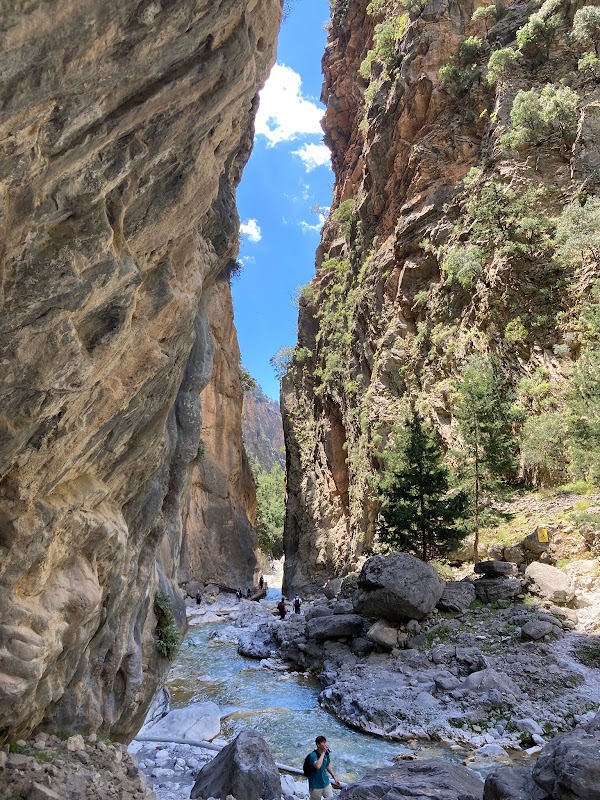
The air is cooler here, even under the Cretan sun. You are standing at the edge of one of Europe's longest and deepest gorges — a sixteen-kilometre slash through the White Mountains that drops nearly twelve hundred metres from the Omalos plateau to the Libyan Sea. The rock walls on either side are pale limestone, banded with grey and ochre, and in some places they rise so high and close together that the sky narrows to a ribbon overhead.
The gorge has been a refuge for thousands of years. During the Second World War, Allied soldiers and Cretan resistance fighters used this route to escape German forces, scrambling down the riverbed to reach boats waiting on the southern coast. Centuries earlier, the gorge sheltered bandits, shepherds, and entire villages during Ottoman raids. The old settlement of Samaria — abandoned in nineteen sixty-two when the gorge became a national park — still stands halfway down the trail, its stone houses roofless and silent among the plane trees.
The trail begins at Xyloskalo, a wooden staircase that zigzags down the cliff face. The first two kilometres are steep, a descent of nearly a thousand metres, and the path is paved with stones worn smooth by decades of boots. As you drop into the gorge, the vegetation changes — cypress and pine give way to plane trees and wild oleander, their roots clutching the rocks along the river.
The Tarraios River runs through the gorge for most of the year, fed by snowmelt from the peaks above. In spring and early summer the water is high and fast, pooling in places where the rock has been hollowed out by centuries of flow. By late summer the river dwindles to a trickle, and in some sections the bed is dry, revealing smooth grey stones and the twisted roots of plane trees.
The narrowest section of the gorge is called the Iron Gates. Here the walls close to just three metres apart, and the rock rises three hundred metres on either side. The light is dim and the air is damp, even in July. The walls are smooth in places, polished by floodwater, and scored with vertical grooves where softer layers have eroded faster than the limestone around them.
The gorge is home to the kri-kri, a wild goat found only in Crete. They are smaller than domestic goats, with long curved horns and pale coats that blend into the rock. You are most likely to see them early in the morning or late in the afternoon, when they come down to the river to drink. They move easily on the steep slopes, leaping from ledge to ledge with a precision that looks effortless.
The hike takes between four and seven hours, depending on your pace. Most people walk downhill, starting at Xyloskalo and finishing at Agia Roumeli, a small village on the coast where boats run east to Hora Sfakion and west to Sougia. The trail is well-marked and maintained, but it is rocky and uneven, and the descent is hard on the knees. There is no way out except forward — once you start, you must finish.
The gorge closes in winter, usually from November to April, when snowmelt and rain turn the river into a torrent. Even in summer, rangers monitor the weather closely. If a storm is forecast, the trail is closed at dawn. Flash floods are rare but fast, and the walls are too steep to climb.
At the southern end, the gorge opens onto a wide riverbed of smooth white stones, and beyond that the sea. Agia Roumeli sits in a crescent of pebble beach, backed by cliffs. The water is cold and clear, and after hours of walking, most people go straight in. The village has a handful of tavernas, a small church, and a few rooms to rent, but no road — everything arrives by boat or on foot.
As you look back toward the gorge, the scale of it becomes clear. The walls rise like curtains of stone, layered and folded, shaped by forces that have been working for millions of years. The river that carved this place is still carving it, grain by grain, flood by flood. You have walked through a landscape that is both ancient and unfinished, and the sound of the water will stay with you long after you leave.
Key facts
What to look for
Practical tips
Common questions
How long do you need at Samaria Gorge?
Plan 5–7 hours. That is the time most visitors spend at Samaria Gorge. The free Lokali audio guide adds about 9 minutes of narration you can listen to as you walk, so it fits inside your visit rather than adding to it.
Is there a free audio guide to Samaria Gorge?
Yes — the Lokali app narrates Samaria Gorge free of charge in 50+ languages. It covers the history, what to look for on site and practical tips, and it works offline once downloaded.
Where is Samaria Gorge?
Samaria Gorge is in Crete, Greece, at 35.2969, 23.9653. Tap the map link on this page for directions from where you are.
What should you know before visiting Samaria Gorge?
Start early to avoid midday heat and crowds.
What is Samaria Gorge known for?
Sixteen kilometres long, one of Europe's longest gorges.
What is the best time to visit Samaria Gorge?
Start at dawn to avoid midday heat and crowds.
On the map
Opens directions to Samaria Gorge from your location.
More to see in Crete


Hear Samaria Gorge in your language
The full story, narrated, in 50+ languages. Download it before you go and it plays offline, at your own pace, with no ticket and no tour group.