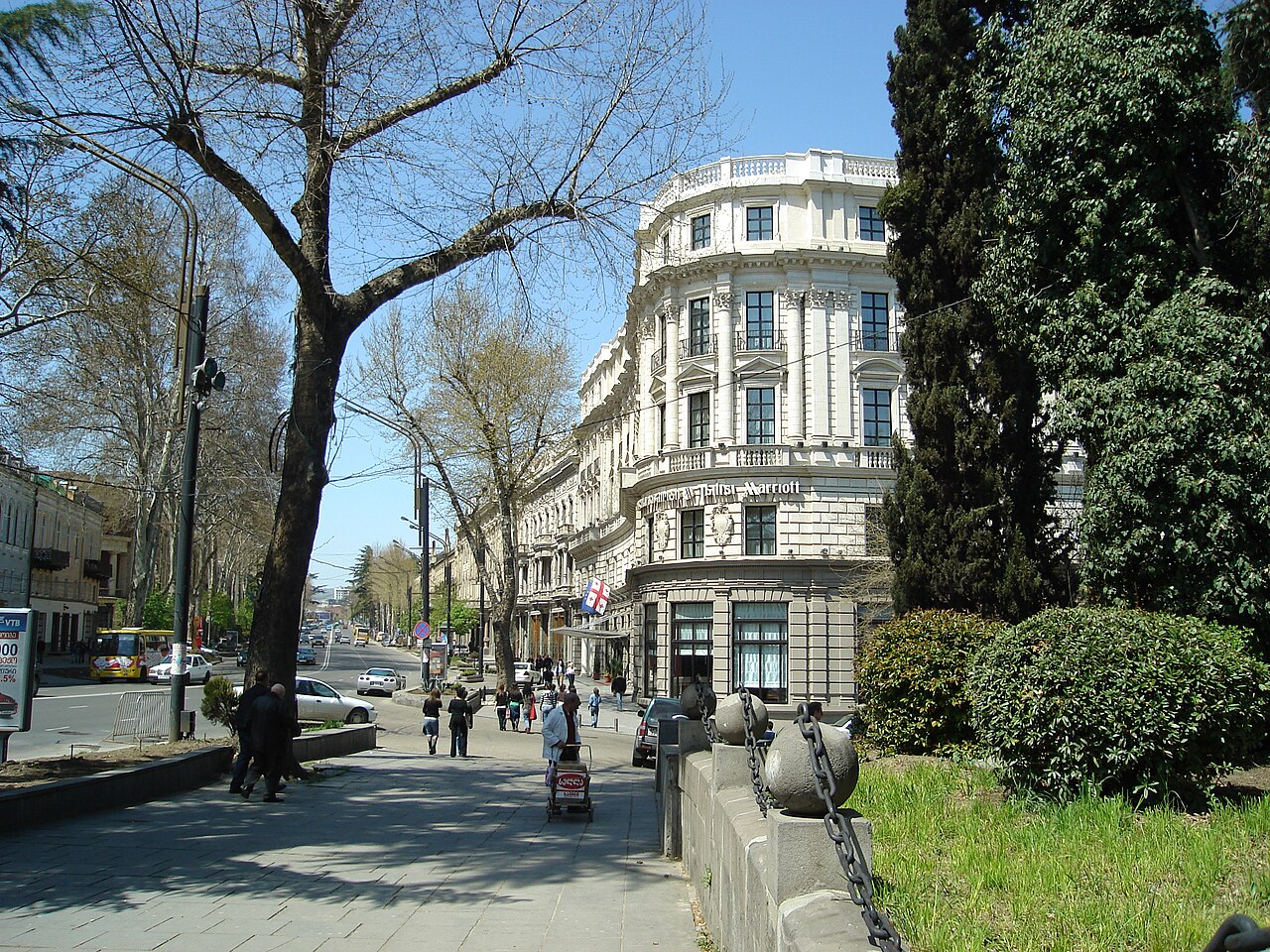
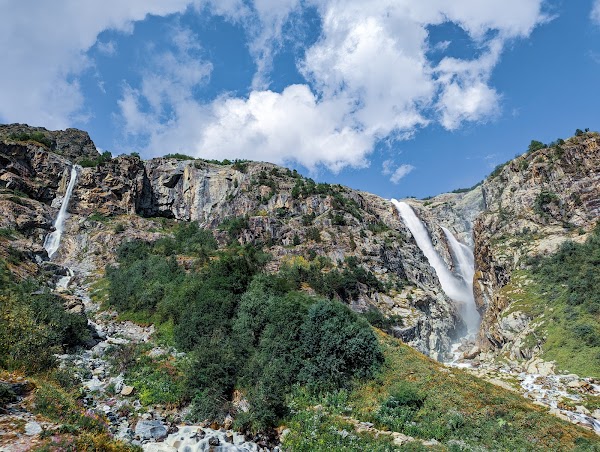
Chalaadi Glacier is a glacier in Mestia, Russia. Sits at roughly two thousand metres elevation. Fed by snowfields of Mount Ushba to the south. Most visitors spend 3-4 hours here. The free Lokali audio guide runs 6 minutes.
✓ Verified October 2026 · how we write these guides
Visitor facts
| Time needed | 3-4 hours |
|---|---|
| Lokali audio guide | 6 min · free |
| Type | Glacier |
| Best for | Photography |
| Location | Mestia, Russia |
| Coordinates | 43.0667, 42.6833 |
| Languages | 45, in the Lokali app |
The story
The air changes first. You feel it before you see anything — a coolness that cuts through the valley warmth, carrying the mineral smell of ancient ice and snowmelt. The path underfoot shifts from packed earth to loose moraine, and then, around a final bend where the river's roar becomes deafening, the glacier appears. A river of ice, blue-white and scarred, pushing down between the peaks of the Caucasus.
Chalaadi Glacier sits at roughly two thousand metres elevation, fed by the high snowfields of Mount Ushba to the south. The snout of the glacier — the blunt, melting terminus where ice meets stone — has retreated noticeably over the past few decades. Locals who grew up in Mestia, the nearest town, remember when the ice reached much farther down the valley. Climate records confirm what the eye can see: the glacier is shrinking, year by year, leaving behind fresh moraine and milky meltwater lakes.
The walk to reach this point takes roughly two hours from the trailhead near Mestia, following the Chalaadi River upstream. The trail is well-trodden but uneven — roots, rocks, loose gravel — and the final kilometre climbs steeply through a boulder field. You hear the glacier before you see it: the constant thunder of meltwater pouring from beneath the ice, carving channels through the moraine. In summer, the sound is overwhelming, a white noise that drowns out conversation.
The ice itself is not smooth. Up close, the surface is fractured and dirty — layers of grey sediment, streaks of black rock dust, deep crevasses where the glacier has bent and cracked as it moves downhill. The blue colour comes from compressed ice that has lost its air bubbles, absorbing red wavelengths and reflecting blue. The older and denser the ice, the deeper the colour. In the crevasses, the blue is almost electric.
This region — Svaneti — has been inhabited for millennia, but the glaciers themselves have never been settled. They are barriers, not homes. Medieval Svan communities built their defensive towers lower in the valleys, where the land could be farmed. The glaciers were sources of water, yes, but also of danger. Sudden ice avalanches, glacial lake outburst floods, and the grinding advance or retreat of the ice shaped where people could live. The Chalaadi was one of many such glaciers in the range, neither the largest nor the most accessible, but close enough to modern Mestia to become a popular hiking destination.
The moraine field around you — the heaps of broken rock and gravel — is the glacier's waste pile. As the ice moves, it grinds the bedrock beneath it into flour-fine sediment and larger boulders, then deposits them at the edges and the snout. The youngest moraine, closest to the ice, is unstable and bare. Walk back fifty metres and you find lichen, then moss, then low shrubs. Walk back two hundred metres and there are trees. The landscape is a timeline, showing how long it takes life to reclaim bare stone after the ice retreats.
Stand still for a moment and watch the ice. You might catch a crack, a groan, a sudden shift as a block calves off the face and tumbles into the meltwater below. The glacier is not static. It flows, imperceptibly, a few centimetres or metres per year, driven by its own weight. In winter, when snowfall exceeds melt, the glacier gains mass. In summer, the reverse. The balance has tipped in recent years — more melt than accumulation — and the snout has pulled back, exposing raw rock that has not seen daylight in centuries.
The light here is sharp and changeable. On clear mornings, the sun hits the ice directly and the whole face glows. By midday, the brightness is blinding, and the ice looks almost white. In late afternoon, when clouds roll in from the west, the glacier turns grey and the crevasses deepen into shadow. The weather in the high Caucasus shifts fast — sun to fog to rain in an hour — so the glacier rarely looks the same twice.
The meltwater stream at your feet is glacial milk, thick with suspended rock flour. It runs grey-white, opaque, and cold enough to numb your hand in seconds. Downstream, this water joins the Enguri River, which eventually powers one of the largest hydroelectric dams in the region. The glacier, in other words, is not just scenery. It is infrastructure, a reservoir in slow motion, feeding the valleys below.
Before you turn back, take a long look at the ice. Glaciers like this one have been here for thousands of years, but they are not permanent. The Chalaadi you see today is smaller than the Chalaadi of fifty years ago, and it will be smaller still fifty years from now. What you are standing in front of is a snapshot, a moment in a long retreat. The moraine, the meltwater, the raw stone — all of it is the glacier saying goodbye.
Key facts
What to look for
Practical tips
Common questions
How long do you need at Chalaadi Glacier?
Plan 3-4 hours. That is the time most visitors spend at Chalaadi Glacier. The free Lokali audio guide runs 6 minutes and is made to listen to while you walk.
Is there a free audio guide to Chalaadi Glacier?
Yes — the Lokali app narrates Chalaadi Glacier free of charge in 50+ languages. No ticket, tour group or subscription, and it works offline once downloaded.
Where is Chalaadi Glacier?
Chalaadi Glacier is in Mestia, Russia, at 43.0667, 42.6833. Tap the map link on this page for directions.
What should you know before visiting Chalaadi Glacier?
Two-hour walk from Mestia trailhead, uneven terrain
What is Chalaadi Glacier known for?
Sits at roughly two thousand metres elevation
What is the best time to visit Chalaadi Glacier?
Clear mornings offer best light on the ice face
On the map
Opens directions to Chalaadi Glacier from your location.
More to see in Mestia


Hear Chalaadi Glacier in your language
The full story, narrated, in 50+ languages. Download it before you go and it plays offline, at your own pace, with no ticket and no tour group.