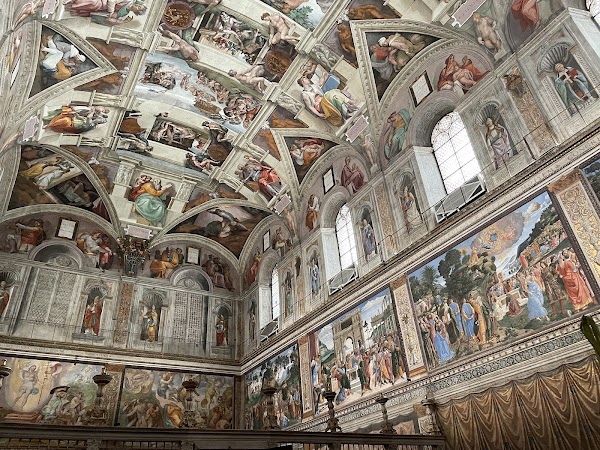
Vatican Museums is a museum in Rome, Italy. The Laocoon was found in Rome in 1506 and bought immediately by Pope Julius II. The early sculpture display formed a core of the papal collection. Most visitors spend 2-4 hours here. The free Lokali audio guide runs 2 minutes.
✓ Verified October 2026 · how we write these guides
Visitor facts
| Time needed | 2-4 hours |
|---|---|
| Lokali audio guide | 2 min · free |
| Type | Museum |
| Best for | Editors’ pick |
| Location | Rome, Italy |
| Coordinates | 41.9065, 12.4536 |
| Languages | 45, in the Lokali app |
The story
The Vatican Museums are not one museum in the simple sense. They are a sequence of papal collections, galleries, chapels, courtyards, archaeological displays, and painting rooms shaped across centuries. Their early sculptural nucleus is tied to Pope Julius II, who acquired the Laocoon after its discovery in Rome in 1506 and displayed it in the Statues Courtyard.
That origin matters because the Vatican route combines faith, collecting, antiquity, Renaissance ambition, and papal power. Classical sculpture, Raphael's rooms, the Sistine Chapel, the Pinacoteca, maps, tapestries, Egyptian and Etruscan collections, and later museums are all part of the same institutional landscape.
Be precise with famous rooms. The Sistine Chapel is a sacred space and a museum endpoint for many visitors, but it is not the whole Vatican Museums. The Raphael Rooms, Pio-Clementino Museum, Gregorian Etruscan Museum, and Pinacoteca each tell separate histories of collecting and display.
A good audio guide here should help visitors manage abundance. Instead of racing through corridors, listen for how each collection turns Rome into a universal centre: pagan antiquity reinterpreted by popes, Renaissance painting placed in papal apartments, and global material gathered into a sacred capital.
The Vatican Museums are best understood as a route through papal collecting rather than a single museum plan. Different popes, periods, and scholarly interests shaped different collections. Classical sculpture, Etruscan archaeology, Egyptian material, Renaissance painting, maps, tapestries, and sacred spaces all entered the visitor route through layered institutional history.
The Laocoon story is a useful starting point because it ties discovery, papal patronage, classical antiquity, and display together. Found in Rome in 1506 and acquired by Julius II, it became part of the early sculptural nucleus that helped define the Vatican as a place where antiquity and Renaissance ambition met.
Do not let the Sistine Chapel erase the rest. The chapel is central and sacred, but the Vatican Museums also include the Raphael Rooms, Pio-Clementino Museum, Pinacoteca, Gallery of Maps, Gregorian Etruscan Museum, and many other spaces. Each belongs to a different collecting and display history.
A careful guide also respects visitor reality. The route can be crowded and physically long, and some visitors experience it as a corridor toward Michelangelo. The better interpretation is to slow the route down where possible and show how papal power used art, archaeology, theology, and geography to construct memory.
Key facts
What to look for
Practical tips
Common questions
How long do you need at Vatican Museums?
Plan 2-4 hours. That is the time most visitors spend at Vatican Museums. The free Lokali audio guide runs 2 minutes and is made to listen to while you walk.
Is there a free audio guide to Vatican Museums?
Yes — the Lokali app narrates Vatican Museums free of charge in 50+ languages. No ticket, tour group or subscription, and it works offline once downloaded.
Where is Vatican Museums?
Vatican Museums is in Rome, Italy, at 41.9065, 12.4536. Tap the map link on this page for directions.
What should you know before visiting Vatican Museums?
Do not call the Vatican Museums a single chronological museum.
What is Vatican Museums known for?
The Laocoon was found in Rome in 1506 and bought immediately by Pope Julius II.
On the map
Opens directions to Vatican Museums from your location.
More to see in Rome


Hear Vatican Museums in your language
The full story, narrated, in 50+ languages. Download it before you go and it plays offline, at your own pace, with no ticket and no tour group.