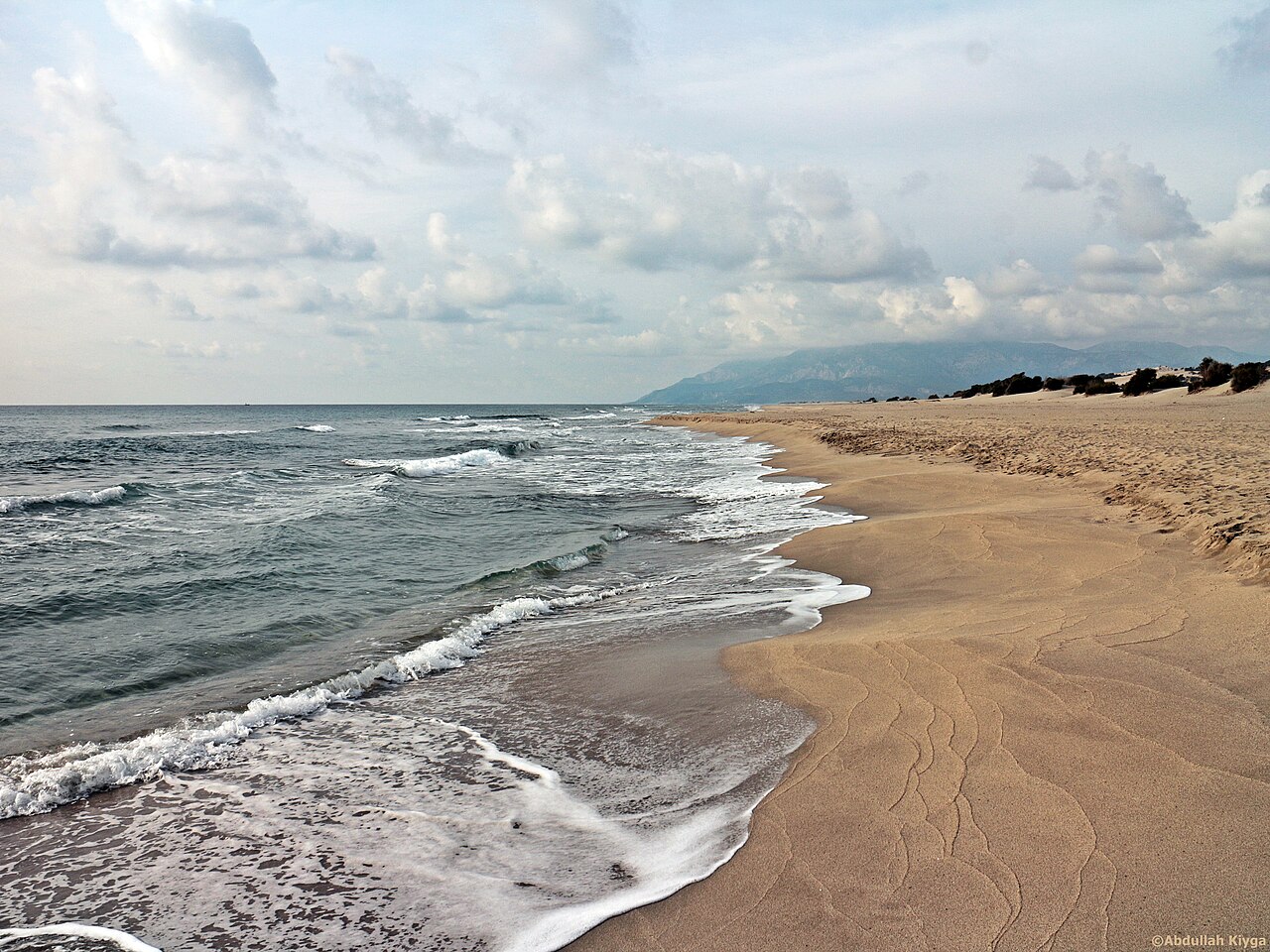
Patara Beach and Ruins is a beach in Kaş, Türkiye. Chief port and leading city of the Lycian League. League voting praised by framers of the United States Constitution. Most visitors spend 3-4 hours here. The free Lokali audio guide runs 6 minutes.
✓ Verified October 2026 · how we write these guides
Visitor facts
| Time needed | 3-4 hours |
|---|---|
| Lokali audio guide | 6 min · free |
| Type | Beach |
| Best for | Families |
| Location | Kaş, Türkiye |
| Coordinates | 36.2603, 29.3117 |
| Languages | 45, in the Lokali app |
The story
Sand is the first character in this story. It blows in off the sea, fine and pale, and drifts against everything — dunes, fences, marble. Walk the entrance road and you will see column stumps rising from low golden banks, like a city surfacing from a slow tide. The wind carries salt, warm grass, and the boom of surf you cannot yet see. Patara gives you two wonders for one ticket: a great ancient city, and one of the longest beaches in Turkey.
Start with the city. Patara was the chief port of Lycia — the ancient seafaring region of this coast — and for long stretches of history it was Lycia's leading city. Grain ships, warships, and pilgrims all passed through its harbour. Emperors landed here. Oracles spoke here. When Lycia's cities needed to decide things together, their representatives sailed to Patara to argue and vote.
That voting system is Patara's quietest claim on the modern world. The Lycian League gathered delegates from dozens of cities, and votes were weighted by a city's size — big cities held three votes, middling ones two, small ones one. Centuries later, French and American thinkers studying federal government praised the arrangement. When the framers of the United States Constitution debated how states might share power, the Lycian League appeared in their arguments as a working example.
You can stand in the very hall where those delegates met. The council house — the bouleuterion — has been restored, and its stone benches curve around the speaker's floor just as they did when Lycia governed itself from this room. Sit down on a bench for a moment. Few places let you park yourself inside an ancestor of modern parliaments, on the edge of a beach, with sand blowing gently across the aisles.
Nearby stands the city's front door — a triple-arched monumental gate built around the year 100, honouring a Roman governor named Modestus. It stayed upright while the city around it sank into marsh and sand. For centuries it was practically all that showed of Patara. Aqueduct channels once fed water through this area from the hills, and you can trace parts of their line on the walk in.
Down by the old harbour rises something rarer still — a Roman lighthouse. An inscription ties it to the Emperor Nero, in the first century, which places it among the oldest lighthouses known anywhere. It collapsed long ago, most likely thrown down by a great wave, and archaeologists have been rebuilding it stone by original stone. A squat, round tower is climbing back into the sky after nearly two thousand years of lying in pieces.
Patara also owns one of history's most surprising birth certificates. Church tradition holds that Nicholas — the fourth-century bishop remembered as Saint Nicholas — was born here, in this port city, before he served in Myra along the coast. Every December, children around the world wait for a figure whose story began, by that tradition, in the town whose sand is now in your shoes. Earlier still, the Acts of the Apostles records that Paul changed ships at Patara on his voyage toward Jerusalem.
Why did such a city die? The harbour did. Sand and river silt slowly choked the bay that made Patara rich, until ships could no longer enter and the port became a marsh. People drifted away, and the dunes moved in like patient tenants. The sand that killed the city also preserved it — burying streets, the theatre, and a huge granary built under the Emperor Hadrian, keeping them safe from stone robbers until archaeologists began digging them out.
The theatre is the best place to feel that burial. For centuries it sat almost completely under a dune, with only the top rows breaking the surface like a ship's rail. Excavation has emptied the bowl again, and you can climb the seats and look out across marsh, ruins, and dunes to the sea. The colonnaded main street nearby often stands in shallow groundwater, its columns doubled by reflection.
Then there is the beach. It runs unbroken for kilometre after kilometre — a vast band of soft sand and shallow, wave-brushed water, backed by dunes rather than buildings. Development is barred, partly because loggerhead sea turtles nest here in summer. The beach closes at night in the nesting season, and marked areas protect the buried eggs. The result is a rare thing on the Mediterranean: a horizon with nothing on it.
Swim with a little care and a lot of pleasure. The bottom stays shallow a long way out, and the waves are usually friendly, though wind can push them up by afternoon. There is a seasonal cafe and sunbeds near the entrance boardwalk, and almost nothing beyond. Shade is scarce, so bring your own. Walk ten minutes along the sand and the crowds fall away to footprints.
Give the day its proper ending here. Patara faces west of south, and sunsets land on the water with the dunes glowing behind you. Turkey named 2020 the Year of Patara to honour the excavations, but the light needs no anniversary. It has closed the day over this beach since Lycian sailors watched for the lighthouse fire. Bring a light layer for the walk back, because the breeze freshens once the sun drops and the dunes cool quickly underfoot.
Before you go, pick up a single handful of sand and let it run out between your fingers. This is the stuff that fed the dunes, buried the theatre, sealed the harbour, and hid a capital city for centuries. It is still moving, grain by grain, every windy day. Cities pass. Beaches, it turns out, can outlast them. Carry that thought up the entrance road, past the drifted columns, and let the wind finish the story behind you.
Key facts
What to look for
Practical tips
Common questions
How long do you need at Patara Beach and Ruins?
Plan 3-4 hours. That is the time most visitors spend at Patara Beach and Ruins. The free Lokali audio guide runs 6 minutes and is made to listen to while you walk.
Is there a free audio guide to Patara Beach and Ruins?
Yes — the Lokali app narrates Patara Beach and Ruins free of charge in 50+ languages. No ticket, tour group or subscription, and it works offline once downloaded.
Where is Patara Beach and Ruins?
Patara Beach and Ruins is in Kaş, Türkiye, at 36.2603, 29.3117. Tap the map link on this page for directions.
What should you know before visiting Patara Beach and Ruins?
Combine ruins and beach — one entrance road serves both
What is Patara Beach and Ruins known for?
Chief port and leading city of the Lycian League
What is the best time to visit Patara Beach and Ruins?
Check night-closure rules during summer turtle nesting
On the map
Opens directions to Patara Beach and Ruins from your location.
More to see in Kaş
Hear Patara Beach and Ruins in your language
The full story, narrated, in 50+ languages. Download it before you go and it plays offline, at your own pace, with no ticket and no tour group.