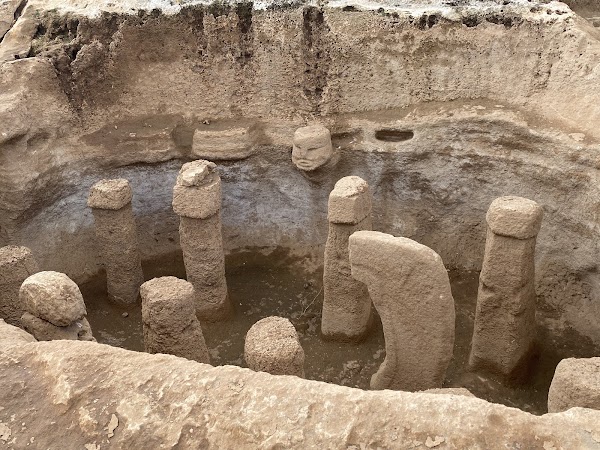
Karahantepe is a neolithic site in Şanlıurfa, Türkiye. Discovered in 1997, excavated intensively since 2019. About 46 kilometres east of Göbekli Tepe. Most visitors spend 1.5-2 hours here. The free Lokali audio guide runs 7 minutes.
✓ Verified October 2026 · how we write these guides
Visitor facts
| Time needed | 1.5-2 hours |
|---|---|
| Lokali audio guide | 7 min · free |
| Type | Neolithic Site |
| Best for | History |
| Location | Şanlıurfa, Türkiye |
| Coordinates | 37.093, 39.303 |
| Languages | 45, in the Lokali app |
The story
Feel the wind first. It comes across the Tek Tek hills with nothing to slow it — no trees, no walls, no sound except dry grass moving against limestone. Then the stones appear. Pale T-shaped pillars stand in hollows of bedrock, shoulder to shoulder, like a crowd frozen mid-gathering. The rock is warm under the sun and worn smooth at the edges. You are standing in one of the oldest built places human beings have ever made.
The scale of that age is hard to hold. These pillars were raised around twelve thousand years ago — before farming, before pottery, before metal, before the wheel, before writing. When the Egyptian pyramids went up, this site was already older to the pyramid builders than the pyramids are to us. Stonehenge is a recent event by comparison. Whatever you thought the beginning of civilization looked like... it starts closer to here.
Local shepherds always knew the hill. They called it Keçilitepe and grazed goats among strange stones poking through the soil. Archaeology arrived in 1997, when researcher Bahattin Çelik identified the site and counted T-shaped pillars by the dozen lying in the surface scatter. For two decades Karahantepe waited quietly while its famous sister site drew the world's attention. Then, in 2019, full excavations began under archaeologist Necmi Karul — and the hill started giving up astonishing things.
More than 250 of the T-shaped pillars have been identified here. The form matters: archaeologists read the T as a stylized human figure, the crossbar a head seen from the side, the shaft a body. At related sites, some pillars carry carved arms, hands, and belts, which supports the idea. These are not columns holding up a roof — they are figures, standing together in enclosures, arranged around larger central pairs. Who they represent — ancestors, spirits, the community itself — nobody yet knows.
The heart of the site is a chamber cut straight down into living bedrock. Inside it, a forest of tall pillars rises from the rock floor — not built, but carved in place, left standing as the stone around them was cut away. From one wall, a human head emerges, watching the chamber with a long, calm face. Researchers have described the pillars here as totem-like, and some read them as phallic forms tied to rituals we can only guess at. The honest answer is that the room's purpose is still unknown. Standing at its edge, that mystery is the point.
Then there are the statues. In September 2023, excavators uncovered a seated human figure 2.3 metres tall — ribs and spine marked with deep cut lines, a V-shaped collar at the neck, hands clasped low on the body. Beside such finds came a sculpted vulture, its wings folded, its eye sharp. The figures share a family likeness with the famous Urfa Man, found near Şanlıurfa in 1993 and counted among the oldest life-sized human statues known anywhere. Most of these carvings now live in the Şanlıurfa Archaeology Museum, and seeing them after the site completes the story.
What makes Karahantepe revolutionary is who built it. These were hunter-gatherers — people we once imagined as small wandering bands with no architecture and no shared projects. Yet here they quarried, carved, and raised monuments that demanded planning, coordination, and shared belief. Recent studies of food remains show they ate wild gazelle and gathered legumes — hunting and collecting, not yet farming. Some researchers argue people lived here year-round, which would make this one of the earliest known villages on earth. The old story — first farming, then settlement, then temples — may in fact run backwards.
Karahantepe does not stand alone. It belongs to the Taş Tepeler project — the Stone Hills — a network of around twelve Neolithic sites spread across these plateaus, all being excavated as one grand research effort. Göbekli Tepe, the celebrated sister site, lies about 46 kilometres to the west. Together they suggest an entire region of connected communities, sharing symbols and building traditions across the landscape twelve millennia ago. Visiting both in one journey turns a famous ruin into a whole lost world.
One more strangeness: at some point in antiquity, the chambers were deliberately filled with earth and rubble. That burial is why the pillars and carvings survived in such condition — sealed away from weather and time. Why the builders did it, no one knows; perhaps closing a sacred place was itself a ritual. And the work is only beginning. By recent estimates, only around five percent of the site has been excavated. On a weekday you may watch archaeologists brushing soil from stones no human eye has seen in twelve thousand years.
Take a moment for the setting itself. The Tek Tek hills are spare, open country — limestone rises, thin soil, goat bells somewhere out of sight, the haze of the Mesopotamian plain to the south. The site opened to visitors in 2023 with raised walkways that loop above the enclosures, so the whole layout reads clearly at your feet. There is very little shade. Early morning and late afternoon bring low golden light that catches the tool marks on the pillars — and far fewer people than Göbekli Tepe sees in an hour.
Practical wisdom for the visit: come from Şanlıurfa with a driver or guide, since public transport does not reach the hills and signage is sparse. Carry water in every season and real sun protection in summer, when the plateau bakes. Give yourself the museum in Şanlıurfa the same day — the statues, the carved heads, and Urfa Man himself wait there in climate-controlled calm, and the pairing of empty site and recovered treasures completes what neither can say alone.
Before you leave, stand close to one pillar — close enough to see the chisel marks. Every stroke was made without metal, stone striking stone, by hands that knew hunger, winter, and the movement of gazelle herds. Those hands built a gathering place anyway — something bigger than survival. As you walk back along the path, the wind returns, the grass moves, and the pillars stay exactly as they have stayed for twelve thousand years... patient, silent, and still keeping most of their secrets under the hill.
Key facts
What to look for
Practical tips
Common questions
How long do you need at Karahantepe?
Plan 1.5-2 hours. That is the time most visitors spend at Karahantepe. The free Lokali audio guide runs 7 minutes and is made to listen to while you walk.
Is there a free audio guide to Karahantepe?
Yes — the Lokali app narrates Karahantepe free of charge in 50+ languages. No ticket, tour group or subscription, and it works offline once downloaded.
Where is Karahantepe?
Karahantepe is in Şanlıurfa, Türkiye, at 37.093, 39.303. Tap the map link on this page for directions.
What should you know before visiting Karahantepe?
Combine with Göbekli Tepe and the Şanlıurfa museum
What is Karahantepe known for?
Discovered in 1997, excavated intensively since 2019
What is the best time to visit Karahantepe?
Go early; the Tek Tek hills give almost no shade
On the map
Opens directions to Karahantepe from your location.
More to see in Şanlıurfa


Hear Karahantepe in your language
The full story, narrated, in 50+ languages. Download it before you go and it plays offline, at your own pace, with no ticket and no tour group.