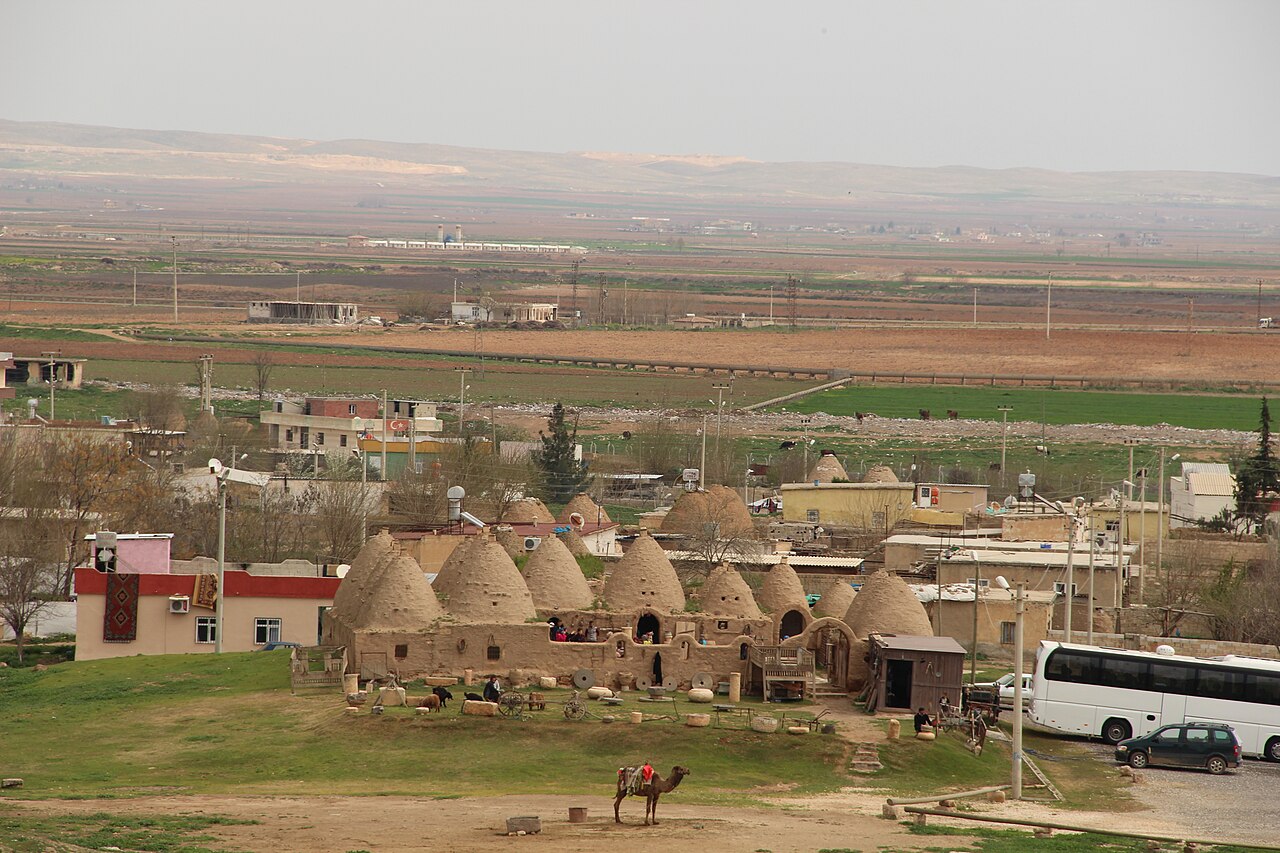
Harran is a historic town in Şanlıurfa, Türkiye. The last Assyrian forces made their final stand here. Harran held a major temple of the moon god. Most visitors spend 2-3 hours here. The free Lokali audio guide runs 6 minutes.
✓ Verified October 2026 · how we write these guides
Visitor facts
| Time needed | 2-3 hours |
|---|---|
| Lokali audio guide | 6 min · free |
| Type | Historic Town |
| Best for | Authentic finds |
| Location | Şanlıurfa, Türkiye |
| Coordinates | 36.8647, 39.0322 |
| Languages | 45, in the Lokali app |
The story
The first thing you notice is the heat, and then the flatness. The plain runs out in every direction with almost nothing to stop your eye. Dry wind moves fine dust across the ground and it settles on your arms. Then you duck through a low doorway into a mud-brick dome, and the temperature drops immediately. It smells of straw, earth and cool clay. Outside it is glaring white. Inside it is dim, and quiet, and several degrees cooler.
These are the domed houses that people come to Harran to see. Each one is a cone of mud brick, laid in rings that step inward until they close at the top. There is no timber in the roof, because timber has always been scarce here. A small hole at the apex lets hot air escape. Families joined several cones together with doorways to make a house. The shape is practical, not decorative — it sheds the rare heavy rain and it keeps out the sun.
Be careful with what you are looking at. The building method here is very old, but the domes standing today are not ancient monuments. Most were built and rebuilt over the last few generations, often using brick recycled from older ruins on the site. Many families have since moved into concrete houses nearby and now use the cones for storage. A few have been set up for visitors, with carpets, low cushions and tea. Ask before you photograph anyone's home.
Walk out from the houses and the ruins begin. You will see broken lines of city wall, a gate, and the low swelling of a settlement mound where thousands of years of building have piled up into a hill. Fragments of brick and pottery lie loose in the dirt. This was a real city for a very long time, sitting on the route between the Mediterranean coast and Mesopotamia. Caravans stopped here because there was water and because the road bent through it.
Harran's fame in the ancient world came from its moon. The city held a great temple of the moon god, called Sin in Mesopotamian records. Assyrian kings wrote about it. Pilgrims and rulers came to it. In the sixth century before the common era, the last king of Babylon rebuilt the temple, and his mother had served the same god here for decades. For hundreds of years, this dusty plain was one of the major religious addresses of the ancient Near East.
The city also saw the end of an empire. When the Assyrian capital fell, the last Assyrian forces regrouped at Harran and made their final stand here, in 609 before the common era. After that the site kept changing hands. Babylonians, Persians, Greeks, Romans, Byzantines, Arabs and Turks all held it. A Roman emperor was defeated nearby in one of Rome's worst military disasters. Standing in this quiet field, that history feels improbable — which is part of the point.
Something unusual survived here. Long after the region became Christian and then Muslim, a community at Harran kept its own older beliefs, including attention to the planets and the moon. They were known as the Sabians of Harran. Their scholars were serious astronomers and mathematicians. One of them, born in this town in the ninth century, translated Greek scientific works into Arabic and did original work in geometry and number theory. Ideas from this plain travelled a very long way.
The tallest thing on the site is a square minaret standing alone above broken walls. It belonged to the congregational mosque of Harran, built in the eighth century under Umayyad rule, when a caliph moved his base to this city. Enough survives to read the plan — a wide courtyard, an arcade, a decorated facade with pointed arches. Look at the carved stonework near the ground. The detail is finer than you expect on a building this ruined.
At the southeastern corner of the walls stands the castle. It is a heavy, dark ruin with round and polygonal towers, built and rebuilt across the medieval centuries. From a distance the towers look solid. Up close you can see the layers of repair, with different stone and brick used at different heights. Watch your footing here, because loose blocks and open drops are everywhere and there is very little railing.
Harran carries a religious name as well. In the book of Genesis, Abraham's family leaves Ur and settles in a place called Haran, and Abraham later departs from there. Jewish, Christian and Muslim tradition connects that account to this site. Many visitors come specifically for that reason. It is tradition rather than archaeology — no excavation can confirm it. But it explains the buses, and it explains why this small village on a hot plain is on so many itineraries.
The living village around the ruins deserves your attention too. Most families here speak Arabic at home, and Turkish and Kurdish are heard as well. Sheep move through the stubble in the evening. Since large irrigation canals reached this plain, cotton and maize now grow in fields that were dry farmland within living memory. Green rectangles sit beside bare brown ones. The change in this landscape over recent decades has been faster than anything in the previous thousand years.
Stand still for a moment before you leave, ideally in the shade of one of the cones. Put your palm on the mud brick. It is warm, gritty, and slightly soft under your fingers. Listen — wind, a dog, a distant tractor, children. The moon temple is gone, the caravans are gone, the astronomers are gone. What is left is a plain, some domes, a broken minaret, and the particular dry air you are breathing right now.
Key facts
What to look for
Practical tips
Common questions
How long do you need at Harran?
Plan 2-3 hours. That is the time most visitors spend at Harran. The free Lokali audio guide runs 6 minutes and is made to listen to while you walk.
Is there a free audio guide to Harran?
Yes — the Lokali app narrates Harran free of charge in 50+ languages. No ticket, tour group or subscription, and it works offline once downloaded.
Where is Harran?
Harran is in Şanlıurfa, Türkiye, at 36.8647, 39.0322. Tap the map link on this page for directions.
What should you know before visiting Harran?
Come early or late; midday heat on the plain is severe
What is Harran known for?
The last Assyrian forces made their final stand here
What is the best time to visit Harran?
Come early or late; midday heat on the plain is severe
On the map
Opens directions to Harran from your location.
More to see in Şanlıurfa


Hear Harran in your language
The full story, narrated, in 50+ languages. Download it before you go and it plays offline, at your own pace, with no ticket and no tour group.