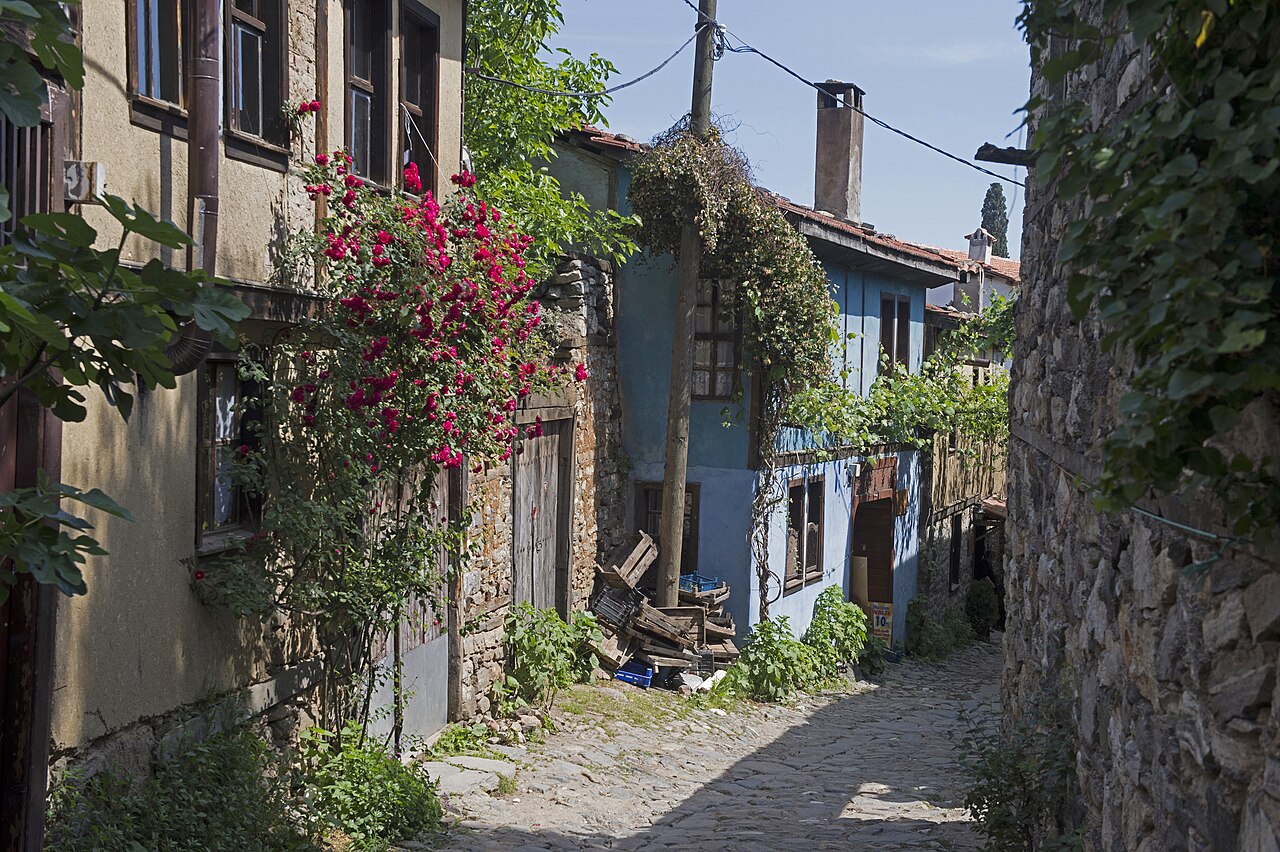
Cumalıkızık Village
40.1794° N · 29.1725° E · Historic Village
Cumalıkızık Village is a historic village in Bursa, Türkiye. Founded as an Ottoman foundation village around 700 years ago. About 270 historic houses line the cobbled lanes. Most visitors spend 2-3 hours here. The free Lokali audio guide runs 6 minutes.
✓ Verified October 2026 · how we write these guides
Visitor facts
| Time needed | 2-3 hours |
|---|---|
| Lokali audio guide | 6 min · free |
| Type | Historic Village |
| Best for | Authentic finds |
| Location | Bursa, Türkiye |
| Coordinates | 40.1794, 29.1725 |
| Languages | 45, in the Lokali app |
The story
The village announces itself underfoot. Cobbles, rounded and uneven, polished by seven centuries of shoes and hooves, with a channel of running water down the middle of the lane. Morning smells here are specific. Wood smoke, baking bread, ripe raspberries in season. Houses lean over the street from both sides, three storeys of timber and plaster painted ochre, white, and faded blue. A rooster crows somewhere. A tractor engine idles at the edge of the village. This is not a museum. People live behind every door.
Most visitors arrive at the square where the village meets the road from Bursa, and the stalls begin immediately. Jam jars, dried herbs, knitted socks, wooden spoons, trays of berries in season. The sellers are mostly village women, and bargaining is gentle. From the square, cobbled lanes lead uphill in several directions, and any of them works. The village is small enough that every loop eventually returns you to where you started, usually past the same smiling jam seller.
Cumalıkızık sits at the foot of Uludağ mountain, just outside Bursa, and it is one of the oldest Ottoman villages anywhere. It was founded around 700 years ago, in the earliest years of the Ottoman state, as a vakıf village. A vakıf was a pious foundation, meaning the village's income supported religious and charitable buildings in Bursa. That legal arrangement mattered. It kept the village intact and off the market for centuries, one reason its houses and street plan survived essentially whole.
The name carries tribal memory. Kızık was one of the traditional twenty-four branches of the Oghuz Turks, the confederation from which the Ottomans emerged. Several villages near Bursa share the suffix, each recalling settlers from the same lineage. The first part of the name is often linked to cuma, the Turkish word for Friday, perhaps because this village held the group's Friday prayers. Take the etymology as probable rather than proven. Villagers will offer their own versions over tea.
Look closely at any house. The ground floor is rough stone with a wide wooden gate, built for animals, carts, and storage. The upper floors are timber-framed, filled with brick or rubble and plastered, and they often project over the street on wooden brackets. That overhang, called a cumba, steals extra floor space and shades the lane below. Roofs wear curved terracotta tiles. Doors keep their old iron knockers. Some facades are freshly painted, others peel down to bare timber, and the mixture is honest.
Around 270 historic houses stand in the village, and a large share are still inhabited, mostly by farming families. In 2014, UNESCO added Cumalıkızık to the World Heritage list, jointly with the monuments of early Ottoman Bursa. The listing treats village and city as one story. Sultans built mosques and tombs in the capital, while villages like this one fed the capital and financed its institutions. Empires are usually remembered through palaces. Here you are walking through the other half of the account.
Wander without a plan, because the plan is the pleasure. Lanes bend, narrow, and open into small triangles of shade. Water runs in open channels, an old system for drainage, for animals, and for washing the cobbles. Find the passage locals call Cin Aralığı, the goblin's gap, a slot between houses so tight that one person passes with turned shoulders. Children will overtake you anyway. Let the village set your pace, which was always the pace of loaded mules.
Food is the village's modern livelihood. On weekend mornings, courtyards and lanes fill with breakfast tables. Village bread, olives, eggs, honey, clotted cream, thin stuffed flatbreads called gözleme, and dozens of small dishes, served by the households themselves. The signature crop is the raspberry. Fields on the lower slopes produce them in early summer, and jars of raspberry jam stack up on windowsills and stalls. Try the fresh juice in season. It is sharp, red, and entirely local.
The village keeps its institutions small. The mosque, rebuilt over the centuries, stands near the main square with a modest minaret. An old bathhouse and fountains survive from Ottoman times, and one house now serves as a small ethnography museum, furnished with tools, looms, and household goods. Nothing takes long to visit. The real exhibition is the streetscape itself, which film and television crews borrow regularly when they need an unspoiled Ottoman setting.
Life still follows the mountain's calendar. Spring brings blossom to the chestnut and walnut trees above the village. Summer is harvest and visitors. In autumn the lanes smell of drying fruit, and woodpiles climb the courtyard walls. Winter closes in quietly, with snow on Uludağ above and smoke standing straight over the chimneys. Villagers sell what the season gives. Whatever month brought you, you are seeing one page of a very long book.
Look for the small signs of negotiation between old and new. Satellite dishes bolted to timber walls. Modern brick patching a collapsed corner. Restoration plaques beside doors. Keeping a 700-year-old village alive is constant work, and not every house has found its rescuer yet. World Heritage status brought money and rules together. Residents will tell you both matter. A house with people in it survives. An empty one sags within a decade.
Before leaving, climb a little way up the lane past the mosque until the roofs drop below you. Terracotta tiles step down toward the plain, and Bursa's apartment blocks stand in the distance, one short ride and seven centuries away. Listen. Water in the channels, doves, a knife on a breakfast plate somewhere. The Ottoman Empire began in these hills as something this size, a few streets of farmers. Stand in it for one more minute before the road takes you back.
Key facts
What to look for
Practical tips
Common questions
How long do you need at Cumalıkızık Village?
Plan 2-3 hours. That is the time most visitors spend at Cumalıkızık Village. The free Lokali audio guide runs 6 minutes and is made to listen to while you walk.
Is there a free audio guide to Cumalıkızık Village?
Yes — the Lokali app narrates Cumalıkızık Village free of charge in 50+ languages. No ticket, tour group or subscription, and it works offline once downloaded.
Where is Cumalıkızık Village?
Cumalıkızık Village is in Bursa, Türkiye, at 40.1794, 29.1725. Tap the map link on this page for directions.
What should you know before visiting Cumalıkızık Village?
Come early on weekends before the breakfast crowds arrive
What is Cumalıkızık Village known for?
Founded as an Ottoman foundation village around 700 years ago
What is the best time to visit Cumalıkızık Village?
Come early on weekends before the breakfast crowds arrive
On the map
Opens directions to Cumalıkızık Village from your location.
Hear Cumalıkızık Village in your language
The full story, narrated, in 50+ languages. Download it before you go and it plays offline, at your own pace, with no ticket and no tour group.