
Rumeli Fortress is a 15th-century Ottoman fortress on the European shore of the Bosphorus, built by Mehmed II before the conquest of Constantinople. It is in Istanbul, Türkiye. Most visitors spend 1–2 hours here. The free Lokali audio guide runs 9 minutes.
✓ Verified August 2026 · how we write these guides
Visitor facts
| Time needed | 1–2 hours |
|---|---|
| Lokali audio guide | 9 min · free |
| Type | Castle |
| Best for | History |
| Location | Istanbul, Türkiye |
| Coordinates | 41.0839, 29.0564 |
| Languages | 45, in the Lokali app |
The story
Stand at the base of these massive stone walls and look up. The towers rise in uneven steps against the sky, their rough limestone surfaces pocked with centuries of weather. This is Rumeli Hisarı, the fortress that changed the fate of an empire — built in just four months during the spring of 1452, when Sultan Mehmed II was barely twenty years old and already planning the impossible.
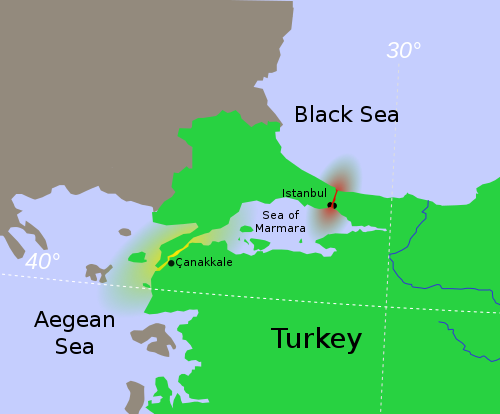
The fortress sits on the narrowest point of the Bosphorus, the strait that divides Europe from Asia. Mehmed chose this exact spot with surgical precision. Directly across the water, on the Asian shore, stands Anadolu Hisarı, a smaller fortress built by his great-grandfather sixty years earlier. Together, the two fortresses formed a vice grip on the strait — any ship trying to reach Constantinople from the Black Sea had to pass between their cannons. The Byzantines called this stretch of water the throat. Mehmed intended to close it.
Walk toward the main gate and notice the construction. Three enormous towers anchor the fortress, each named for one of Mehmed's viziers who supervised its building — Saruca Pasha, Halil Pasha, Zağanos Pasha. The men competed to finish their sections first. The entire structure, including thirteen smaller towers and curtain walls nearly seven metres thick, went up in nineteen weeks. Thousands of laborers worked around the clock. Stone was quarried from nearby hills and ferried across the water. Lime for mortar came from demolished Byzantine churches. Speed mattered more than comfort — Constantinople would not wait.
The fortress never saw a long siege. It did not need to. By August 1452, Rumeli Hisarı was operational, its cannons loaded and aimed at the water. When a Venetian ship ignored the order to stop and lower its sails, Mehmed's gunners sank it with a single shot. The captain and surviving crew were beheaded on the shore as a warning. After that, every ship paid the toll or turned back. Constantinople, just five kilometres down the strait, was cut off from resupply by sea. The city that had stood for over a thousand years was suddenly starving.
Climb the interior pathways and you will see how the fortress doubles as theater. The layout follows the slope of the hill — the towers step down toward the water in a rhythm that feels almost musical. In the nineteen-fifties, the Turkish government cleared out the village that had grown inside the walls and restored the open courtyard. Now, every summer, orchestras and opera companies perform here. The acoustics are extraordinary. Sound bounces off the stone and carries across the Bosphorus — audiences on the Asian shore can hear the music drifting over the water.
Look closely at the stonework as you move through the fortress. The walls are not uniform. You can see where different crews worked — some sections use carefully dressed blocks, others show rougher masonry, joints filled with smaller stones and thick mortar. This is what happens when an entire fortress goes up in four months. There was no time for perfection, only for function. And it functioned exactly as Mehmed intended. Nine months after Rumeli Hisarı was completed, Constantinople fell. The city became Istanbul, and the fortress became a monument to the speed and ruthlessness of that transformation.
The view from the upper towers is worth the climb. To the south, you can see the domes and minarets of the old city across the water. To the north, the Bosphorus opens toward the Black Sea, the water shifting from deep blue to pale green depending on the light. Freighters and tankers pass through the strait every hour, just as galleys and merchant ships did five centuries ago. The difference is that now they pass freely. No one stops them. No one demands a toll.
Pause for a moment in the central courtyard and listen. The fortress is quiet now, except for the wind moving through the towers and the distant hum of traffic on the coastal road below. It is hard to imagine this place filled with soldiers, the smell of gunpowder, the sound of cannons firing across the water. But the walls remember. Every stone in this fortress was placed with a single purpose — to take a city that everyone said could not be taken. And it worked.
As you leave, notice the contrast between the fortress and the neighbourhood that has grown up around it. Cafés and seafood restaurants line the waterfront. Ferries dock at the small pier below the walls. The fortress is no longer a weapon. It is a stage, a park, a place where people come to watch the sunset over the Bosphorus. But the weight of what happened here in 1452 still hangs in the air, quiet and undeniable, like the shadow of the towers stretching across the water at dusk.
Key facts
What to look for
Practical tips
Common questions
How long do you need at Rumeli Fortress?
Plan 1–2 hours. That is the time most visitors spend at Rumeli Fortress. The free Lokali audio guide adds about 9 minutes of narration you can listen to as you walk, so it fits inside your visit rather than adding to it.
Is there a free audio guide to Rumeli Fortress?
Yes — the Lokali app narrates Rumeli Fortress free of charge in 50+ languages. It covers the history, what to look for on site and practical tips, and it works offline once downloaded.
Where is Rumeli Fortress?
Rumeli Fortress is in Istanbul, Türkiye, at 41.0839, 29.0564. Tap the map link on this page for directions from where you are.
What should you know before visiting Rumeli Fortress?
Climb the upper towers for views across the strait.
What is Rumeli Fortress known for?
Built in just four months during spring 1452.
What is the best time to visit Rumeli Fortress?
Climb the north tower for a view across to the Asian shore and the Faith Sultan Mehmet Bridge.
On the map
Opens directions to Rumeli Fortress from your location.
More to see in Istanbul


Hear Rumeli Fortress in your language
The full story, narrated, in 50+ languages. Download it before you go and it plays offline, at your own pace, with no ticket and no tour group.