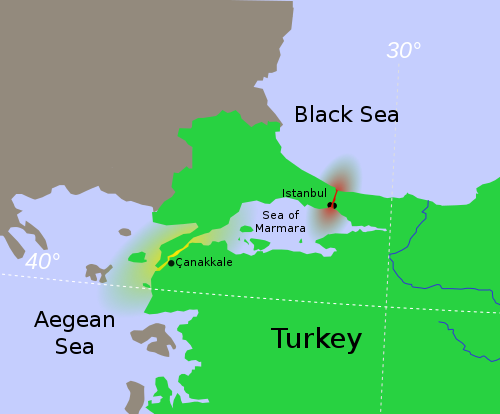
Bosphorus Strait is the narrow waterway separating Europe and Asia, lined with palaces, fortresses, and fishing villages. It is in Istanbul, Türkiye. Most visitors spend 30–60 min here. The free Lokali audio guide runs 5 minutes.
✓ Verified August 2026 · how we write these guides
Visitor facts
| Time needed | 30–60 min |
|---|---|
| Lokali audio guide | 5 min · free |
| Type | Viewpoint |
| Best for | Photography |
| Location | Istanbul, Türkiye |
| Coordinates | 41.0426, 29.0374 |
| Languages | 45, in the Lokali app |
The story
A broad ribbon of blue-green water winds through the middle of the city, crowded with ferries, fishing boats, and great ships, palaces and wooden mansions lining its banks, bridges leaping high overhead. This is the Bosphorus, the strait that splits Istanbul between two continents and gives the city its shape and its character.
The strait links the Black Sea to the north with the Sea of Marmara to the south, and in doing so divides Europe from Asia. Istanbul sits on both banks, so the city is, unusually, spread across two continents, joined by bridges and a constant criss-cross of ferries.
For thousands of years whoever controlled this narrow channel controlled the trade between two seas and two worlds, which is why a great city has stood here since ancient times. The Bosphorus is the reason Istanbul exists where it does, and the key to its long importance.
The simplest and best way to experience the strait is from the water. Public ferries and longer cruises run up and down and across it all day, and a ferry ride is cheap, ordinary transport for locals and one of the great pleasures of the city for visitors.
From the water you pass a parade of sights: waterfront palaces, old fortresses guarding the narrows, elegant wooden mansions, mosques, and modern suburbs, with the domes and minarets of the old city falling away behind. Each bank tells part of the city's long story.
Among the most charming sights are the yalis, old wooden waterside mansions built right at the edge of the water by wealthy families over the centuries. Some are beautifully kept, others fading, and they give the shores a particular, gentle grandeur.
At the narrowest point, great stone fortresses face each other across the water, built to control the strait in times of war. High above, modern suspension bridges carry roads between the continents, so the crossing happens both at water level and far overhead.
The strait changes constantly with the light and weather, from bright blue on a clear day to silver and grey under cloud, with fishing boats and ferries always moving across it. At sunset the water and the waterfront buildings glow, a favourite hour for a cruise.
Life clusters along the shores. Fishermen line the bridges and railings, simple restaurants serve the morning's catch, and tea gardens look out over the water. Eating fresh fish by the strait, or drinking tea as the ships pass, is part of everyday Istanbul.
Taking a ferry from the European to the Asian side, for the price of a local fare, lets you set foot on another continent and see a calmer, more residential Istanbul, with its own markets, cafes, and waterfront. It is one of the easiest and most rewarding trips in the city.
A few practical notes. Use the regular public ferries for value and the feel of local life, or a dedicated cruise for commentary and a longer route. Sunset trips are popular, so come early for a rail seat, and bring a layer, as the water breeze is cool.
Find a spot at the rail of a ferry, with Europe on one side and Asia on the other and the city sliding past, and let the strait do the work. More than any single monument, the Bosphorus is Istanbul — the seam where continents, seas, and histories meet. When you step back onto land, you carry the movement of the water with you.
Key facts
What to look for
Practical tips
Common questions
How long do you need at Bosphorus Strait?
Plan 30–60 min. That is the time most visitors spend at Bosphorus Strait. The free Lokali audio guide adds about 5 minutes of narration you can listen to as you walk, so it fits inside your visit rather than adding to it.
Is there a free audio guide to Bosphorus Strait?
Yes — the Lokali app narrates Bosphorus Strait free of charge in 50+ languages. It covers the history, what to look for on site and practical tips, and it works offline once downloaded.
Where is Bosphorus Strait?
Bosphorus Strait is in Istanbul, Türkiye, at 41.0426, 29.0374. Tap the map link on this page for directions from where you are.
What should you know before visiting Bosphorus Strait?
Ride a cheap public ferry for the experience.
What is Bosphorus Strait known for?
The strait dividing Europe from Asia.
What is the best time to visit Bosphorus Strait?
Take a local commuter ferry rather than a tourist boat—you'll travel with Istanbulites and pay a fraction of the price.
On the map
Opens directions to Bosphorus Strait from your location.
More to see in Istanbul


Hear Bosphorus Strait in your language
The full story, narrated, in 50+ languages. Download it before you go and it plays offline, at your own pace, with no ticket and no tour group.