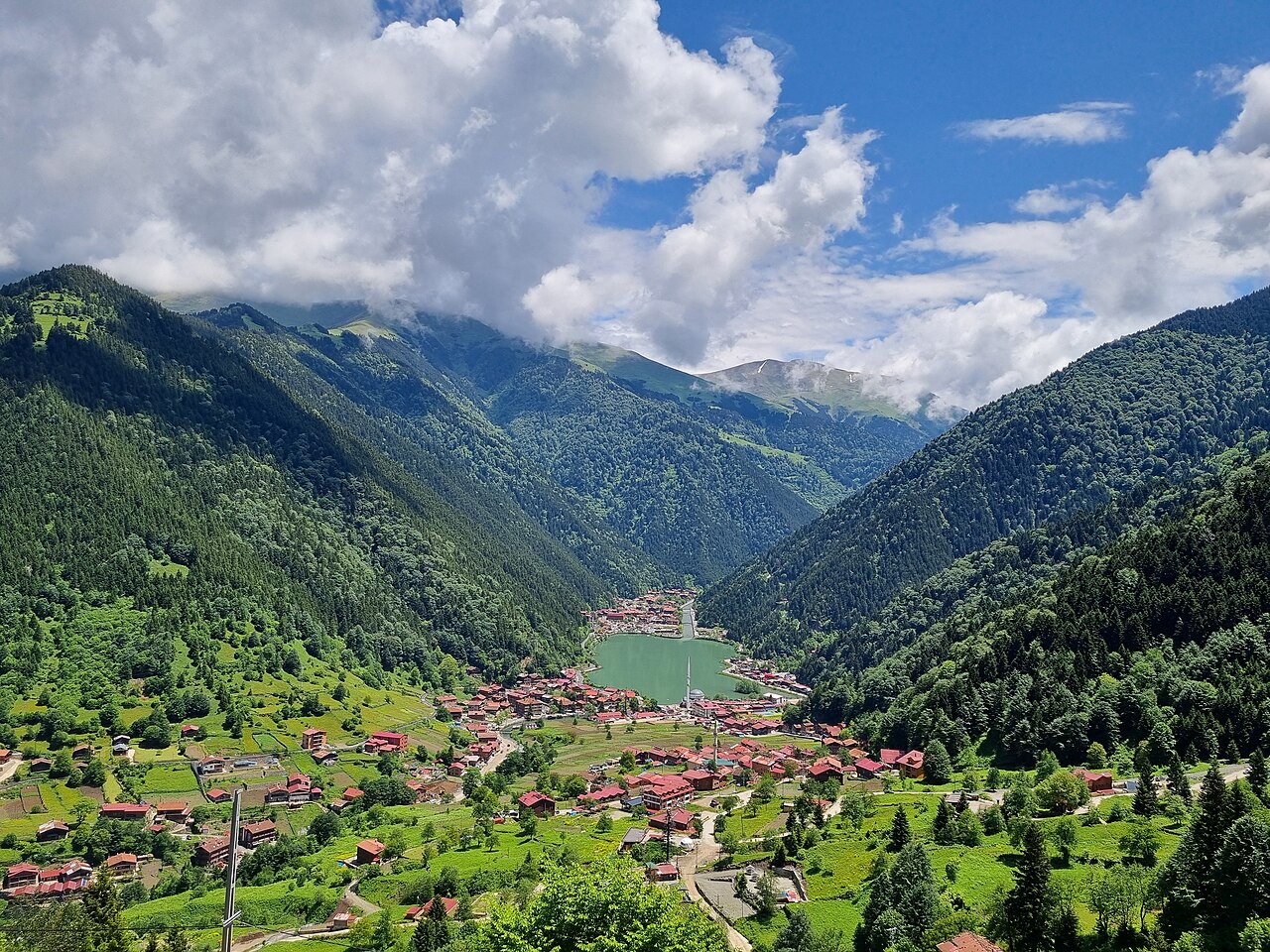
Uzungöl is a lake in Trabzon, Türkiye. Uzungöl means long lake in Turkish. A landslide dammed the Haldizen stream to form the lake. Most visitors spend 3-4 hours here. The free Lokali audio guide runs 6 minutes.
✓ Verified October 2026 · how we write these guides
Visitor facts
| Time needed | 3-4 hours |
|---|---|
| Lokali audio guide | 6 min · free |
| Type | Lake |
| Best for | Photography |
| Location | Trabzon, Türkiye |
| Coordinates | 40.6183, 40.2894 |
| Languages | 45, in the Lokali app |
The story
Step out of the car and the first thing that reaches you is the temperature. The air is cool and wet even in August, and it smells of woodsmoke, pine resin and cold water. A stream runs somewhere close, loud and constant. Above the roofs, cloud sits low against dark green slopes and moves while you watch it. If you have come up from the Black Sea coast in an hour, the change is abrupt.
The name means long lake, and that is exactly what it is — a narrow strip of water lying along the floor of a steep valley in Çaykara district, at roughly 1,100 metres above sea level. It is not large. You can see from one end to the other. What makes it work is the frame around it: slopes rising several hundred metres on both sides, covered in spruce and fir right down to the shore.
The lake was not always here. A landslide came down one of those slopes and blocked the Haldizen stream. The water ponded up behind the debris and filled this section of the valley floor. Nobody recorded the date. Look at the lower end where the water drains away and you can see the natural dam of loose rock and soil holding it in place. In geological terms this is a temporary feature, which is a strange thought while looking at it.
The picture almost everyone takes is from the northern end. A mosque stands close to the shore with a slim white minaret, and on a still morning the whole thing appears again upside down in the water. Give it a few minutes if the surface is moving. Wind on this valley floor comes in short bursts, and between them the lake goes flat enough to hold a clean reflection for maybe thirty seconds at a time.
Do not plan around sunshine. The eastern Black Sea region receives the heaviest rainfall in Turkey, and this valley catches a large share of it. Cloud builds through the morning, sits in the valley through the afternoon, then lifts and drops again. Local people treat rain as background weather rather than as an event. The upside is that mist doing slow laps around the ridgelines is better to watch than a clear blue sky.
The forest deserves attention. Oriental spruce and fir dominate the higher slopes, with alder, hazel and chestnut lower down, and thick banks of rhododendron underneath. Rhododendron flowers in late spring and covers whole slopes at once. These are the Pontic mountains, and they hold some of the last extensive temperate rainforest in this part of the world. Brown bears live in the wider forest, though you are very unlikely to see one from the lakeside.
Before the hotels, this was a small settlement of farming families. Tea and hazelnuts grow lower down toward the coast, but not at this height. Up here the pattern was livestock. Families moved animals to higher pastures in summer and came back down before the snow. Look for the old wooden storehouses raised on short posts, called serander. The gap underneath keeps rodents and damp away from the maize and cheese stored inside.
Trout is the local dish, farmed in tanks fed straight from the stream, so it goes from water to grill in minutes. It arrives fried in cornmeal, with cornbread on the side and often a bowl of kuymak — melted cheese stirred into cornmeal until it pulls into strings. This is mountain food built for cold, wet days. Order it that way and skip anything on the menu that could have come from anywhere else.
Now the honest part. Uzungöl became very popular very quickly, particularly with visitors from the Gulf states, and hotels went up along the valley faster than any plan could handle. Some were built without permits and have since been demolished. You will see signs in Arabic, Persian and Turkish, and the shoreline is busier than the photographs suggest. Knowing this in advance makes the visit better, because you can plan around the crowd instead of being surprised by it.
The way to do that is to go higher. Roads climb from the village toward Demirkapı and the surrounding plateaus, reaching well above the treeline. Up there the spruce gives out and the ground turns to open alpine meadow, grazed by cattle, with wildflowers through early summer and snow patches lasting into July. The road surface varies and some sections need a vehicle with decent clearance. Ask locally about conditions before you set off.
Back at the lake, take the footpath around the shore rather than the road. The far side goes quiet within about ten minutes of walking. Ducks work the shallows. Trout rise in the evening. Cows walk along the path with no interest in anyone. From the southern end you get the reverse view, with the minaret small at the far end and the valley narrowing behind it. The circuit is short enough to walk twice, and the light changes between rounds.
Wait until the light goes if you can. Cloud settles into the valley in the evening and the far slopes turn flat grey-blue, one behind another. Woodsmoke starts up from the chimneys. The stream is still the loudest thing here, exactly as it was before anyone built a hotel. Stand on the shore for a minute and let the noise of the water fill in the rest. That sound is the oldest thing in this valley.
Key facts
What to look for
Practical tips
Common questions
How long do you need at Uzungöl?
Plan 3-4 hours. That is the time most visitors spend at Uzungöl. The free Lokali audio guide runs 6 minutes and is made to listen to while you walk.
Is there a free audio guide to Uzungöl?
Yes — the Lokali app narrates Uzungöl free of charge in 50+ languages. No ticket, tour group or subscription, and it works offline once downloaded.
Where is Uzungöl?
Uzungöl is in Trabzon, Türkiye, at 40.6183, 40.2894. Tap the map link on this page for directions.
What should you know before visiting Uzungöl?
Pack a rain jacket even for clear summer mornings.
What is Uzungöl known for?
Uzungöl means long lake in Turkish.
What is the best time to visit Uzungöl?
Pack a rain jacket even for clear summer mornings.
On the map
Opens directions to Uzungöl from your location.
More to see in Trabzon

Hear Uzungöl in your language
The full story, narrated, in 50+ languages. Download it before you go and it plays offline, at your own pace, with no ticket and no tour group.