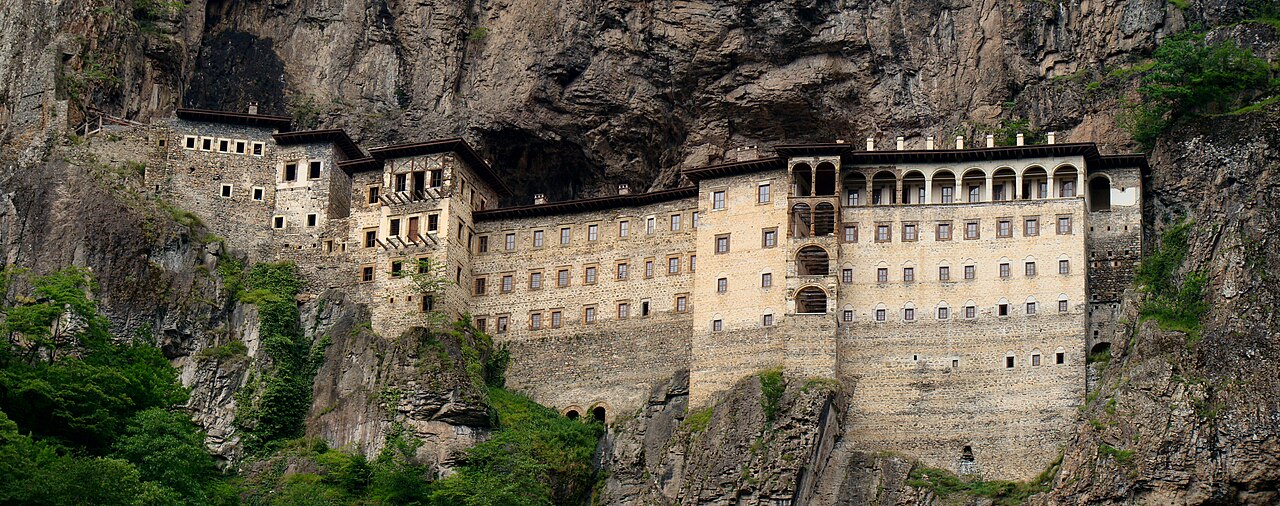
Sumela Monastery is a monastery in Trabzon, Türkiye. Monks left during the 1923 population exchange. Divine Liturgy returned to the site in 2010. Most visitors spend 2-3 hours here. The free Lokali audio guide runs 7 minutes.
✓ Verified October 2026 · how we write these guides
Visitor facts
| Time needed | 2-3 hours |
|---|---|
| Lokali audio guide | 7 min · free |
| Type | Monastery |
| Best for | History |
| Location | Trabzon, Türkiye |
| Coordinates | 40.6903, 39.6583 |
| Languages | 45, in the Lokali app |
The story
The sound reaches you before the building does. Water — the river below, running fast over stones, and somewhere closer, water dripping down the rock face. The air in this valley is damp and cool, and it smells of wet leaf litter and pine. Cloud sits in the trees on the opposite slope. Then you look up, and there it is: a row of pale buildings pressed into a vertical cliff, several hundred metres above the valley floor, with forest below and bare rock above.
Nothing about the position is accidental. The monastery is built into a natural cave and onto the ledge in front of it, high on the cliff. Getting there required a climb, then and now. That was the point. Monastic communities in this tradition looked for places that were hard to reach, quiet, and defensible. The cave gave shelter and a source of water. The cliff gave everything else — isolation, a long view of the approach, and protection from above.
The founding story is a tradition rather than a documented event, and it is worth telling as such. It says two monks from Athens, Barnabas and Sophronios, were guided to this cliff by an icon of the Virgin Mary, said to have been painted by the apostle Luke. They found the icon in the cave and founded the monastery around it. The tradition places this in the late fourth century. Historians treat the earliest centuries here as uncertain.
What is documented begins much later. From the thirteenth century this region formed the Empire of Trebizond, a Greek-speaking state on the Black Sea coast that outlasted Constantinople itself as an independent power. Its emperors gave the monastery land, money, and legal privileges. One of them, Alexios the Third, is closely associated with its expansion. Sumela became wealthy, and it held rights over villages and farmland in the valleys around it.
The next part surprises people. After the Ottoman conquest, the monastery was not shut down. Sultans issued decrees confirming its rights and its property, and those documents were kept and renewed over generations. The community continued, and the buildings grew. Much of the accommodation block you see clinging to the cliff — the tall front with rows of windows — belongs to relatively late periods, not to the earliest centuries of the site.
The heart of the complex is the rock church, formed from the original cave. Its walls carry frescoes, and so does the outer face of the building, which is unusual. The paintings continue onto surfaces fully exposed to the open air. Scenes from the life of Christ and of the Virgin cover them. The colours stay strong where they survive: deep blue backgrounds, red robes, gold outlines. Layers from different periods sit directly on top of one another.
Much of the painting is damaged, and not only by weather. After the buildings stood empty, visitors scratched names and dates into the surfaces, and treasure hunters cut into walls and floors. You will see gouges through faces and through robes. Conservation teams have stabilised what remains rather than repainting it. Repainting would erase the evidence of what was originally there. So the losses stay visible, which is honest, and uncomfortable to look at.
The monks left in 1923. That year Greece and Turkey agreed a compulsory exchange of populations, and the Greek Orthodox communities of this coast were part of it. Families who had lived here for many generations moved to Greece. The monastery emptied. According to accounts from the community, the icon and other objects were hidden before the departure, then recovered years later, in 1930, and carried to Greece.
Those objects went to a new home. A monastery named Panagia Soumela was established in northern Greece, at the foot of Mount Vermio, and it became the centre of the tradition for the descendants of the exchanged families. The Greek foundation dates from the middle of the twentieth century. So there are now two Soumelas — the original cliff in Turkey, and its namesake in Greece. People travel between them, and the connection stays active.
And the original cliff is not silent. In 2010 the authorities gave permission for the Divine Liturgy to be celebrated at Sumela again, and it has been held there each year since, on 15 August, the feast of the Dormition of the Virgin. The Ecumenical Patriarch has led the service. Pilgrims come from Greece, from Russia, from Georgia, and from the Turkish Black Sea region itself. For one day each year, the church works as a church.
The site closed to visitors in 2015. Loose rock above the buildings posed a real danger, and a long programme of work followed: rock anchoring, netting, structural repair, and conservation of the frescoes. Sections reopened as the work advanced, and the monastery reopened fully in 2020. Access today runs by a path through the forest, or by shuttle up the valley road followed by steps. The climb is steep, and the stone is often wet.
The valley itself is part of the visit. The Altındere valley is thickly forested, and this coast receives a great deal of rain, which is why everything is so green. Beech, fir, and rhododendron grow on the slopes. Mist forms and clears within minutes. The road up follows the river, and there are picnic areas along it where local families spend whole days. Allow time at the bottom as well as at the top.
There is more than one building to look at. Besides the rock church there are a chapel, a library, a kitchen, guest rooms, and a spring that the community treated as holy. An aqueduct with a long row of arches carried water along the cliff to the complex. Much of the structure was rebuilt after damage, so what you see is a restoration rather than untouched fabric. Watch for the difference between old and new stonework.
Stand on the terrace at the front and turn away from the frescoes for a moment. Look out instead. Below you the forest drops steeply to the river, and cloud moves through the trees at eye level. A monk standing on this ledge six hundred years ago saw the same slope, the same water, the same weather coming up the valley. The building has been emptied, damaged, repaired, and reopened. The view has been here the whole time.
Key facts
What to look for
Practical tips
Common questions
How long do you need at Sumela Monastery?
Plan 2-3 hours. That is the time most visitors spend at Sumela Monastery. The free Lokali audio guide runs 7 minutes and is made to listen to while you walk.
Is there a free audio guide to Sumela Monastery?
Yes — the Lokali app narrates Sumela Monastery free of charge in 50+ languages. No ticket, tour group or subscription, and it works offline once downloaded.
Where is Sumela Monastery?
Sumela Monastery is in Trabzon, Türkiye, at 40.6903, 39.6583. Tap the map link on this page for directions.
What should you know before visiting Sumela Monastery?
Wear shoes with grip; the steps stay wet
What is Sumela Monastery known for?
Monks left during the 1923 population exchange
What is the best time to visit Sumela Monastery?
Avoid 15 August unless you want the pilgrimage crowd
On the map
Opens directions to Sumela Monastery from your location.
More to see in Trabzon

Hear Sumela Monastery in your language
The full story, narrated, in 50+ languages. Download it before you go and it plays offline, at your own pace, with no ticket and no tour group.