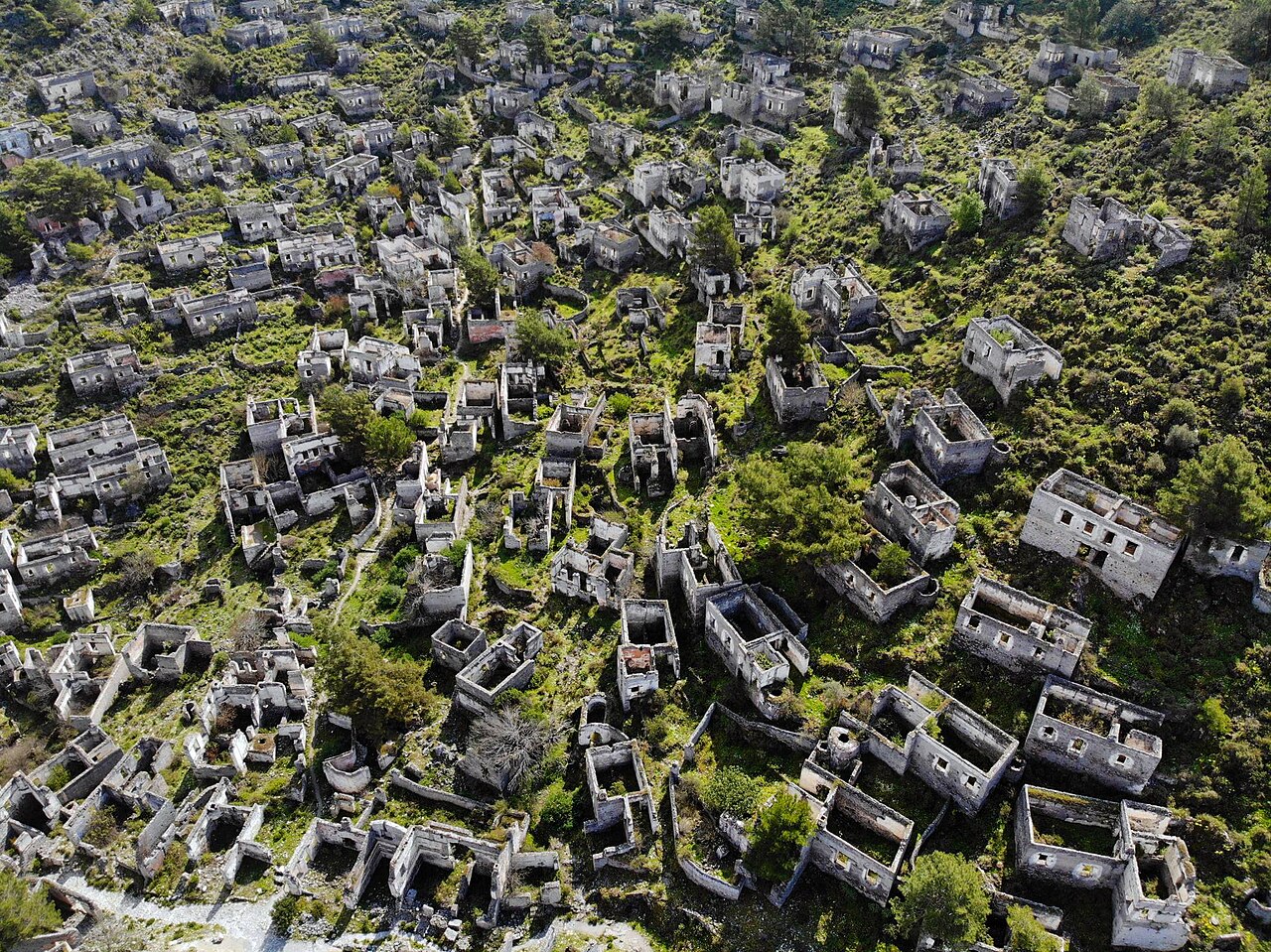
Kayaköy Ghost Village is an abandoned village in Fethiye, Türkiye. Abandoned in 1923 during the Greece-Turkey population exchange. Formerly Levissi, a Greek Orthodox town of thousands. Most visitors spend 1.5-2 hours here. The free Lokali audio guide runs 6 minutes.
✓ Verified October 2026 · how we write these guides
Visitor facts
| Time needed | 1.5-2 hours |
|---|---|
| Lokali audio guide | 6 min · free |
| Type | Abandoned Village |
| Best for | Authentic finds |
| Location | Fethiye, Türkiye |
| Coordinates | 36.5758, 29.0908 |
| Languages | 45, in the Lokali app |
The story
The first sound you notice is the absence of sound. A whole hillside of stone houses climbs above you — hundreds of them, street after street — and not one has a roof. Window openings frame squares of blue sky. Fig trees grow out of old kitchens. Somewhere up the slope, a goat bell knocks softly, and the wind moves through empty doorways. It looks like a town holding its breath, and in a way, it is.
This is Kayaköy, and for most of its life it was called Levissi. It was a busy Greek Orthodox town of craftspeople, traders, and farmers — home to thousands of people. They built their houses of stone up the dry hillside and left the fertile valley floor below for fields. Their Muslim Turkish neighbours farmed that valley, and by most accounts the two communities lived side by side, trading goods, labour, and festival sweets.
Then came 1923. After years of war between Greece and Turkey, the two countries signed an agreement at Lausanne that required a massive population exchange. Orthodox Christians in Turkey were sent to Greece. Muslims in Greece were sent to Turkey. Around two million people lost their homes by treaty, sorted by religion rather than by language or by choice. The people of Levissi — Turkish-speaking, many of them — were shipped to a country most had never seen.
Muslim families arriving from Greece were offered the empty houses. Most did not stay. They were farming people, and a dry hillside town with no fields of its own suited them poorly. Some also felt uneasy living among another community's abandoned rooms. Family by family, they moved down to the valley or away entirely. The town emptied a second time — this time for good.
Weather did the rest. Roof timbers rotted or were carried off for other buildings, and once the roofs went, the rain got in. In 1957, a strong earthquake struck the Fethiye region and shook the fragile walls further. What survives today is a skeleton town — around several hundred stone shells, two large churches, chapels, a fountain square, and schools, all open to the sky.
Walk the old lanes slowly. The cobbles are worn smooth in the middle from generations of feet. Beside almost every house you will find a plastered stone tank — a cistern. The town had little running water, so each family caught winter rain from the roof and stored it for the dry months. The cisterns survived better than the houses. Some still hold dark water after rain, decades after the last owners left.
Look into the ruined chapels and you can still find colour. Patches of painted plaster cling to the walls — faded blues, ochres, and reds around niches and arches. In the larger of the churches near the lower slope, a courtyard floor of black and white pebbles survives, laid out in patterns by hand. Please walk around such floors, not across them. They have lasted a century of abandonment and deserve a few more.
Guides here like to point out how the houses are arranged — stepped up the slope so that no house blocks the light or the view of the one behind it. Whether that was a written rule or simple courtesy, nobody can prove. Locals tell it as a story about how neighbours once thought of each other. Standing in the tiered streets, you can believe it.
Kayaköy has reached readers far beyond Turkey. The novelist Louis de Bernières wandered these ruins and built his novel Birds Without Wings around a fictional town modelled on Levissi — its friendships, its wars, and its emptying. And every year, descendants of the exiled families travel here from Greece, walking lanes their grandparents described from memory. Some carry old photographs, matching doorways to faces.
Today the site is managed as an open-air museum, and you buy a ticket at the entrance booth. Paths are rough, loose, and stony, so wear real shoes and take your time. From the upper streets, the view opens across the valley — red-roofed farmhouses, gardens, and pine ridges. A marked walking trail continues over the hills to Ölüdeniz for those with water, daylight, and energy to spare.
In the flat land below the ruins, life carries on. There are farm restaurants under vine shade, horses in paddocks, and stalls selling pancakes and pomegranate juice. The contrast is the point. One Kayaköy still cooks, argues, and harvests. The other stands above it, silent, as a reminder of how quickly a signature on a treaty can turn a town into a monument.
Give yourself more time than the ruins seem to ask. The town rewards slow wandering — a doorway framing the valley, a staircase climbing to nothing, a bread oven built into a wall. Spring covers the slopes with poppies and wild fennel, and in autumn the stone glows warm in the low light. Summer middays are hot and exposed, so carry water and a hat. Count the small details as you go: iron hinges rusted into place, thresholds worn into curves, tool marks on the doorposts, swifts nesting in the wall gaps. Every house repeats the same quiet fact — real hands built this, one stone at a time.
Before you go, stand in one empty house and give it a full minute. Notice the fireplace blackened by dinners nobody remembers, and the niche where an icon or a lamp once sat. A century ago this room held voices in two languages. The people were forced out, but the room is still here, still waiting, still ordinary. History rarely feels this close to the skin — one family's kitchen at a time.
Key facts
What to look for
Practical tips
Common questions
How long do you need at Kayaköy Ghost Village?
Plan 1.5-2 hours. That is the time most visitors spend at Kayaköy Ghost Village. The free Lokali audio guide runs 6 minutes and is made to listen to while you walk.
Is there a free audio guide to Kayaköy Ghost Village?
Yes — the Lokali app narrates Kayaköy Ghost Village free of charge in 50+ languages. No ticket, tour group or subscription, and it works offline once downloaded.
Where is Kayaköy Ghost Village?
Kayaköy Ghost Village is in Fethiye, Türkiye, at 36.5758, 29.0908. Tap the map link on this page for directions.
What should you know before visiting Kayaköy Ghost Village?
Wear closed shoes — lanes are loose stone and rubble
What is Kayaköy Ghost Village known for?
Abandoned in 1923 during the Greece-Turkey population exchange
What is the best time to visit Kayaköy Ghost Village?
Go late afternoon for cooler air and long shadows
On the map
Opens directions to Kayaköy Ghost Village from your location.
Hear Kayaköy Ghost Village in your language
The full story, narrated, in 50+ languages. Download it before you go and it plays offline, at your own pace, with no ticket and no tour group.