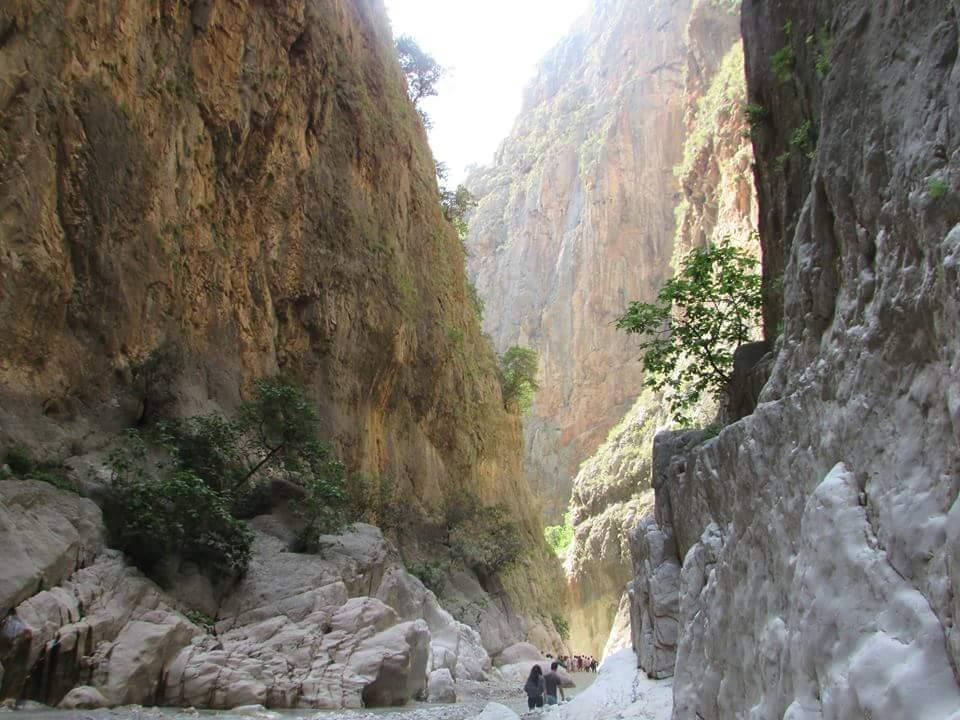
Saklıkent Gorge is a gorge in Fethiye, Türkiye. Canyon runs about eighteen kilometres through limestone. Walls rise up to roughly 300 metres high. Most visitors spend 2-3 hours here. The free Lokali audio guide runs 7 minutes.
✓ Verified October 2026 · how we write these guides
Visitor facts
| Time needed | 2-3 hours |
|---|---|
| Lokali audio guide | 7 min · free |
| Type | Gorge |
| Best for | Families |
| Location | Fethiye, Türkiye |
| Coordinates | 36.4789, 29.4014 |
| Languages | 45, in the Lokali app |
The story
The temperature drops before you even see the gorge. One moment you are in the flat, hot glare of the valley, cicadas sawing in the plane trees. Then you step onto a wooden walkway bolted to a cliff, and cold air pours over you like an open freezer. Below the boards, a river the colour of milk and glass thunders past. Above, two rock walls lean toward each other until the sky is just a bright crack.
Saklıkent means hidden city in Turkish, and the name is fair. From the outside, the canyon is almost invisible — a shadowed slot in the mountainside. Inside, it runs for about eighteen kilometres through the limestone, with walls that rise up to roughly 300 metres. It ranks among the deepest canyons in Turkey. Most of it is untouched. Visitors on foot see only the first stretch, and that is plenty.
The sculptor here is water. Rain and snow falling on the high Akdağlar mountains — part of the western Taurus range — sink into the limestone and travel underground. The rock dissolves, crack by crack, over enormous stretches of time. The river you hear is the result: a cold, mineral-clouded torrent that has sawed this slot deeper and deeper. In spring, swollen with snowmelt, it fills the canyon floor wall to wall.
That is why the deep gorge opens to walkers only in the warmer months. By summer the river drops, gravel banks appear, and the canyon lets people in. Even then, the water never really warms up. Step into it in August and your ankles will ache within a minute. Locals grin about this. The cold is part of the ritual.
Your visit starts on the boardwalk — a plank path fixed to the cliff a few metres above the rushing water. It leads you around the corner, out of sight of the entrance, to where the canyon widens into a shadowed chamber with a pebble floor. Springs burst straight out of the rock walls here, feeding the river. There are platforms with cushions where you can sit with your feet hanging over the current.
Then comes the crossing, and it is the moment everyone remembers. To continue upstream, you must wade through the river itself — an icy, thigh-deep current pushing hard against your legs. A rope line is strung across for grip. People shriek, wobble, laugh, and haul themselves over. On the far side, dripping and grinning, you enter the true gorge, where the crowds thin with every hundred metres.
Upstream, the walls tighten and the light turns strange. The rock is smooth, scalloped, and cool to the touch, polished by floods into curves like poured wax. The sky narrows to a ribbon far above, and in places it disappears entirely behind overhangs. You walk on gravel, then through shin-deep water, then over pale mud. Sound behaves oddly — the river echoes, and voices arrive around corners before the people do.
Along the way you will find the mud. Natural clay pools collect in hollows of the canyon floor, and visitors paint themselves grey from head to toe, let it dry, then rinse off in the river. Locals credit the clay with softening skin. Take that as tradition rather than medicine. As entertainment, though, it works every time — nobody stays dignified in a mud pool.
Saklıkent was declared a national park in 1996, and simple rules keep it intact. Stay within the open section, which runs a few kilometres before the going becomes technical. Beyond that point, the gorge belongs to canyoning teams with ropes, helmets, and wetsuits. Heed the staff if they close the gorge — rain far away in the mountains can raise the river here with little warning, and flash floods in slot canyons are deadly serious.
Back at the entrance, the valley turns the volume up again. Wooden platforms stand on stilts over the river, shaded by trees, where you can eat fresh trout and thin gözleme pancakes with your feet cooling in the spray. Stalls sell river shoes, which are worth the small cost — the stones are sharp and the current is pushy. In season, some operators run river tubing on the gentler stretch below the gorge.
The river that carved all this has one more job. It flows out of the mountains and across the plain as the Eşen stream, watering fields and greenhouses, and finally reaches the Mediterranean beside the ancient city of Patara. The same water that numbs your ankles this morning will pass a Lycian lighthouse by nightfall. Geography on this coast likes to connect its stories.
If you come outside high summer, the gorge shows a different face. In spring the river runs silver and violent, filling the canyon wall to wall, and visitors stay on the boardwalk while the water performs below. The plane trees at the entrance turn green early, and the mountain peaks behind still carry snow — the very snow that will chill your ankles in July. Autumn brings low sun and empty platforms. Each season keeps the same cold river and offers a different reason to stand beside it.
Plan roughly half a day here. The drive takes under an hour from Fethiye and about the same from Kaş, and tour minibuses often pair the gorge with Tlos or Patara. Children generally love the crossing and the mud, though smaller ones need a steady hand against the current. Bring a change of clothes and expect to be splashed. Nobody leaves Saklıkent entirely dry — that is roughly the point of coming.
Before you leave, stop once more on the boardwalk and put your hand flat against the canyon wall. The rock is cold, damp, and utterly still — yet everything around you is the record of its movement, grain by grain, flood by flood. A river with enough time can cut a mountain in half. You have just walked through the proof.
Key facts
What to look for
Practical tips
Common questions
How long do you need at Saklıkent Gorge?
Plan 2-3 hours. That is the time most visitors spend at Saklıkent Gorge. The free Lokali audio guide runs 7 minutes and is made to listen to while you walk.
Is there a free audio guide to Saklıkent Gorge?
Yes — the Lokali app narrates Saklıkent Gorge free of charge in 50+ languages. No ticket, tour group or subscription, and it works offline once downloaded.
Where is Saklıkent Gorge?
Saklıkent Gorge is in Fethiye, Türkiye, at 36.4789, 29.4014. Tap the map link on this page for directions.
What should you know before visiting Saklıkent Gorge?
Buy river shoes at the entrance stalls — stones are sharp
What is Saklıkent Gorge known for?
Canyon runs about eighteen kilometres through limestone
What is the best time to visit Saklıkent Gorge?
Visit in summer — high water closes the gorge
On the map
Opens directions to Saklıkent Gorge from your location.
More to see in Fethiye


Hear Saklıkent Gorge in your language
The full story, narrated, in 50+ languages. Download it before you go and it plays offline, at your own pace, with no ticket and no tour group.