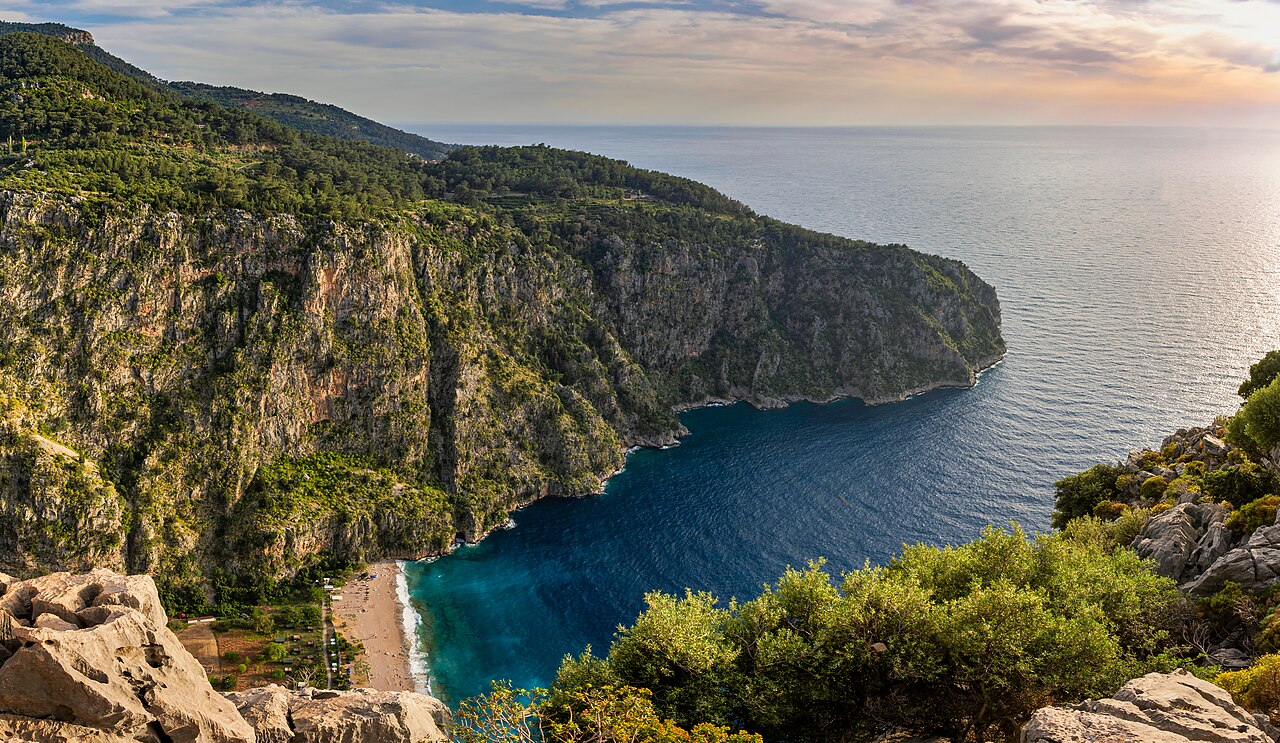
Butterfly Valley is a beach valley in Fethiye, Türkiye. Cliff walls rise roughly 350 metres on both sides. Declared a first-degree natural protected site in 1995. Most visitors spend 3-4 hours here. The free Lokali audio guide runs 6 minutes.
✓ Verified October 2026 · how we write these guides
Visitor facts
| Time needed | 3-4 hours |
|---|---|
| Lokali audio guide | 6 min · free |
| Type | Beach Valley |
| Best for | Romantic |
| Location | Fethiye, Türkiye |
| Coordinates | 36.4942, 29.1281 |
| Languages | 45, in the Lokali app |
The story
The boat rounds a headland and the cliffs open like a doorway. Two rock walls, streaked grey and orange, rise straight from the sea and frame a wedge of green between them. At their feet lies a short beach of pale pebbles and sand. The engine slows. The water under the hull turns from deep blue to clear turquoise, and you can see stones on the bottom ten metres down. Somewhere inland, out of sight, you can hear a thin thread of falling water.
This is Butterfly Valley — Kelebekler Vadisi in Turkish. It is a steep canyon that cuts back from the sea into the mountains below the village of Faralya. The cliff walls stand roughly 350 metres tall, close enough together that the sun reaches the valley floor for only part of the day. A cold stream runs down the middle, fed by springs in the rock, and it keeps the valley green through the driest weeks of summer.
The name comes from the creatures that gather here in the warm months. The most famous of them, the Jersey tiger, is not technically a butterfly at all. It is a day-flying moth. Its forewings are striped black and cream, like a zebra crossing folded into a triangle. At rest, it looks like a scrap of shadow on the rock. Then it flies — and flashes hindwings of bright orange-red. The surprise is the whole show.
In high summer, Jersey tigers gather in the cool, damp corners of the valley, especially near the waterfall at its far end. They rest on wet stone and hanging plants, sometimes dozens within a few steps. Local guides say that around one hundred species of butterflies and moths have been recorded in the valley over the years. Treat the exact number loosely. What is certain is that this shaded, spring-fed canyon is a rare refuge on a hot, dry coast.
The valley is protected, and strictly. In 1995, Turkey declared it a first-degree natural protected site, the country's tightest category. Permanent construction is banned. There is no road, no hotel, and no concrete. What you find instead is a simple camp behind the beach — wooden platforms, tents, a basic kitchen, solar panels. People who stay overnight wash in the stream and go to bed with the generator off, under a sky crowded with stars.
Most visitors come by boat, and that is the sensible choice. Water taxis and tour boats run from Ölüdeniz through the morning, and the ride takes well under an hour. The only land route is a steep path dropping from Faralya, high on the cliff. Parts of it rely on fixed ropes, the ground is loose, and it has caused serious accidents. Guides advise against it in wet weather or beach shoes — and they mean it.
From the beach, a flat trail leads inland along the stream. You pass the camp, then old terraced garden plots where valley caretakers grow vegetables and fruit under the cliffs. Mulberry, olive, and citrus trees stand in rough rows. The air cools as the walls narrow. After fifteen or twenty minutes of easy walking, the path ends at the waterfall — a ribbon of water sliding down a mossy rock face into a shallow pool.
In spring the fall runs hard and loud. By late August it can thin to a trickle, so match your expectations to the season. The wet rock around it stays cool all day, and this is where the moths concentrate. Move slowly and scan the dark, damp surfaces. What looks like bare stone will often twitch, then lift off, then blink orange. Stand still for a minute and the air around you fills with quiet movement.
Guard your honesty about timing. The Jersey tigers appear in the hottest months, roughly June to September, and even then a windy or cool day can keep them hidden. Outside those months the valley is still worth the trip — for the cliffs, the stream, and the swimming — but you may see few wings at all. No one can schedule the animals. That is part of what a real refuge means.
The beach itself rewards the wait. The water is clear and deepens quickly, and the cliff walls cut the wind, so the sea inside the cove often stays smooth when the open coast is choppy. Swim out fifty metres and turn around. From the water you can see the whole valley at once — beach, gardens, green canyon floor, and the two great walls leaning together toward the mountains. It is one of the best views on the Turquoise Coast, and it costs nothing.
By late afternoon the day boats sound their horns and pull out, and the valley changes character. Shadows climb the eastern wall. Goats pick along ledges that look impossible. The stream gets louder as the human noise fades. Overnight guests light candles at the camp tables, and the beach empties to a few footprints. If you can arrange to stay past the last boat, you will meet a different valley from the one the day-trippers photograph.
Before you leave, crouch at the stream where it crosses the beach and let the cold water run over your hand. That thin current is the reason for everything here — the green floor, the gardens, the damp shade, the wings. The cliffs kept the roads out, and the water kept life in. Few places on this coast are protected this simply — by rock, by distance, and by a stream that refuses to dry.
Key facts
What to look for
Practical tips
Common questions
How long do you need at Butterfly Valley?
Plan 3-4 hours. That is the time most visitors spend at Butterfly Valley. The free Lokali audio guide runs 6 minutes and is made to listen to while you walk.
Is there a free audio guide to Butterfly Valley?
Yes — the Lokali app narrates Butterfly Valley free of charge in 50+ languages. No ticket, tour group or subscription, and it works offline once downloaded.
Where is Butterfly Valley?
Butterfly Valley is in Fethiye, Türkiye, at 36.4942, 29.1281. Tap the map link on this page for directions.
What should you know before visiting Butterfly Valley?
Take the boat from Ölüdeniz — the cliff path is hazardous
What is Butterfly Valley known for?
Cliff walls rise roughly 350 metres on both sides
On the map
Opens directions to Butterfly Valley from your location.
More to see in Fethiye


Hear Butterfly Valley in your language
The full story, narrated, in 50+ languages. Download it before you go and it plays offline, at your own pace, with no ticket and no tour group.