Pergamon Acropolis
39.1319° N · 27.1844° E · Archaeological Site
Pergamon Acropolis is an archaeological site in Bergama, Türkiye. Attalus the Third bequeathed the kingdom to Rome in 133 BC. Plutarch claimed the library once held 200,000 scrolls. Most visitors spend 2-3 hours here. The free Lokali audio guide runs 6 minutes.
✓ Verified October 2026 · how we write these guides
Visitor facts
| Time needed | 2-3 hours |
|---|---|
| Lokali audio guide | 6 min · free |
| Type | Archaeological Site |
| Best for | History |
| Location | Bergama, Türkiye |
| Coordinates | 39.1319, 27.1844 |
| Languages | 45, in the Lokali app |
The story
Height is the whole idea here. You stand on a ridge hundreds of metres above the plain, and the wind pushes at you steadily, carrying dust, thyme, and the far-off noise of the town of Bergama below. Marble columns catch the light on the summit behind you. In every direction the land falls away, fields, reservoir water, distant hills. The people who built this city did not want comfort first. They wanted to be seen from everywhere, and to see everything.
Pergamon's rise reads like an adventure story. After Alexander the Great died, his generals fought over the empire, and one of them stored a huge treasury in this hilltop fortress, trusting it to an officer named Philetaerus. He quietly made the money his own, founded a dynasty, and his successors, the Attalids, turned a garrison into one of the most brilliant capitals of the Greek world during the third and second centuries BC. Sculptors, scholars, and engineers all worked on this hill at once.
Learning was the dynasty's favourite weapon. The Attalids built a library that ancient writers ranked second only to Alexandria's. Plutarch, writing centuries later, claimed it held 200,000 scrolls, a figure to take as ancient rumour rather than inventory. The rivalry with Egypt produced a famous story. When papyrus exports were cut off, ancient authors say, Pergamon perfected writing on specially treated animal skin. The material took the city's name, pergamena in Latin, parchment in English. However embellished the tale, the word is real, and it is yours today.
The library stood beside the sanctuary of Athena, and you can walk through its foundations. Look for the rows of holes and niches in the surviving wall, which may have anchored wooden shelving. The books had a dramatic ending too. Plutarch records the claim that Mark Antony gave the entire collection to Cleopatra, as a gift to restock Alexandria's library. True or not, the story shows what these scrolls were worth. Whole kingdoms flattered each other with books.
Now find the theatre, and approach it slowly. Cut into the hillside below the terraces, it drops at an angle that feels closer to a cliff than a staircase, with seating for about ten thousand people. It is among the steepest theatres to survive from the ancient world. Descend carefully if you try the stairs, holding the rail where there is one. From the stage far below, the top rows seem to hang in the air. Every seat, even the highest, kept a full view of the plain.
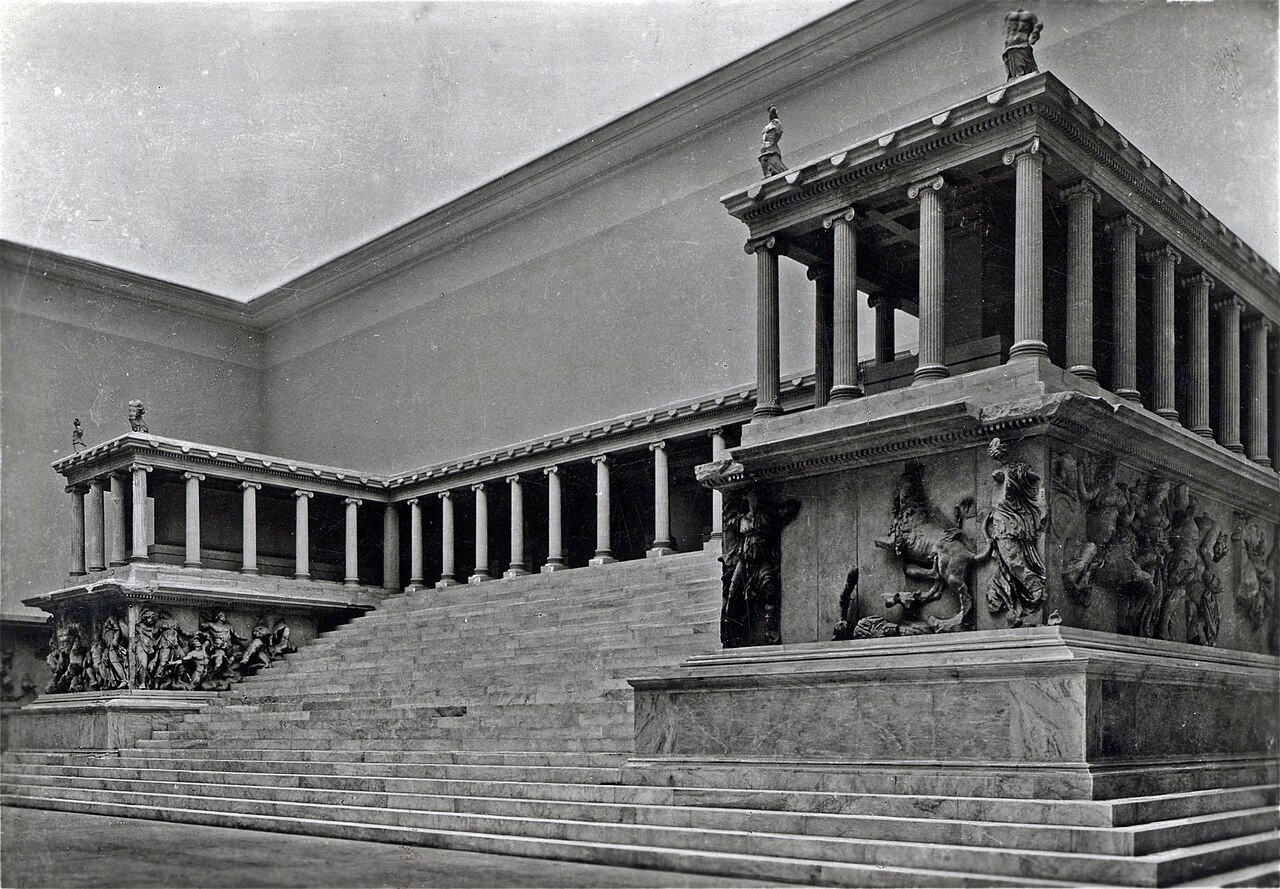
One terrace held the Great Altar of Pergamon, built in the second century BC and wrapped in a marble frieze of gods battling giants, carved with a motion and violence that still startle visitors. You will not see the frieze here. German engineer Carl Humann began excavating it in 1878, and the sculptures went to Berlin, where a museum was eventually named after them. On the hill itself, the altar's wide stepped foundation remains, with a pine growing beside it. Stand on the platform and rebuild the rest in your mind.
The white columns crowning the summit belong to the Temple of Trajan, added when Rome ruled here, and dedicated to emperors worshipped as gods. It stands on an enormous artificial terrace held up by vaulted chambers, a piece of engineering as impressive as the marble above it. Archaeologists re-erected part of the colonnade in the twentieth century. From its platform you get the acropolis's best view, with the theatre falling away at your feet.
Rome acquired all of this without a battle. In 133 BC the last king, Attalus the Third, died without an heir and left his entire kingdom to Rome in his will. The bequest astonished contemporaries, and historians still debate his motives. The kingdom became the Roman province of Asia, and Pergamon continued as a wealthy provincial city for centuries. Few empires have ever changed hands by paperwork. This one did.
Pergamon's most famous son came later. Galen, born here in 129 AD, became the most influential physician of antiquity, doctor to gladiators in his hometown and later to emperors in Rome. His writings dominated European and Middle Eastern medicine for well over a thousand years. He trained at the Asclepion, the healing sanctuary on the plain below, where treatment mixed baths, rest, exercise, and the interpretation of dreams. Its colonnaded remains can be visited separately after you descend.
The hilltop had a water problem, and the solution still amazes engineers. Hellenistic builders ran a pipeline from mountains many kilometres to the north, and its final stretch worked as a pressurized siphon, forcing water up to the citadel through sealed pipes. No pumps, only gravity and pressure, managed with second-century BC mathematics. As you walk, remember that every fountain, bath, and garden up here ran on that hidden line.
In 2014, UNESCO added Pergamon and its layered landscape to the World Heritage list. The layers are easy to read from up here. Below the acropolis stands the Red Hall, a vast brick temple complex from Roman times, later converted to a church. Ottoman minarets rise among the modern roofs of Bergama. A cable car glides up the slope you may have climbed. Twenty-two centuries of city, stacked on one view.
Find a quiet block of marble and sit for a moment before leaving. The wind up here never really stops. It crossed this ridge when the library was full, when the altar smoked, when the last king signed his strange will. Below, tractors move on the plain, and the town gets on with its afternoon. Kingdoms turn out to be temporary. The height, the light, and the wind were the permanent collection all along.
Key facts
What to look for
Practical tips
Common questions
How long do you need at Pergamon Acropolis?
Plan 2-3 hours. That is the time most visitors spend at Pergamon Acropolis. The free Lokali audio guide runs 6 minutes and is made to listen to while you walk.
Is there a free audio guide to Pergamon Acropolis?
Yes — the Lokali app narrates Pergamon Acropolis free of charge in 50+ languages. No ticket, tour group or subscription, and it works offline once downloaded.
Where is Pergamon Acropolis?
Pergamon Acropolis is in Bergama, Türkiye, at 39.1319, 27.1844. Tap the map link on this page for directions.
What should you know before visiting Pergamon Acropolis?
Take the cable car up to skip the steep road
What is Pergamon Acropolis known for?
Attalus the Third bequeathed the kingdom to Rome in 133 BC
On the map
Opens directions to Pergamon Acropolis from your location.
Hear Pergamon Acropolis in your language
The full story, narrated, in 50+ languages. Download it before you go and it plays offline, at your own pace, with no ticket and no tour group.