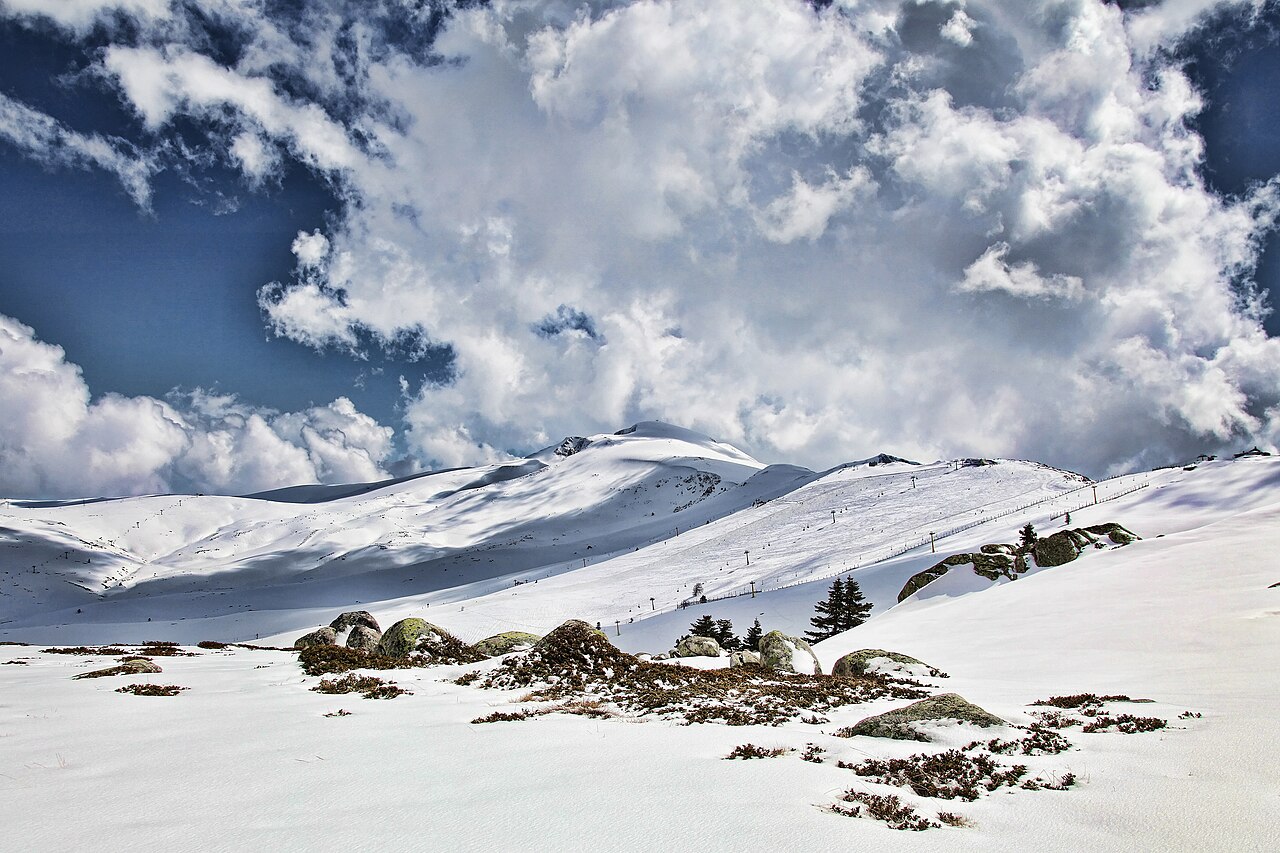
Uludağ National Park is a mountain in Bursa, Türkiye. The summit reaches 2,543 metres above sea level. Declared a national park in 1961. Most visitors spend 4-6 hours here. The free Lokali audio guide runs 6 minutes.
✓ Verified October 2026 · how we write these guides
Visitor facts
| Time needed | 4-6 hours |
|---|---|
| Lokali audio guide | 6 min · free |
| Type | Mountain |
| Best for | Families |
| Location | Bursa, Türkiye |
| Coordinates | 40.0997, 29.2211 |
| Languages | 45, in the Lokali app |
The story
The air is the first change. It is cooler up here, thinner, scented with resin and wet stone, and it moves through the fir branches with a sound like distant water. Shreds of cloud drift below eye level on many days. Somewhere a cowbell knocks. Underfoot, the ground is granite gravel, pine needles, or snow, depending on the month. Bursa's heat and traffic sit far below you now. You are on Uludağ, the Great Mountain, the highest point of the entire Marmara region.
The numbers deserve a moment. Uludağ's summit stands at 2,543 metres above sea level. The mountain was declared a national park in 1961, one of Turkey's earliest, protecting forests, glacial lakes, and high meadows across its upper slopes. In winter, deep snow turns the plateau into the country's best-known ski grounds. In summer, the same slopes carry hikers, picnicking families, and grazing herds. The mountain runs two entirely different lives, roughly six months each.
The ancients knew this mountain as Olympus. Not the famous one in Greece. The classical world named many high mountains Olympus, and this was the Mysian Olympus, after the surrounding region. Writers of antiquity mentioned its snows and its wild forested slopes. From its ridges on a clear day you can see the Sea of Marmara shining to the north. The modern name, Uludağ, simply means great mountain, and it was adopted in the early years of the Turkish Republic.
Before that, for centuries, Turks called it Keşiş Dağı, the Mountain of Monks. The name remembered a real population. In Byzantine times, hermits and monastic communities settled these slopes, drawn by remoteness, water, and forest, and the mountain became one of Anatolia's important monastic centres. Saints' biographies from that era describe winters of brutal snow and summers of grazing flocks. The monks are gone. Their weather report still holds.
Most visitors arrive the enjoyable way. A cable car climbs from the edge of Bursa, rebuilt in 2014, and its line runs nearly nine kilometres, among the longest such rides anywhere. The gondola crosses orchards, then chestnut and beech forest, then dark firs, with the city shrinking behind. In under half an hour you pass through climate zones that would take a day to walk. Watch the vegetation change order as you rise. The mountain organizes itself by altitude, layer above layer.
Those layers make the park a field course in botany. Olive and laurel country gives way to chestnut, then to beech woods, then to a dark belt of conifers. The signature tree is the Uludağ fir, a variety that grows naturally only in this part of the world. Above roughly 2,000 metres the trees stop entirely, and alpine meadows take over, cropped short, scattered with rocks and summer flowers. Botanists have recorded dozens of plants on this mountain that grow nowhere else.
The summit zone keeps the mountain's quietest treasures. In hollows scraped out by ice-age glaciers lie several small lakes, Aynalıgöl, Karagöl, and Kilimligöl among them, cold and clear, frozen for much of the year. Reaching them requires a proper hike from the hotel zone, several hours over stony ground. Go prepared if you go. Weather changes fast at this height, and summer afternoons can build sudden fog. The reward is water, rock, and silence, with no human additions.
Skiing gave the mountain its modern fame. Winter sports began here in the 1930s, making Uludağ the country's oldest ski destination, and generations of Turkish families learned their first turns on these slopes. Today a hotel zone with dozens of lifts operates through the winter, at its liveliest around the New Year. Istanbul crowds arrive by car and cable car. If you are standing here in summer, the empty lift pylons overhead are the framework of a whole second town.
The forests hold more animals than most visitors realise. Wild boar root through the beech leaf-litter. Wolves and brown bears live at low density in the remoter valleys, avoiding people. Birds of prey ride the ridge winds. You are unlikely to meet anything larger than a squirrel on the main paths, but keep food packed away, walk with company on long routes, and leave dusk to the mountain. A national park works best when its residents keep their distance.
The mountain also works for a living. Its snowmelt feeds the springs and streams that supply Bursa below, and a famous Turkish mineral water and soda brand has bottled from these slopes since the 1930s, carrying the mountain's name to shop shelves across the country. At the mountain's foot, hot springs have fed Bursa's bathhouses since Roman times. One mountain, many products. Snow, water, timber, pasture, and now views.
For most day visitors, the heart of the mountain is Sarıalan, a broad clearing at the cable car's plateau station. Bursa families arrive with hampers and settle under the firs for the day. Teahouses pour endless small glasses, grills smoke, children chase each other around the trunks. It is unpretentious, loud, and entirely local. Walk ten minutes past the last picnic table, though, and the forest turns quiet again, and you have the mountain nearly to yourself.
Find a rock with a view before you head down. Below, the plain of Bursa spreads toward the Sea of Marmara, with the city stitched along the mountain's foot. Monks watched winters from here. Foresters cut timber, skiers carved decades of Februaries, and the cable car hums on its wire behind you. The mountain absorbs all of it without much comment. Breathe the resin air once more. It is the same air, at the same altitude, as it ever was.
Key facts
What to look for
Practical tips
Common questions
How long do you need at Uludağ National Park?
Plan 4-6 hours. That is the time most visitors spend at Uludağ National Park. The free Lokali audio guide runs 6 minutes and is made to listen to while you walk.
Is there a free audio guide to Uludağ National Park?
Yes — the Lokali app narrates Uludağ National Park free of charge in 50+ languages. No ticket, tour group or subscription, and it works offline once downloaded.
Where is Uludağ National Park?
Uludağ National Park is in Bursa, Türkiye, at 40.0997, 29.2211. Tap the map link on this page for directions.
What should you know before visiting Uludağ National Park?
Check the last cable car time before descending on foot
What is Uludağ National Park known for?
The summit reaches 2,543 metres above sea level
What is the best time to visit Uludağ National Park?
Pack a warm layer even on summer days
On the map
Opens directions to Uludağ National Park from your location.
More to see in Bursa


Hear Uludağ National Park in your language
The full story, narrated, in 50+ languages. Download it before you go and it plays offline, at your own pace, with no ticket and no tour group.