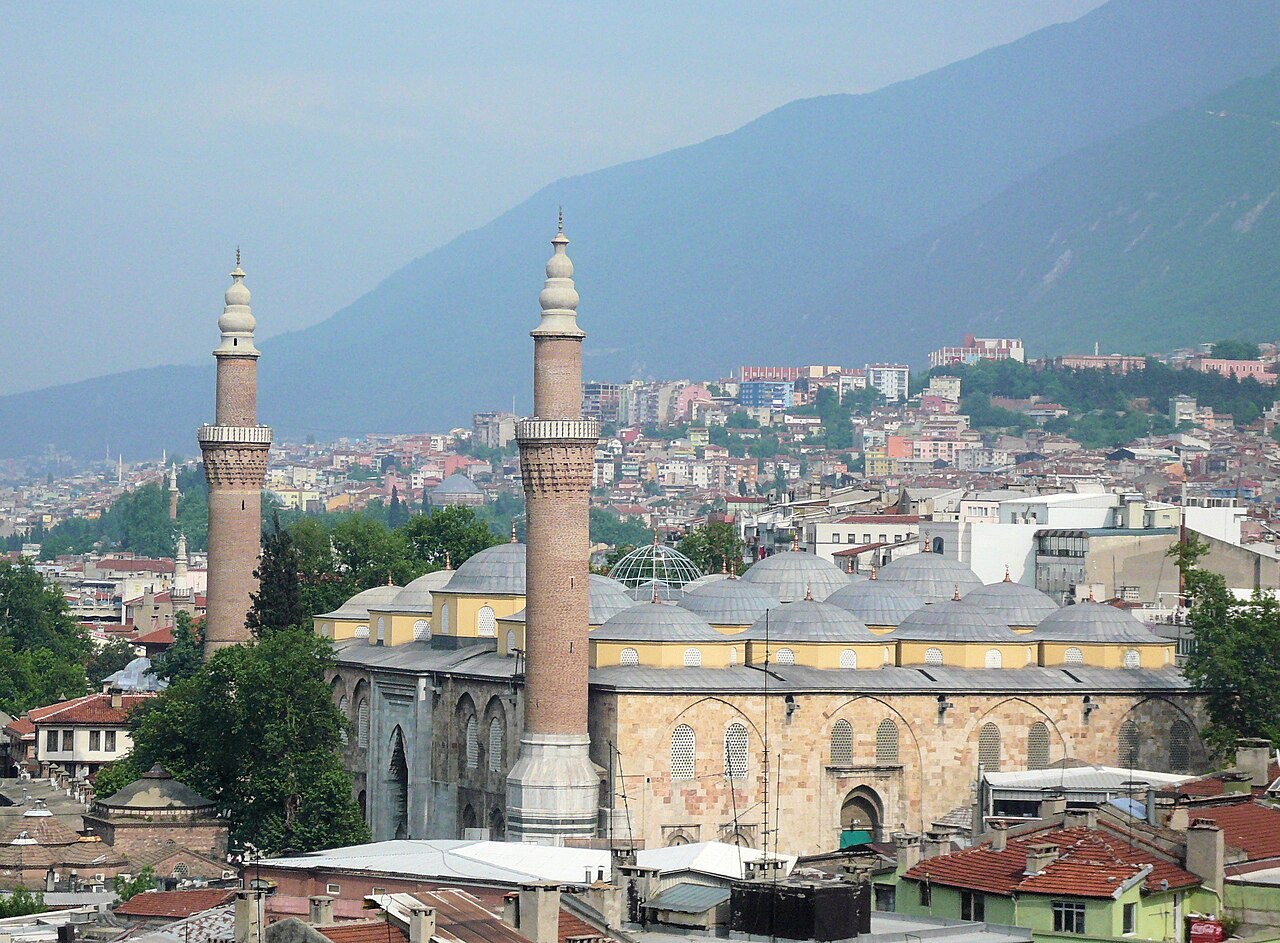
Bursa Grand Mosque is a mosque in Bursa, Türkiye. Built between 1396 and 1399 for Sultan Bayezid the First. Twenty domes rest on twelve stone piers. Most visitors spend 45-60 min here. The free Lokali audio guide runs 6 minutes.
✓ Verified October 2026 · how we write these guides
Visitor facts
| Time needed | 45-60 min |
|---|---|
| Lokali audio guide | 6 min · free |
| Type | Mosque |
| Best for | History |
| Location | Bursa, Türkiye |
| Coordinates | 40.1842, 29.0611 |
| Languages | 45, in the Lokali app |
The story
Step through the door and the city noise cuts off. In its place, water. A fountain splashes in the middle of the prayer hall, an unexpected sound indoors, echoing gently under stone vaults. The floor spreads out in carpet, red and soft underfoot. Twenty domes hang overhead in rows, resting on twelve massive piers. Daylight drops through a glass roof above the fountain and lies on the water. People sit against the piers, reading, resting, praying. Nobody hurries in here.
This is the Grand Mosque of Bursa, Ulu Cami in Turkish, built between 1396 and 1399 on the orders of Sultan Bayezid the First. His nickname was Yildirim, the Thunderbolt, earned by the speed of his military campaigns. Bursa was the first great capital of the Ottomans, and this was its statement mosque, the largest the young dynasty had yet attempted. More than six centuries later it is still a working mosque at the centre of the city's daily life, surrounded by bazaars.
A famous story explains the ceiling. Before the Battle of Nicopolis in 1396, Bayezid vowed to build twenty mosques if God granted him victory. He won, the story goes, and then built one mosque with twenty domes instead, on the advice of a scholar and with an eye on the treasury. Historians cannot confirm the vow. What is certain is the number. Stand near a pier and count the shallow domes in their four rows of five. The compromise, if it was one, produced a hall unlike any other Ottoman mosque.
The indoor fountain has its own tradition. Locals say that when land was being bought for the mosque, one stubborn owner refused to sell his plot. A mosque cannot stand on unjustly taken ground, so the fountain, tradition says, was placed exactly over that disputed plot, keeping prayer space off it. Documents for the tale are lacking, but the sadirvan, the ablution fountain, really is indoors, which is rare, and the opening above it was later closed with glass. Its sound reaches every corner of the hall.
Now look at the walls and piers. The mosque holds 192 monumental calligraphic panels, one of the most important collections of wall calligraphy in the Islamic world. Master calligraphers painted and repainted them over the centuries, mostly in black and gold. Some spell out verses of the Quran, others the names of God. You do not need to read Arabic to feel their effect. The letters are composed like pictures, balanced and enormous, some taller than a person.
Among the inscriptions, look for a letter shaped like a comma with a deep round bowl, repeated alone in several places. It is the Arabic letter waw. Calligraphers and mystics loaded this letter with meaning. Its numerical value, its shape like a person bowed in prayer, its role in the word for oath. The paired waw panels of this mosque are especially loved, and you may see visitors photographing that single letter more than anything else in the building.
The wooden minbar, the pulpit beside the prayer niche, deserves slow attention. It was carved from walnut at the end of the fourteenth century and assembled in the kundekari technique, hundreds of interlocking pieces joined without nails or glue. Geometric stars and polygons cover its flanks. A modern claim holds that the pattern encodes the sun and planets at their relative distances. Take that as a story, not a fact. The certainty is the joinery, still tight after six hundred years.
Tradition also gathers around the mosque's opening ceremony. A humble baker of the city, remembered as Somuncu Baba, was revealed that day, so the story goes, as a hidden saint, when he was asked to give the opening sermon and explained the first chapter of the Quran in seven different ways. Bursa still tells the tale, and bakeries still invoke his name. Treat it as sacred folklore, the kind that shows what a city wants its buildings to mean.
The building has survived real punishment. Timur's army occupied Bursa in 1402 after defeating Bayezid at the Battle of Ankara, and the city suffered again in later sieges, when the mosque itself was damaged and repaired. A great earthquake in 1855 brought down many of the domes, which were rebuilt in the years that followed. Each repair left traces for sharp eyes, in changed stonework and renewed paint. A working building six centuries old is never a single moment. It is a long negotiation with disaster.
As architecture, the hall around you is a bridge between eras. Early Ottoman builders inherited the Seljuk tradition of broad prayer halls held up by many supports, and this is its grandest expression. Later imperial mosques in Istanbul chased a different idea, one vast dome over one open space. Here the pleasure is different. Twenty modest domes, rhythm instead of climax, a hall that feels like a sheltering grid of stone. Many visitors find it more intimate than the famous domes that came after.
In 2014, UNESCO inscribed Bursa's early Ottoman monuments, this mosque among them, on the World Heritage list, together with the village of Cumalıkızık outside the city. When you leave, the setting continues the story. The covered bazaar begins almost at the mosque door, and a short walk brings you to Koza Han, a courtyard inn built in 1491, where silk merchants have traded for five centuries. Tea gardens fill its yard now, around a small raised prayer kiosk.
Before you go, return to the fountain and stay for one more minute. Water keeps its own time. It ran through this hall while sultans came and went, while earthquakes and fires were repaired, while the empire ended and the republic began. Around you, people continue doing what people have done here since 1399. Sitting, washing, whispering, resting their backs against warm stone. Add your minute to that long account, then step back out into the bazaar noise.
Key facts
What to look for
Practical tips
Common questions
How long do you need at Bursa Grand Mosque?
Plan 45-60 min. That is the time most visitors spend at Bursa Grand Mosque. The free Lokali audio guide runs 6 minutes and is made to listen to while you walk.
Is there a free audio guide to Bursa Grand Mosque?
Yes — the Lokali app narrates Bursa Grand Mosque free of charge in 50+ languages. No ticket, tour group or subscription, and it works offline once downloaded.
Where is Bursa Grand Mosque?
Bursa Grand Mosque is in Bursa, Türkiye, at 40.1842, 29.0611. Tap the map link on this page for directions.
What should you know before visiting Bursa Grand Mosque?
Enter between prayer times and keep voices low
What is Bursa Grand Mosque known for?
Built between 1396 and 1399 for Sultan Bayezid the First
What is the best time to visit Bursa Grand Mosque?
Sit near the indoor fountain to watch the light change
On the map
Opens directions to Bursa Grand Mosque from your location.
More to see in Bursa


Hear Bursa Grand Mosque in your language
The full story, narrated, in 50+ languages. Download it before you go and it plays offline, at your own pace, with no ticket and no tour group.