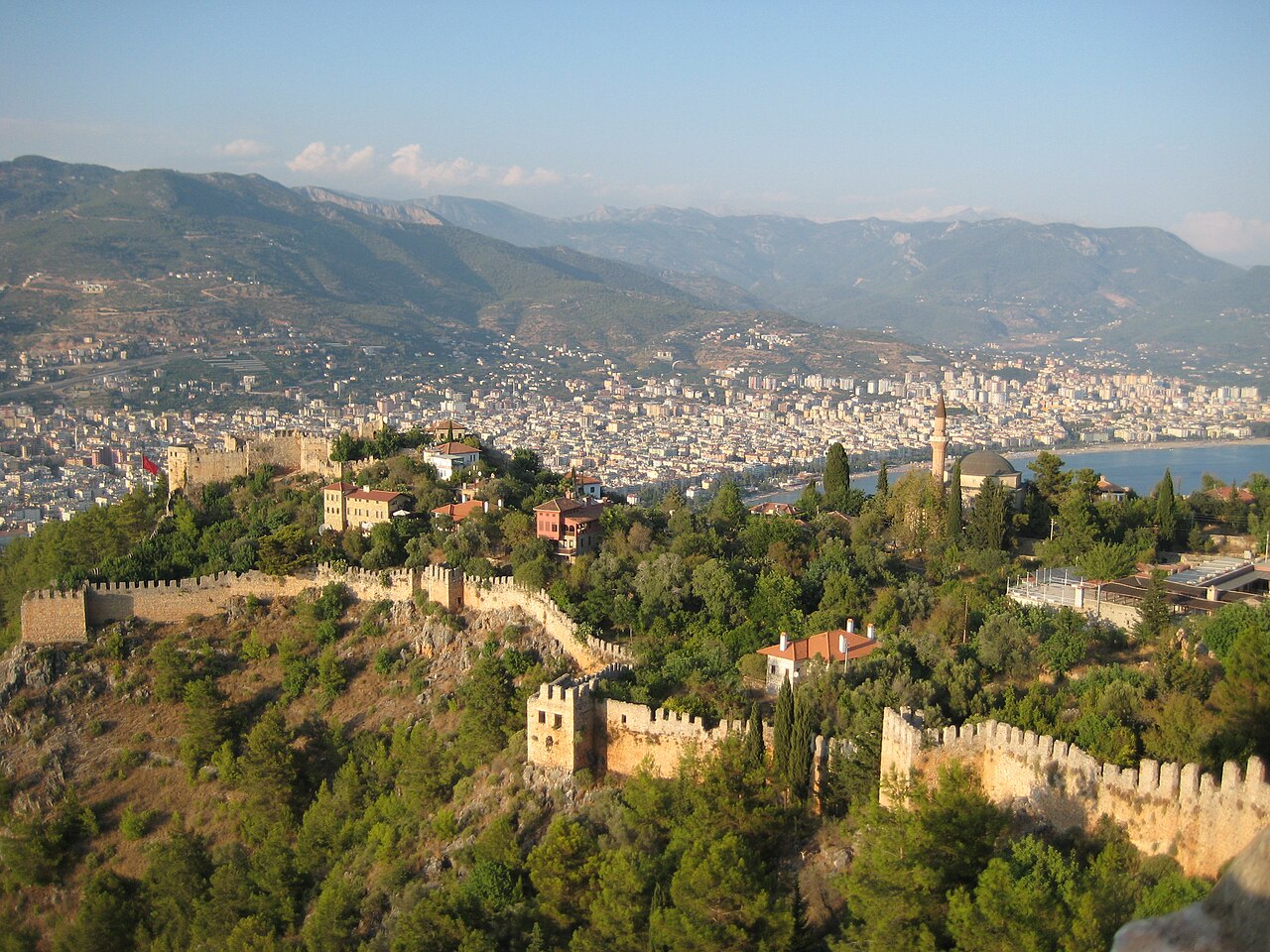
Alanya Castle is a castle in Alanya, Türkiye. Sultan Alaeddin Keykubad the First took the town in 1221. An inscription dates the Red Tower to 1226. Most visitors spend 2-3 hours here. The free Lokali audio guide runs 6 minutes.
✓ Verified October 2026 · how we write these guides
Visitor facts
| Time needed | 2-3 hours |
|---|---|
| Lokali audio guide | 6 min · free |
| Type | Castle |
| Best for | Photography |
| Location | Alanya, Türkiye |
| Coordinates | 36.5319, 31.9964 |
| Languages | 45, in the Lokali app |
The story
The wind reaches you before the view does. Up here on the rock it comes off the open sea, steady and warm, carrying salt and the dry smell of thyme and sage baking on the slopes. Put a hand on the wall. The stone is rough, full of small shells and grit, and hot enough on the sunny side to make you pull back. Below, gulls hang almost motionless in the updraft. Cicadas keep going in the pines. The town noise arrives thin and far away.
Look at the shape of the land. A steep rock headland pushes out into the Mediterranean, with a long beach curving away on one side and a working harbour tucked into the other. That is the whole logic of this fortress in one glance. Whoever held this rock controlled two anchorages, watched a long stretch of coast, and could not easily be starved out. Behind it all, the Taurus Mountains rise straight from the shoreline, grey and folded, still holding snow in spring.
The fortress you see is mainly the work of one ruler. In 1221 the Seljuk sultan Alaeddin Keykubad the First took this town. He renamed it after himself and made it a winter residence, away from the cold of the inland plateau. Then he built. Walls were run along the ridges of the rock, towers were placed where the ground allowed, and the harbour below was given defences of its own. It was a large project, and it was finished quickly.
The walls are the scale to appreciate first. They follow the natural crest of the headland for several kilometres, climbing and dropping with the rock rather than fighting it. In places the wall is the cliff, with only a low parapet added on top. Dozens of towers punctuate the line. Some are square, some rounded, and their spacing follows the terrain rather than any neat pattern. Walking even part of this circuit takes real effort in the heat.
Down beside the harbour stands the Red Tower, and it deserves a look up close. It is octagonal, built of stone at the base and red brick above, which is where the name comes from. An inscription on the tower records the year 1226 and credits a builder who came from Aleppo. Inside, the floors are supported around a central pillar, and a cistern sits at the bottom to hold water for a siege. It is a serious military building, not a decoration.
Just along the shore from the tower is something rarer. A row of vaulted bays opens directly onto the sea, cut and built into the rock at the waterline. This was the sultan's shipyard, finished shortly after the tower. Ships were built and repaired under those arches, sheltered from sun and weather, and launched straight into the water. The Seljuks were a land power from inland Anatolia. Building a Mediterranean fleet here was a deliberate change of ambition.
Water was the constant problem on this rock. There are no springs at the top. So the builders dug and lined cisterns, and channelled rain from roofs and paved surfaces into them. Several survive, dark and cool, some still holding water after rain. When you are standing on a hot, treeless slope, the cisterns explain more about how the fortress worked than any tower does. A castle without water is simply a very tall trap.
Inside the innermost enclosure, at the highest point, stands a small ruined church built of stone. It carries the name of Saint George. Its walls are older than the Seljuk fortress around it, which tells you the rock was already fortified and inhabited before 1221. Byzantine and earlier defenders used the same natural advantages. When the Seljuks arrived, they did not start from nothing. They rebuilt, extended, and put their own inscriptions on what they finished.
Near the edge of the inner castle there is a viewing point with a long drop below it. Local tradition says condemned prisoners were once brought here. According to the story, a prisoner was given a stone and told to throw it into the sea. If the stone cleared the rocks and reached water, the person went free. That is folklore rather than documented history. Try it yourself with a small pebble and you will understand why the story survives.
For centuries after the Seljuk period, people simply lived up here. The area inside the walls held a village, with houses, gardens, cisterns, a mosque and a bathhouse. Mulberry trees were grown for silk. You can still see the pattern of that settlement in the low stone walls and terraces among the trees. The village emptied slowly as the town below grew and as life at the top of a steep hill became inconvenient rather than safe.
Today the rock is quiet in a different way. Cats sleep on warm ancient stone. Bougainvillea spills over garden walls in hot pink. A cable car runs up from the beach, which turns a long climb into a short ride, and a road loops round for cars and minibuses. Photographers gather at the western viewpoints in late afternoon, when the sun drops toward the sea and the whole beach below turns the colour of pale honey.
Find a spot on the wall away from the main viewpoints, sit down, and let your eyes rest on the horizon rather than the town. From here the sea looks empty, as it would have looked to a guard watching for sails. The wind you are feeling is the same one that decided whether ships came or stayed away. Notice how far the sound of the town has to travel to reach you. Then take the path down slowly.
Key facts
What to look for
Practical tips
Common questions
How long do you need at Alanya Castle?
Plan 2-3 hours. That is the time most visitors spend at Alanya Castle. The free Lokali audio guide runs 6 minutes and is made to listen to while you walk.
Is there a free audio guide to Alanya Castle?
Yes — the Lokali app narrates Alanya Castle free of charge in 50+ languages. No ticket, tour group or subscription, and it works offline once downloaded.
Where is Alanya Castle?
Alanya Castle is in Alanya, Türkiye, at 36.5319, 31.9964. Tap the map link on this page for directions.
What should you know before visiting Alanya Castle?
Ride the cable car up, then walk back down
What is Alanya Castle known for?
Sultan Alaeddin Keykubad the First took the town in 1221
What is the best time to visit Alanya Castle?
Come late afternoon for cooler air and softer light
On the map
Opens directions to Alanya Castle from your location.
More to see in Alanya

Hear Alanya Castle in your language
The full story, narrated, in 50+ languages. Download it before you go and it plays offline, at your own pace, with no ticket and no tour group.