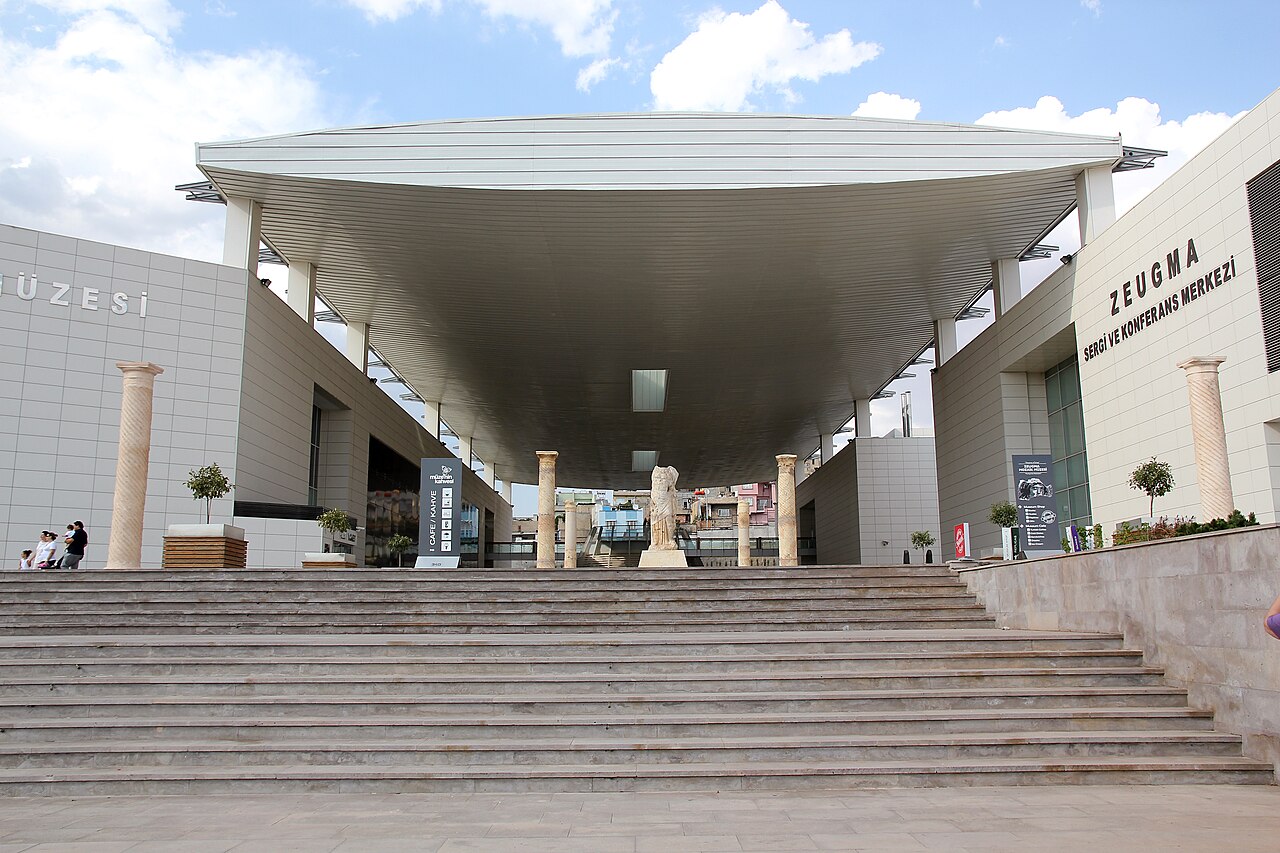
Zeugma Mosaic Museum is a museum in Gaziantep, Türkiye. Zeugma sat where a boat bridge crossed the Euphrates. A Roman legion was stationed at the city. Most visitors spend 2-3 hours here. The free Lokali audio guide runs 6 minutes.
✓ Verified October 2026 · how we write these guides
Visitor facts
| Time needed | 2-3 hours |
|---|---|
| Lokali audio guide | 6 min · free |
| Type | Museum |
| Best for | History |
| Location | Gaziantep, Türkiye |
| Coordinates | 37.0644, 37.3903 |
| Languages | 45, in the Lokali app |
The story
The doors close behind you and the street noise of Gaziantep disappears. The air inside is cool and dry, and the light is low and directional. Your footsteps carry. Ahead, a floor the size of a small room hangs on the wall in front of you, and the whole surface glitters slightly as you move past it. That is the first thing to understand here — mosaic is made of thousands of separate stones, so it changes as you walk.
Lean in close to any panel. The picture breaks apart into small cubes of cut stone, each one roughly the size of a fingernail or smaller. They are called tesserae. Craftsmen sorted them by colour, then set them into wet lime mortar, tighter and smaller where a face needed detail, larger and looser out in the background. A single dining room floor could take months and use well over a million pieces. Nobody signed most of this work.
These floors come from a city called Zeugma, on the west bank of the Euphrates, roughly a hundred kilometres east of here. A general of Alexander the Great founded it, and its later Greek name simply means a joining or a crossing. That is exactly what it was — the place where a bridge of boats carried the road over the river. Whoever controlled the crossing collected from everything that used it.
Under Roman rule the city became wealthy and strategically important. A Roman legion was stationed there, guarding the frontier with the Parthian empire to the east. Merchants, officers and landowners built houses on the terraced slope above the river, with courtyards, painted walls, fountains and mosaic floors. They ordered images from the Greek myths, the same subjects wealthy Romans wanted in Italy or North Africa. What you are looking at is the interior decoration of a border town that had money.
It ended quickly. In the middle of the third century, Sasanian Persian forces under their king took and burned the city. Roofs collapsed. Earth and debris fell across the floors and sealed them. That destruction is the reason these mosaics survive at all — burial protected them from weather, from reuse and from being lifted for other buildings. The city never fully recovered, and a village eventually settled over the ruins.
Then came the second flood, and this one was planned. When the Birecik dam was built on the Euphrates, its reservoir was going to cover part of the ancient site. In 2000, archaeologists worked against a rising deadline, lifting mosaics and recording what they could before the water arrived. Photographs from that season show teams working in trenches with the new shoreline visible behind them. Some of the site is now permanently underwater.
Follow the signs to a small dark room set apart from the rest. Inside, a single fragment is lit on its own. It shows the head and shoulders of a young person with tousled hair, looking sideways out of the frame. It is known as the Gypsy Girl, though nobody knows who she was meant to be; she may be a follower of the wine god, or a personification of something now lost. The eyes appear to follow you across the room.
That panel has a second story. Pieces cut from the same floor were removed illegally from the site decades ago and ended up in a university collection in the United States. After long negotiation, twelve fragments were returned to Turkey in 2018 and reunited with the rest of the work here. When you look at this mosaic, you are looking at something that was taken apart, scattered across an ocean, and then put back together.
Give the larger halls proper time. There are gods and sea creatures — a bearded river figure, a sea god with his consort surrounded by fish, dolphins and a small winged figure riding across the water. There is a wedding scene, a woman receiving a shower of gold, and a hero discovered in disguise among a king's daughters. Watch how the artists handled water: overlapping curved lines in three or four greys, which read as waves from a distance and as nothing up close.
The museum does not only show floors. There are wall paintings lifted from the same houses, columns, pools, statues, and the reconstructed shapes of rooms so you can see how a mosaic actually sat in a home. One bronze statue of the war god stands alone in a case, and it is worth walking around it twice. Notice too that many floors have a plain border. That was the zone covered by dining couches, where nobody would ever see a picture.
Think about the colours. Almost everything here comes from stone found in the region — limestone, marble, coloured pebbles from the riverbed. For the strongest blues and some greens, craftsmen had to use cut glass instead, because no local stone gave that tone. Look for panels where the blue looks slightly brighter and glassier than its neighbours. That difference is a technical choice made by hand, on site, before the mortar set.
Before you leave, find a floor mosaic displayed low, and stand where a guest would have stood. These were not pictures for a wall. People walked on them in sandals, spilled wine on them, swept them, and argued and ate above them without looking down. Now they hang in a dark, quiet, air-conditioned room, and you have come a long way to look at them carefully. That reversal is worth a moment before you step back out into the noise.
Key facts
What to look for
Practical tips
Common questions
How long do you need at Zeugma Mosaic Museum?
Plan 2-3 hours. That is the time most visitors spend at Zeugma Mosaic Museum. The free Lokali audio guide runs 6 minutes and is made to listen to while you walk.
Is there a free audio guide to Zeugma Mosaic Museum?
Yes — the Lokali app narrates Zeugma Mosaic Museum free of charge in 50+ languages. No ticket, tour group or subscription, and it works offline once downloaded.
Where is Zeugma Mosaic Museum?
Zeugma Mosaic Museum is in Gaziantep, Türkiye, at 37.0644, 37.3903. Tap the map link on this page for directions.
What should you know before visiting Zeugma Mosaic Museum?
Visit the darkened side room holding the single lit portrait
What is Zeugma Mosaic Museum known for?
Zeugma sat where a boat bridge crossed the Euphrates
On the map
Opens directions to Zeugma Mosaic Museum from your location.
Hear Zeugma Mosaic Museum in your language
The full story, narrated, in 50+ languages. Download it before you go and it plays offline, at your own pace, with no ticket and no tour group.