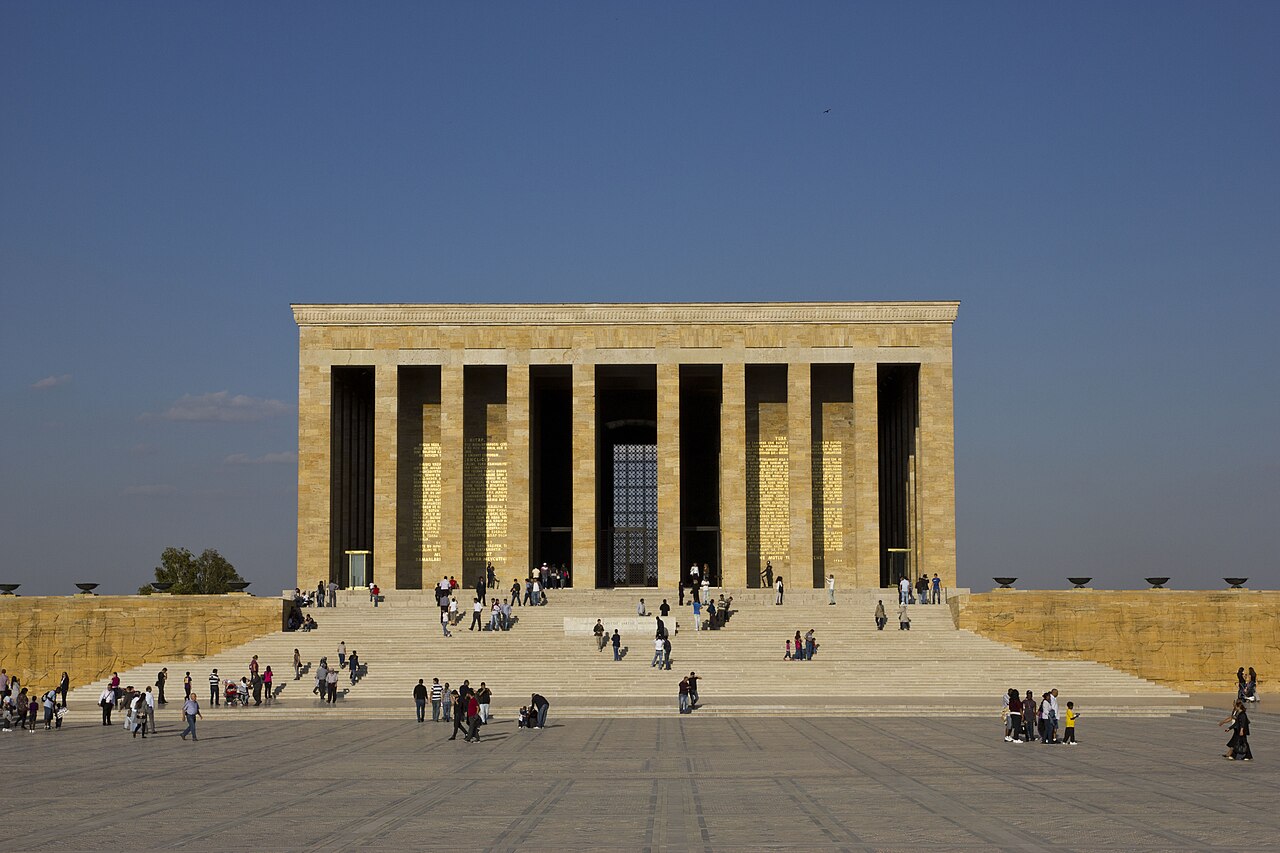
Anıtkabir is a mausoleum in Ankara, Türkiye. Emin Onat and Orhan Arda won the design competition. Construction of the complex ran from 1944 to 1953. Most visitors spend 2-3 hours here. The free Lokali audio guide runs 7 minutes.
✓ Verified October 2026 · how we write these guides
Visitor facts
| Time needed | 2-3 hours |
|---|---|
| Lokali audio guide | 7 min · free |
| Type | Mausoleum |
| Best for | History |
| Location | Ankara, Türkiye |
| Coordinates | 39.9251, 32.8369 |
| Languages | 45, in the Lokali app |
The story
The quiet arrives before anything else. You come up from a busy Ankara street, pass through the gate, and the traffic noise drops away behind the trees. Then you hear your own footsteps on stone. The paving here is large and pale, and it carries sound cleanly. Wind moves across the open ground with nothing to break it. Somewhere ahead, a guard's boots strike the pavement in a slow, deliberate rhythm. People lower their voices without being asked to.
Look up at the hill. This site was chosen partly for its position — high ground with a wide view over the capital. When work began, archaeologists found something unexpected in the hill itself. Burial mounds from the Phrygian period, thousands of years old, lay under the surface. They were excavated, and the finds went to museums in the city. So the ground chosen for a twentieth-century tomb turned out to have been a burial place already, very long before.
The design came out of an open competition held in the early 1940s. Architects from Turkey and abroad submitted entries. Two Turkish architects, Emin Onat and Orhan Arda, won with a scheme that avoided both a domed Ottoman form and a copy of a classical temple. What they produced is severe, rectangular and very large, built from stone, with square columns rather than round ones. It was intended to look like nothing else, and it does.
Construction ran from 1944 to 1953, through years when the country had little money to spare. Mustafa Kemal Atatürk, the founder and first president of the Turkish Republic, had died on 10 November 1938. His body rested in a museum building elsewhere in Ankara while this site was being built. On 10 November 1953, fifteen years to the day after his death, his remains were brought here. That date is why the anniversary is marked at this place every year.
Begin where most visitors begin, on the Lion Road. Twenty-four stone lions line the approach in facing pairs. They are carved in a deliberately old style, drawn from Hittite sculpture — the Bronze Age civilisation of central Anatolia, whose capital lay a few hours east of here. The lions are not roaring or rearing. They lie down, calm and heavy, with their front paws forward. The choice was intentional. Strength shown at rest reads differently from strength shown in threat.
The walk itself is part of the design. The Lion Road is long, level and slightly narrowing, and it is paved in a way that makes you slow down. There is no shortcut and no side path. Everyone approaches the same way, at roughly the same speed, on foot. Whether you arrive as a head of state or a school pupil, the building makes you cover that distance yourself before it will show you anything.
At the end the ground opens into a large ceremonial plaza. The paving is laid in a pattern of coloured stone that has often been compared to an Anatolian carpet spread across the ground. Ten towers stand around the edges of this space, each with a name connected to the values and events of the republic's founding, and each carrying carved reliefs. Soil brought from every province of the country was placed here, so that the whole of Turkey is represented underfoot.
The stone deserves attention. The materials came from quarries in different regions of Turkey, and the colours differ from one part of the complex to another — warm cream, grey, red, dark tones near the tomb itself. Run your eye along a wall in low sun and the variation shows clearly. Nothing was imported to make the point. The building is assembled out of the country it commemorates, which was a decision made deliberately.
Now climb the wide steps toward the Hall of Honour. On either side of the stairway are large relief panels showing scenes from the war that founded the republic. Above, a row of tall square columns supports a heavy stone roof. The scale changes here. Standing at the base of those columns, most people stop talking. The proportions are calculated to make an individual feel small without feeling excluded, and it works on almost everyone.
Inside the hall the light is dim and the ceiling is high, patterned with mosaic taken from traditional Turkish textile and carpet designs. At the far end stands a single enormous block of marble. It is important to understand what it is. That block is a marker, not a coffin. Atatürk's remains lie in a chamber below, cut into the hill, on the same axis. Visitors approach the marker, stop, and stand. Many bring flowers and leave them there.
Across the plaza, opposite the main tomb, is a second tomb. It holds İsmet İnönü, who fought in the war of independence, served as prime minister, and became the country's second president. He died in 1973 and was buried here facing his predecessor. Placing the two men opposite each other across the same open space is a plain architectural statement about continuity, made without any need for a written explanation.
The complex also holds a museum, and it is more affecting than most people expect. There are Atatürk's personal belongings, his uniforms, his desk, his books with his own notes in the margins, and one of his cars. He read constantly and wrote in his books as he went. Elsewhere, large painted panoramas show the campaigns of the independence war. The ceremonial guard changes at intervals throughout the day, in silence, in front of whoever happens to be standing there.
Before you leave, walk to the edge of the plaza and look out at Ankara below. From up here the city spreads in every direction — apartment blocks, hills, roads, ordinary life continuing. Turn back and look at the plaza itself, and notice how many people are here today, from small children to people old enough to remember 1953. This is a place people come to for their own reasons. Stand quietly for a moment, then walk back down the Lion Road.
Key facts
What to look for
Practical tips
Common questions
How long do you need at Anıtkabir?
Plan 2-3 hours. That is the time most visitors spend at Anıtkabir. The free Lokali audio guide runs 7 minutes and is made to listen to while you walk.
Is there a free audio guide to Anıtkabir?
Yes — the Lokali app narrates Anıtkabir free of charge in 50+ languages. No ticket, tour group or subscription, and it works offline once downloaded.
Where is Anıtkabir?
Anıtkabir is in Ankara, Türkiye, at 39.9251, 32.8369. Tap the map link on this page for directions.
What should you know before visiting Anıtkabir?
Dress and behave respectfully; this is an active national memorial
What is Anıtkabir known for?
Emin Onat and Orhan Arda won the design competition
On the map
Opens directions to Anıtkabir from your location.
More to see in Ankara

Hear Anıtkabir in your language
The full story, narrated, in 50+ languages. Download it before you go and it plays offline, at your own pace, with no ticket and no tour group.