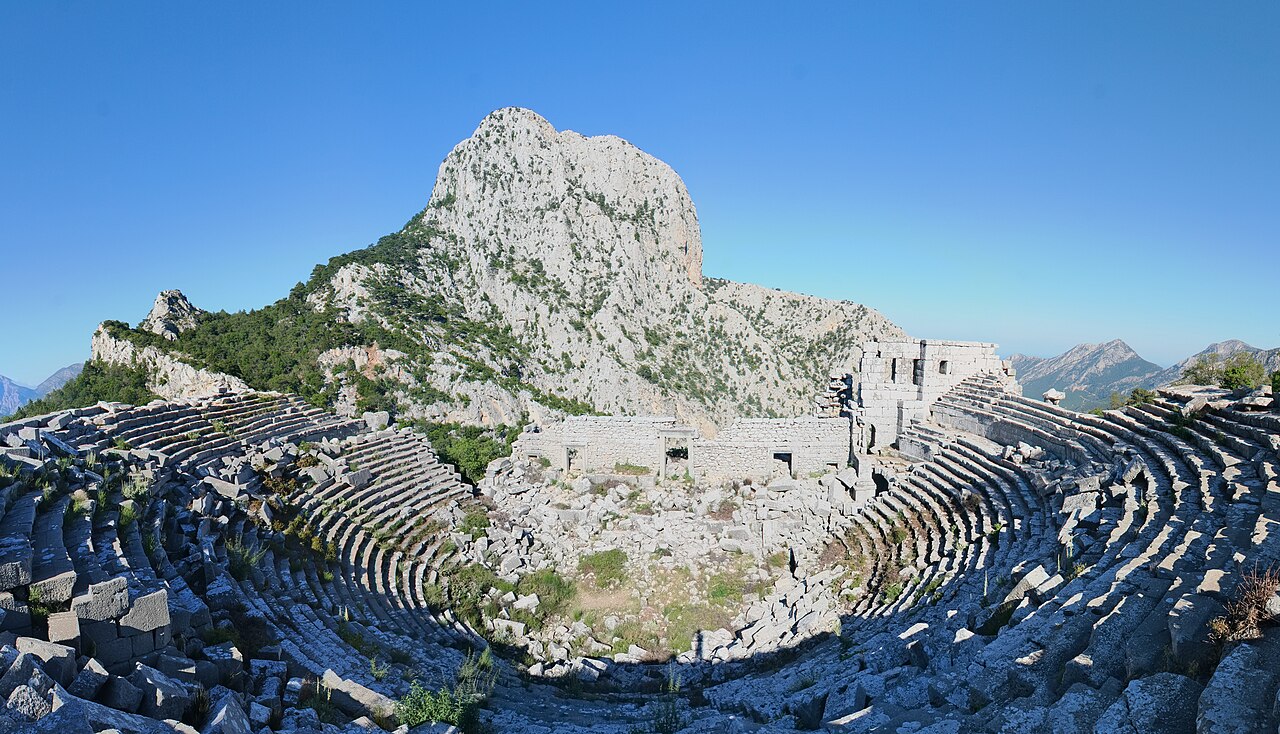
Termessos is an archaeological site in Antalya, Türkiye. Termessos stands at over 1,000 metres in a national park. Its people were Pisidians, with their own language. Most visitors spend 3-4 hours here. The free Lokali audio guide runs 6 minutes.
✓ Verified October 2026 · how we write these guides
Visitor facts
| Time needed | 3-4 hours |
|---|---|
| Lokali audio guide | 6 min · free |
| Type | Archaeological Site |
| Best for | History |
| Location | Antalya, Türkiye |
| Coordinates | 36.9836, 30.4636 |
| Languages | 45, in the Lokali app |
The story
Stop walking for a second and listen. Up here the noise is mostly wind moving through pine branches, and then nothing. A bird calls somewhere below the path. Your own breathing is loud, because the climb is steep and the air is thinner than at the coast. The ground is loose limestone and pine needles, and it smells of hot resin. Fallen blocks of cut stone lie among the trees, half covered in moss and dry leaves.
Termessos sits inside a national park in the mountains northwest of Antalya, at over 1,000 metres. A road brings you up through the forest to a parking area. From there a footpath climbs steadily to the ruins, and most people need around thirty minutes to reach the main area. It is a genuine walk, not a stroll. The reward is a city that almost nobody built over, in a setting that explains itself the moment you arrive.
The people who lived here were Pisidians. They were not Lycians, and they were not Greek colonists. Pisidia was the mountain country inland from this coast, and its towns had a reputation for independence and for fighting. They spoke their own language before Greek took over as the written one. Living at this height, behind cliffs, with one difficult approach road, was a deliberate strategy rather than an accident of geography.
Alexander the Great came this way during his campaign through Asia Minor, and Termessos is one of the places he did not take. Ancient accounts describe him arriving below the city, assessing the position, and deciding that a siege here would cost more than it was worth. He moved on. Walk up the last section of path and look back down the valley, and the reasoning becomes obvious. There is no easy way to bring an army up here.
The approach was defended by walls and towers. As you climb, watch for lines of masonry running across the slope and for the remains of a gateway on the old road. Blocks were cut and fitted without mortar, relying on weight and accuracy. In places you can see where the wall was built onto natural rock, so the cliff became part of the defence. Anyone attacking had to funnel into a narrow, overlooked space.
The theatre is the reason many people make this climb. It is cut into the hillside at the edge of a drop, and the seating faces a gap where the stage building has partly fallen away. Through that gap you look straight out at the mountain across the valley and at layers of ridges beyond it. Sit halfway up and stay a while. Few ancient theatres anywhere are placed with this much confidence.
Water was the city's central problem. There is no river up here and no reliable spring, so the inhabitants cut enormous cisterns into the bedrock and collected rain from roofs and paved surfaces. Several of them survive on the flat ground near the centre, with narrow mouths opening into deep chambers. Some are unfenced. Watch your step around them, and keep children close — the openings are easy to miss among the scrub.
Around the open area you will find the remains of civic buildings: a gymnasium and bath block with high standing walls, a council chamber, and terraces that once held temples and monuments. Trees now grow through most of it. Blocks lie exactly where they landed. The lack of reconstruction is part of the appeal. You are looking at collapse rather than at a restoration, and you have to piece the buildings together yourself.
Follow the signs to the necropolis and the site changes character. Hundreds of stone sarcophagi are scattered across the slopes among the pines, many tipped over, cracked, or with their heavy lids slid off. Some carry carved rosettes, shields or lion figures. Earthquakes and tomb robbers between them account for the disorder. Walking through it is strange and memorable — a whole hillside of broken stone coffins, with nobody else in sight.
One tomb stands apart. Cut into a rock face is a chamber with a relief of a horseman in armour, along with weapons and a shield. Tradition identifies it as the burial place of Alcetas, an officer of Alexander who ended up on the losing side of the wars that followed Alexander's death, and who died at Termessos. The carving is damaged and weathered, but the horse and rider are still readable in raking light.
The city was never destroyed by an enemy. The likeliest explanation for its end is an earthquake that broke the water system, after which living at this height stopped making sense. People moved down. The forest closed in. Today the national park around it protects wild goats, deer and birds of prey, and you may see or hear them on the walk. Early morning is the best time for both wildlife and cool air.
Termessos has never been fully excavated. Surveys and clearing work have been carried out, but most of the city still lies under soil, scrub and fallen stone. That is unusual for a site of this size in Türkiye. It also means the paths are informal and the signage is limited, so allow more time than the distances suggest. Inscriptions turn up on blocks in the undergrowth, many of them recording gifts made to the city by named citizens.
Before you start down, sit on a block near the theatre and do nothing for a few minutes. The wind is the loudest thing here. Below you the valley drops away, and the road you drove up is a thin line in the trees. People chose this hard, waterless ridge because it kept them free, and they held it against the most successful army of their age. Now the pines have it. Take your time on the path down.
Key facts
What to look for
Practical tips
Common questions
How long do you need at Termessos?
Plan 3-4 hours. That is the time most visitors spend at Termessos. The free Lokali audio guide runs 6 minutes and is made to listen to while you walk.
Is there a free audio guide to Termessos?
Yes — the Lokali app narrates Termessos free of charge in 50+ languages. No ticket, tour group or subscription, and it works offline once downloaded.
Where is Termessos?
Termessos is in Antalya, Türkiye, at 36.9836, 30.4636. Tap the map link on this page for directions.
What should you know before visiting Termessos?
Allow about thirty minutes for the steep climb from parking
What is Termessos known for?
Termessos stands at over 1,000 metres in a national park
What is the best time to visit Termessos?
Come early for cooler air and a chance of wildlife
On the map
Opens directions to Termessos from your location.
More to see in Antalya


Hear Termessos in your language
The full story, narrated, in 50+ languages. Download it before you go and it plays offline, at your own pace, with no ticket and no tour group.