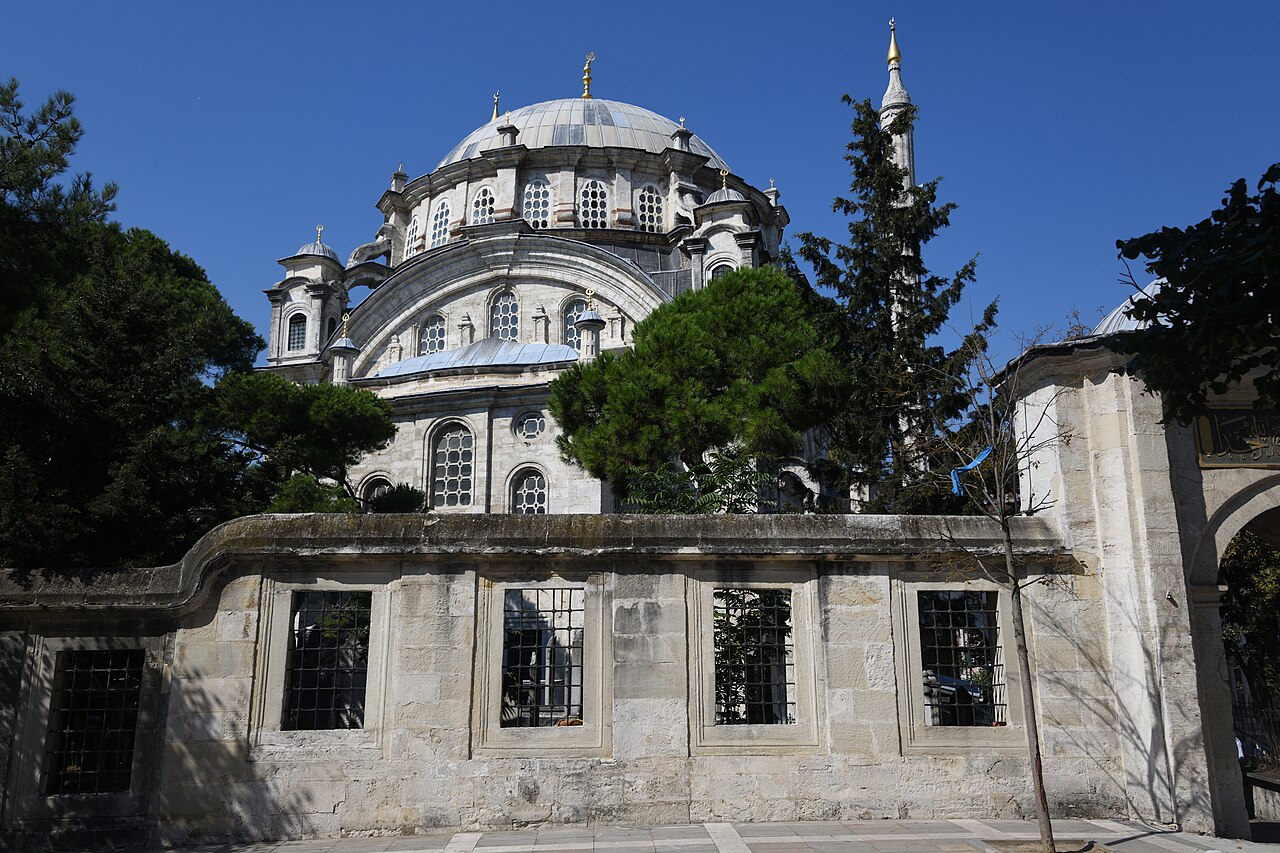
Selimiye Mosque is a mosque in Edirne, Türkiye. Completed in 1575 for Sultan Selim the Second. Architect Sinan finished it in his mid-eighties. Most visitors spend 45-90 min here. The free Lokali audio guide runs 6 minutes.
✓ Verified October 2026 · how we write these guides
Visitor facts
| Time needed | 45-90 min |
|---|---|
| Lokali audio guide | 6 min · free |
| Type | Mosque |
| Best for | Editors’ pick |
| Location | Edirne, Türkiye |
| Coordinates | 41.1456, 26.556 |
| Languages | 45, in the Lokali app |
The story
Long before you reach the door, the mosque has already found you. Its four minarets rise over Edirne like slim pencils, visible from the wheat plains far outside the city. Up close, stand a moment in the courtyard. Pigeons rattle up from the arcades, taps run at the ablution fountains, and the stone underfoot holds the day's heat. Then step inside, into one enormous breath of space. Almost nothing interrupts it. The dome hangs overhead on eight hidden supports, and light enters from every direction.
This is the Selimiye Mosque, finished in 1575 for Sultan Selim the Second, son of Suleiman the Magnificent. The sultan chose Edirne, not Istanbul, for his great imperial mosque. That decision puzzled some at the time, and historians still discuss it. Edirne had been the Ottoman capital before the conquest of Istanbul, a beloved royal city near the empire's European frontier. Whatever the reason, the choice gave this provincial city one of the most admired buildings in the history of architecture.
Selim the Second never prayed inside the finished building. He died late in 1574, months before the last stones were set, and the mosque opened under his son. Ottoman chroniclers link its funding partly to the conquest of Cyprus in 1571. Selim is a curious patron for a masterpiece. History mostly remembers him as a quiet ruler who left campaigning to his ministers. Yet his name is fixed to the skyline of Edirne, spoken daily by everyone who points at the horizon and says Selimiye.
The architect was Mimar Sinan, the most celebrated builder of the Ottoman Empire. Taken into the Janissary corps as a young man from a Christian family in Anatolia, he learned engineering on military campaigns, building bridges and siege works. He became chief imperial architect in 1538 and worked into his nineties. Mosques, bridges, baths, aqueducts, schools. Hundreds of structures across the empire carry his name. When he began the Selimiye, he was already in his late seventies, with nothing left to prove.
Tradition preserves a line attributed to Sinan in memoirs dictated to a friend. He is said to have called the Sehzade Mosque in Istanbul his apprenticeship, the mighty Süleymaniye his journeyman work, and the Selimiye his masterpiece. Whether the exact words are his, the ranking has stuck. Architects have travelled to Edirne to study this building for more than four centuries. Sinan reportedly wanted to prove Ottoman builders could raise a dome to rival Hagia Sophia's, a challenge he had carried for decades.
Look up and take your time. The dome spans roughly 31 metres and rises more than forty metres above the floor. Instead of resting on four huge piers, as earlier mosques did, it sits on eight slimmer ones, pushed outward toward the walls. The result is the point of the whole design. No forest of columns, no dark corners. Nearly the entire floor lies open under a single canopy of light. Windows circle the dome's base, so the ceiling brightens and dims with the passing clouds.
The four minarets are records in stone. Each rises about 71 metres, fluted like a reed, with three balconies for the call to prayer. Inside two of them, three separate spiral staircases wind around each other, so three muezzins could climb to different balconies without ever meeting. It is a quiet display of engineering skill. From the courtyard, notice how the minarets stand at the corners of the prayer hall itself, pulling the whole composition upward like tent poles.
Under the centre of the dome stands a square marble platform on small arches, the muezzin's gallery. It is an unusual position, directly beneath the dome's crown. Crouch near its base and look for a small carved tulip, upside down. Legend says the land here held a tulip garden, and its owner refused to sell unless the flower was remembered in the mosque. The inverted bloom, locals say, records both the tulip and the man's stubbornness. No document confirms the story. The carving is real.
Walk toward the far wall, the one facing Mecca. The prayer niche there, the mihrab, sits in its own half-domed recess, lined with Iznik tiles from the finest period of Ottoman ceramics. Their reds are famous. That particular coral red proved impossible to reproduce after the Iznik workshops declined, and later imitations never quite matched it. Beside the niche rises the marble minbar, the pulpit, its side panels carved into stone lacework so fine it looks woven.
Give the interior a slow circle. Calligraphy medallions carry the names of God, the Prophet Muhammad, and the early caliphs. Painted decoration climbs the pendentives and the dome, much of it renewed in later centuries. Under the sultan's private gallery, original decoration survives in quiet corners. Count the levels of windows as you turn. Row upon row pierce every wall, which is why the hall feels lit from within even late in the day.
The mosque was inscribed on the UNESCO World Heritage list in 2011, together with its külliye, the complex of buildings that served it. Part of that complex is under your feet. A covered bazaar called the arasta runs along the base of the terrace, and its shop rents once paid for the mosque's upkeep. Edirne rewards a longer wander too. Ottoman bridges, older mosques, and the famous oil-wrestling festival held each summer belong to the same city.
Before leaving, step back into the courtyard and find a spot against the cool arcade wall. Watch people cross the marble, small under the minarets. Sinan finished this building in his mid-eighties and lived to nearly one hundred. He asked to be remembered by his work. Four and a half centuries later, you stood inside his answer, on an ordinary day in Edirne, while the light kept changing overhead.
Key facts
What to look for
Practical tips
Common questions
How long do you need at Selimiye Mosque?
Plan 45-90 min. That is the time most visitors spend at Selimiye Mosque. The free Lokali audio guide runs 6 minutes and is made to listen to while you walk.
Is there a free audio guide to Selimiye Mosque?
Yes — the Lokali app narrates Selimiye Mosque free of charge in 50+ languages. No ticket, tour group or subscription, and it works offline once downloaded.
Where is Selimiye Mosque?
Selimiye Mosque is in Edirne, Türkiye, at 41.1456, 26.556. Tap the map link on this page for directions.
What should you know before visiting Selimiye Mosque?
Remove shoes and dress modestly before entering the prayer hall
What is Selimiye Mosque known for?
Completed in 1575 for Sultan Selim the Second
On the map
Opens directions to Selimiye Mosque from your location.
Hear Selimiye Mosque in your language
The full story, narrated, in 50+ languages. Download it before you go and it plays offline, at your own pace, with no ticket and no tour group.