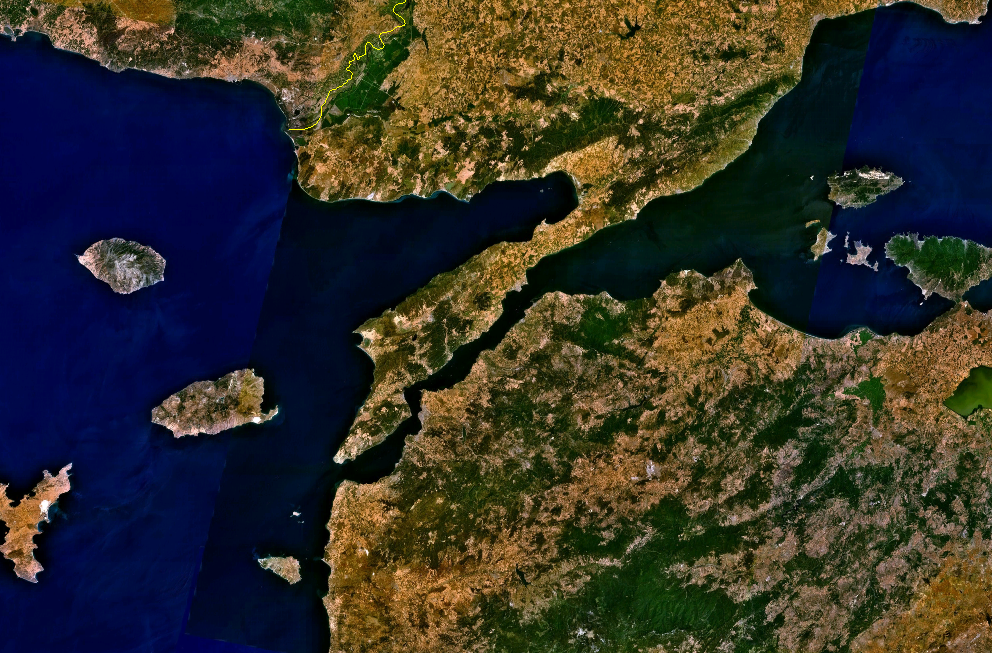
Gallipoli Peninsula
40.2417° N · 26.2811° E · Memorial Site
Gallipoli Peninsula is a memorial site in Çanakkale, Türkiye. Allied naval attack on the strait failed on 18 March 1915. Landings at Helles and Anzac Cove began 25 April 1915. Most visitors spend 4-6 hours here. The free Lokali audio guide runs 7 minutes.
✓ Verified October 2026 · how we write these guides
Visitor facts
| Time needed | 4-6 hours |
|---|---|
| Lokali audio guide | 7 min · free |
| Type | Memorial Site |
| Best for | History |
| Location | Çanakkale, Türkiye |
| Coordinates | 40.2417, 26.2811 |
| Languages | 45, in the Lokali app |
The story
The Aegean is rarely loud here. Waves fold onto narrow shingle beaches in a slow rhythm, wind moves through the pines, and gulls cross between the headlands. It is a quiet, handsome coastline — low green hills, clear water, small coves. That is the hardest thing to hold in your head. In 1915, this peninsula was one of the most violent places on earth. The calm around you is the aftermath of one of the fiercest campaigns of the First World War.
The Gallipoli Peninsula — Gelibolu in Turkish — forms the European shore of the Dardanelles, the narrow strait that connects the Aegean Sea toward Istanbul and the Black Sea. In 1915, that geography made it a target. Britain and France, at war with the Ottoman Empire, wanted to force the strait, reach the Ottoman capital, and open a supply route to their ally Russia. The plan promised to shorten the war. Instead it produced a campaign of nearly nine months — and no breakthrough at all.
The first attempt came by sea. On 18 March 1915, an Allied fleet of battleships pushed into the strait to silence the Ottoman forts. Mines and shore guns stopped them — several battleships were sunk or crippled in a single day. Turkey remembers 18 March as the day of the Çanakkale naval victory, and the small minelayer Nusret, which laid a decisive line of mines, is honoured to this day. After the naval failure, the Allies decided to land troops and take the peninsula on foot.
The landings came on 25 April 1915 — at Cape Helles on the peninsula's tip, and further north at a cove soon known as Anzac. Anzac stood for the Australian and New Zealand Army Corps, and for those two young nations the date became permanent — 25 April is still commemorated every year as Anzac Day. The terrain fought the invaders from the first hour: narrow beaches backed by steep ridges and ravines, defended from above. The front lines formed in those first days and barely moved for the rest of the campaign.
On the ridges above Anzac Cove, an Ottoman colonel named Mustafa Kemal led his 57th Regiment into the counterattacks that held the high ground. His order that day became legendary in Turkey for its bluntness about sacrifice, and the regiment fought until it was almost entirely destroyed. A memorial to the 57th stands on the battlefield now. Kemal survived Gallipoli, rose through the war that followed, and later founded the Turkish Republic, taking the name Atatürk. His path to leading a nation began on these hills.
The fighting settled into trenches, in places only metres apart. At posts along the Anzac line, soldiers could throw grenades into the opposing trench — and in quieter spells, they sometimes threw tins of food and tobacco instead. A brief truce in May 1915 let both sides bury their dead between the lines, and some men left it with a changed view of the enemy. That strange respect became one of the campaign's legacies. It is why Turkish, Australian, and New Zealand ceremonies here are often held together.
In August 1915, the Allies tried to break the deadlock with new landings at Suvla Bay and assaults on the heights — at Lone Pine, the Nek, and Chunuk Bair. New Zealand troops briefly held the summit of Chunuk Bair, one of the few moments Allied soldiers looked down on the strait that was the campaign's whole objective. Ottoman counterattacks, again led by Mustafa Kemal, retook the hill. The offensives failed with immense losses on both sides. After August, no one broke through again.
Battle was only part of the ordeal. Summer brought heat, flies, and disease that swept through the trenches; water on the Allied side was scarce and shipped in. Late November brought a flood and then a blizzard that killed men in the trenches. Ottoman soldiers endured the same ground and the same weather. Disease and exposure claimed a great share of the campaign's losses — in total, the two sides together counted hundreds of thousands of killed and wounded.
The end was the campaign's best-run operation. In December 1915 and January 1916, the Allies evacuated the peninsula in stages, at night, under elaborate deception — including rifles rigged to fire on their own with dripping water weights, to convince the defenders the trenches were still manned. The withdrawal was completed with remarkably few casualties. For Turkey, the campaign sealed a great defensive victory. For the Allies, it became a lasting lesson in courage spent on a flawed plan.
Today the peninsula is a memorial landscape. Dozens of cemeteries and monuments lie among the pines — small, immaculate, and quiet. Near the southern tip at Morto Bay stands the Çanakkale Martyrs' Memorial, a vast four-pillared monument honouring the Ottoman soldiers who died here. Lone Pine carries the Australian memorial, Chunuk Bair the New Zealand one. At Anzac Cove, dawn services each 25 April draw thousands of visitors who arrive in darkness and wait together for first light.
Near Anzac Cove stands a memorial carved with words of consolation addressed to the mothers of foreign soldiers — telling them their sons, buried in this soil, are at peace in a friendly country. The words are attributed to Atatürk in the 1930s, and historians debate their exact origin. But the sentiment matches how the whole peninsula is kept. The cemeteries of all nations are tended with equal care, and visitors from Turkey, Australia, and New Zealand mourn here side by side.
Wherever you are standing — a beach, a ridge, a cemetery lawn — take a moment without commentary. Read a few headstones and note the ages. Look at the ground itself: how steep the slopes are, how exposed. Then listen again to the ordinary sounds — wind in the pines, waves on the shore. They are the same sounds the soldiers heard in the quiet hours between bombardments. More than a century has passed. The land has grown green again, and the quiet itself is now the memorial. You are part of keeping it.
Key facts
What to look for
Practical tips
Common questions
How long do you need at Gallipoli Peninsula?
Plan 4-6 hours. That is the time most visitors spend at Gallipoli Peninsula. The free Lokali audio guide runs 7 minutes and is made to listen to while you walk.
Is there a free audio guide to Gallipoli Peninsula?
Yes — the Lokali app narrates Gallipoli Peninsula free of charge in 50+ languages. No ticket, tour group or subscription, and it works offline once downloaded.
Where is Gallipoli Peninsula?
Gallipoli Peninsula is in Çanakkale, Türkiye, at 40.2417, 26.2811. Tap the map link on this page for directions.
What should you know before visiting Gallipoli Peninsula?
Allow a full day; sites are spread across the peninsula
What is Gallipoli Peninsula known for?
Allied naval attack on the strait failed on 18 March 1915
On the map
Opens directions to Gallipoli Peninsula from your location.
More to see in Çanakkale


Hear Gallipoli Peninsula in your language
The full story, narrated, in 50+ languages. Download it before you go and it plays offline, at your own pace, with no ticket and no tour group.