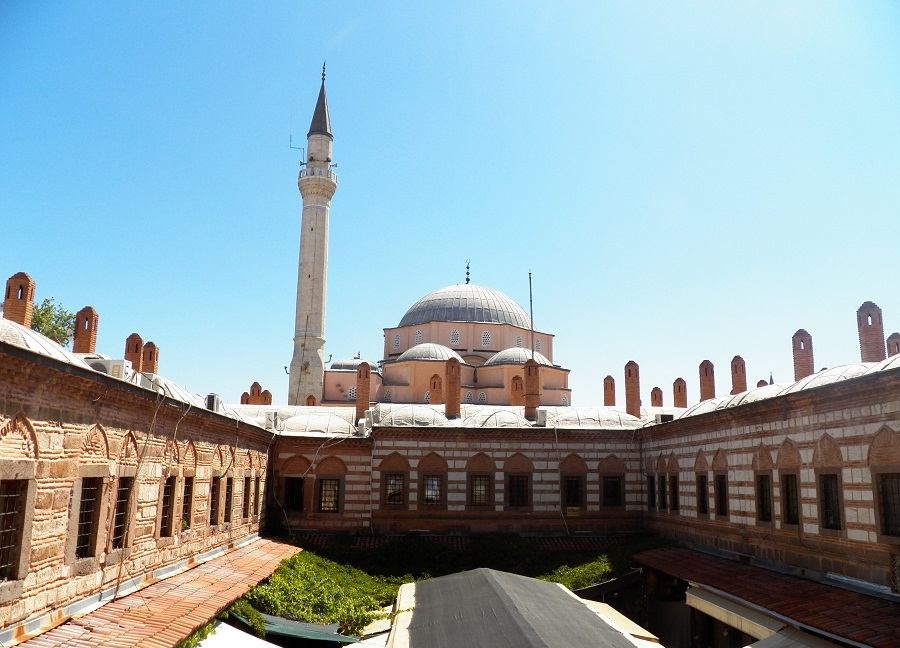
Photo: Olgunkin · CC BY-SA 3.0 · Wikimedia Commons
Kemeraltı Bazaar is a bazaar in Selçuk, Türkiye. Main street traces a harbour filled from the seventeenth century. Kızlarağası Han caravanserai was completed in 1744. Most visitors spend 2-3 hours here. The free Lokali audio guide runs 6 minutes.
✓ Verified October 2026 · how we write these guides
Visitor facts
| Time needed | 2-3 hours |
|---|---|
| Lokali audio guide | 6 min · free |
| Type | Bazaar |
| Best for | Authentic finds |
| Location | Selçuk, Türkiye |
| Coordinates | 38.4189, 27.1287 |
| Languages | 45, in the Lokali app |
The story
Close your eyes for three seconds and just listen. A metal grinder shrieks somewhere to your left. Tea glasses clink on a swinging tray. A vendor calls out prices in a singsong voice, and roasting coffee drifts past, followed by grilled meat and soap. Overhead, awnings and vine leaves filter the sunlight into patches. Now open your eyes. This is Kemeraltı, the market heart of İzmir, and it has been trading, arguing, and eating in these lanes for around four hundred years.
Here is the secret hiding in plain sight. The main artery, Anafartalar Street, bends in a long, smooth arc, and streets almost never curve like that by accident. The arc follows the shoreline of a vanished harbour. Ships once anchored where shops now stand. From the seventeenth century onward, the inner bay was gradually filled in, and the market spread across the new land. As you walk that curve today, you are strolling along an old waterline.
Kemeraltı grew into the trading centre of a city then known to the world as Smyrna, one of the great ports of the Mediterranean. Caravans arrived from inland Anatolia and from Persia, loaded with silk, cotton, dried figs, and raisins. European merchants kept warehouses near the water. Goods changed hands here between camel drivers and sea captains. The bazaar was the hinge between two worlds — the caravan roads of Asia and the shipping lanes of Europe.
To feel that era, step into the Kızlarağası Han, a caravanserai completed in 1744. It was funded by the chief eunuch of the Ottoman palace in Istanbul, one of the most powerful men in the empire. Merchants slept upstairs while animals and cargo filled the courtyard below. Today the courtyard holds cafes, and the arcades sell jewellery, antiques, and souvenirs. Sit under the arches with a Turkish coffee and let the stone geometry do the talking.
A few steps away rises the Hisar Mosque, the largest in İzmir, founded in the sixteenth century. Its name means fortress, because a castle guarding the old inner harbour once stood nearby. Outside, it is broad and calm. Inside, it is one of the city's finest rooms, with painted decoration and detailed woodwork. Porters and shopkeepers slip in to pray between sales. Visitors are welcome outside prayer times. Dress modestly, remove your shoes, and take your time.
Now find Havra Street — the name means Synagogue Street. After 1492, Jews expelled from Spain found refuge in the Ottoman Empire, and many settled in Smyrna. Their community built a remarkable cluster of synagogues here, standing almost wall to wall, some dating back centuries. Several have been restored and can be visited. The street itself is a loud food market, selling fish, greens, and pickles. Few places in the world layer daily commerce and heritage this closely.
Eating is half the reason to come. Try boyoz, a dense, oily pastry of Sephardic origin, pulled into layers and eaten warm with a hard-boiled egg — İzmir's classic breakfast. Try kumru, a toasted sandwich with sausage and cheese that locals defend fiercely. Coffee roasters grind to order, and lokma stalls fry sweet dough rings in bubbling oil. Follow the queues of local shoppers. In a market this old, the crowd knows exactly where the good things are.
At the upper edge of the bazaar lies something far older — the Agora of Smyrna, the marketplace of the Roman city. An earthquake wrecked Smyrna in 178 AD, and the emperor Marcus Aurelius helped fund the rebuilding. What survives best is underground: long vaulted galleries with rows of arches, cool and dim, where an ancient water channel still runs. Standing down there, you realise this neighbourhood has been doing business continuously for nearly two thousand years.
Back in the lanes, notice how trades cluster together, a habit inherited from the Ottoman guilds. One street sells wedding dresses, another buttons and thread, another gold, another spices and nuts. Coppersmiths hammer in one corner, while shoe shops fill a whole block. This is not staged for visitors — it is how the market organises itself. If you need anything on Earth, someone in Kemeraltı probably sells it, and their neighbour sells the same thing cheaper.
Watch the tea runners. They move through the crowds carrying trays that swing from three chains, loaded with tulip-shaped glasses. Shopkeepers order by shouting down the lane, and empty glasses wait on doorsteps for collection. Thousands of shops run on this fuel. Bargaining is normal for souvenirs and gold, less so for food. Accept tea if a seller offers it. It costs you nothing, obliges you to nothing, and slows the day down pleasantly.
Do not try to navigate perfectly, because getting lost here is the actual attraction. Use two anchors. At the seaward end stands the clock tower of Konak Square, built in 1901, the symbol of İzmir. At the upper end lies the Agora. Between them stretch the covered passages, courtyards, and mosque yards of the bazaar. Weekday mornings are calmest. Fridays around midday fill the mosque courtyards, and many shops rest on Sundays.
Before you leave the lanes, stop once more under an awning and listen again. The grinder, the tray, the singsong prices — the sounds have outlived empires, fires, and the harbour itself. The sea has moved away, but the tide of people still comes in every morning. You joined it today, one more shopper on the old waterline. Somewhere a glass of tea is landing on a doorstep. That small clink is the true bell of İzmir.
Key facts
What to look for
Practical tips
Common questions
How long do you need at Kemeraltı Bazaar?
Plan 2-3 hours. That is the time most visitors spend at Kemeraltı Bazaar. The free Lokali audio guide runs 6 minutes and is made to listen to while you walk.
Is there a free audio guide to Kemeraltı Bazaar?
Yes — the Lokali app narrates Kemeraltı Bazaar free of charge in 50+ languages. No ticket, tour group or subscription, and it works offline once downloaded.
Where is Kemeraltı Bazaar?
Kemeraltı Bazaar is in Selçuk, Türkiye, at 38.4189, 27.1287. Tap the map link on this page for directions.
What should you know before visiting Kemeraltı Bazaar?
Try boyoz pastry with a hard-boiled egg for breakfast
What is Kemeraltı Bazaar known for?
Main street traces a harbour filled from the seventeenth century
What is the best time to visit Kemeraltı Bazaar?
Come weekday mornings; many shops rest on Sundays
On the map
Opens directions to Kemeraltı Bazaar from your location.
More to see in Selçuk


Hear Kemeraltı Bazaar in your language
The full story, narrated, in 50+ languages. Download it before you go and it plays offline, at your own pace, with no ticket and no tour group.