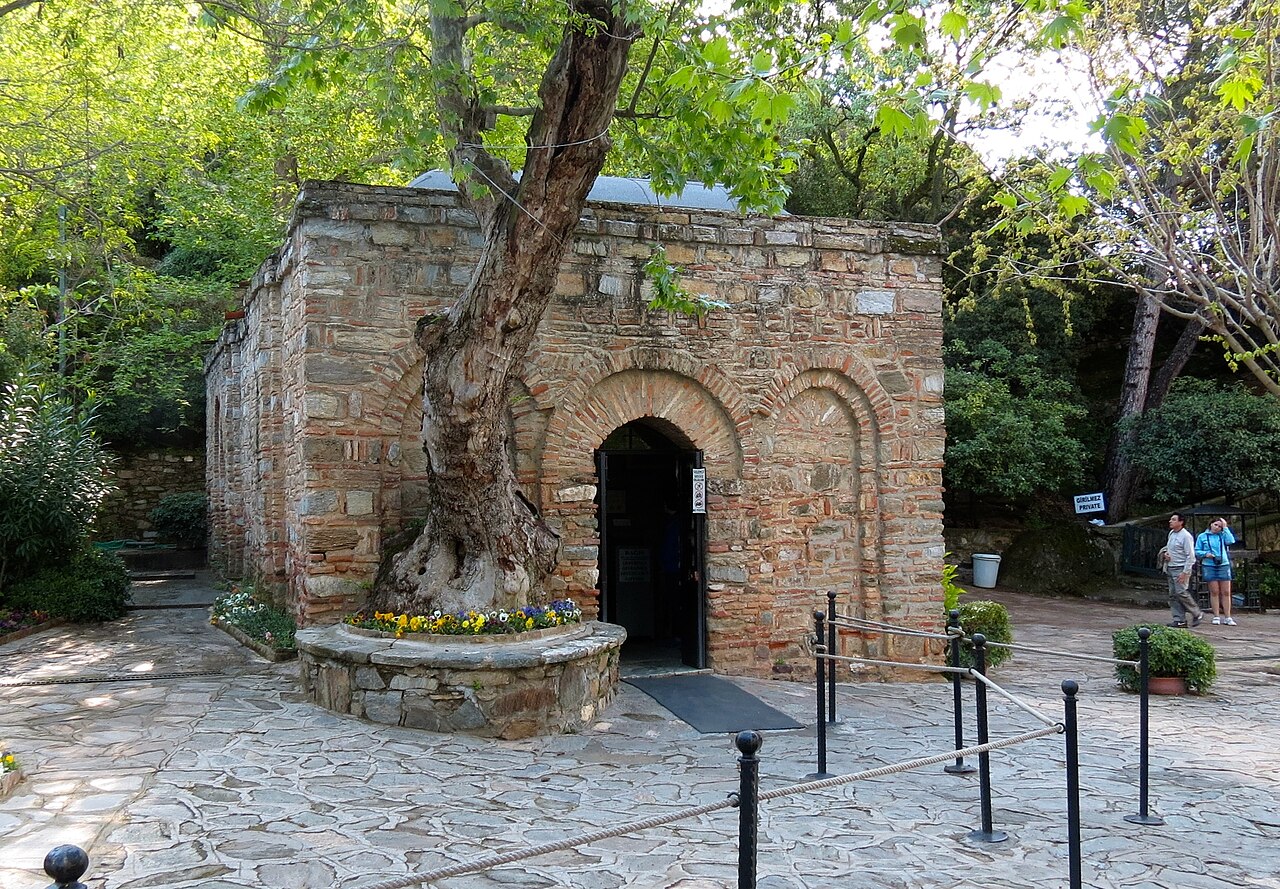
House of the Virgin Mary
37.9125° N · 27.3333° E · Religious Site
House of the Virgin Mary is a religious site in Selçuk, Türkiye. A German nun's published visions guided the 1891 expedition. Pope Paul the Sixth prayed here in 1967. Most visitors spend 1-1.5 hours here. The free Lokali audio guide runs 6 minutes.
✓ Verified October 2026 · how we write these guides
Visitor facts
| Time needed | 1-1.5 hours |
|---|---|
| Lokali audio guide | 6 min · free |
| Type | Religious Site |
| Best for | Authentic finds |
| Location | Selçuk, Türkiye |
| Coordinates | 37.9125, 27.3333 |
| Languages | 45, in the Lokali app |
The story
The road climbs through pine forest to reach this place, and the air keeps the coolness of the climb. You are high on a wooded hill above the ruins of Ephesus, a hill long known as Nightingale Mountain. Birds carry on in the branches. Water runs somewhere below the terrace. The house itself is small, built of rough brown stone, with a single low doorway and a bell beside it. People speak quietly here without being asked. The place teaches its own volume.
The tradition attached to this house is easily told. Christian scripture records that Jesus, dying on the cross, entrusted his mother Mary to a beloved disciple. Early Christian memory associated that disciple, John, with Ephesus, where he was believed to have lived and died. From those two threads grew a belief. That Mary came to Ephesus in John's care, and that she spent her final years in a small house on this hill, away from the city below.
It is worth saying plainly what is known and what is believed. No ancient text names this hillside. An old rival tradition places the end of Mary's life in Jerusalem, where a tomb is also venerated. The Catholic Church has never issued a formal ruling declaring this house authentic. What the Church has done is treat the shrine with respect, bless its pilgrimages, and send three popes here to pray. Belief and evidence sit side by side on this terrace, and the shrine does not pretend otherwise.
The modern story begins, surprisingly, in a sickroom in Germany. Anne Catherine Emmerich, a bedridden Augustinian nun who never travelled, described detailed visions of Mary's last home near Ephesus. A stone house on a hill, its layout, its distance from the city. The writer Clemens Brentano recorded the visions, and they were published in the years after her death in 1824. For decades the account remained simply a book among books.
Then, in 1891, priests from Izmir decided to test the book against the ground. An expedition led by Lazarist fathers searched these hills with the text in hand. They found the ruin of a small stone building matching the described location, with a spring nearby. They also found something else. Orthodox Christian villagers from Şirince, in the valley beyond, already held a pilgrimage to this spot each August, calling it Panaya Kapulu, the doorway of the All-Holy. The discovery was, in part, a rediscovery of local memory.
Archaeologists who examined the site judged that the visible walls stood on much older foundations, with some material reaching back toward the first centuries of the Christian era. The building you enter today is a restored chapel, rebuilt above those old stones in the twentieth century. Inside, look for a painted red line running along the lower walls. Below the line, the masonry is original, found in place. Above it, restoration. It is an unusually honest piece of architecture.
The papal visits are documented history. Pope Paul the Sixth prayed here in 1967, the first pope to do so. John Paul the Second celebrated at the shrine in 1979. Benedict the Sixteenth said Mass on this terrace in 2006, before a crowd spread among the trees. Whatever the archaeology finally proves or never proves, the shrine has entered the devotional life of the Catholic Church at the highest level, and the visits marked the hill permanently.
This is also a Muslim place of prayer, which surprises some visitors. Mary, called Meryem in Turkish, is honoured in Islam as the mother of the prophet Jesus, and an entire chapter of the Quran carries her name. She is mentioned by name in the Quran more often than in the New Testament. Muslim visitors come here to ask for her intercession, especially for children and health. On a busy day, the queue outside the chapel holds several faiths at once, without ceremony about it.
Inside, the chapel is a single small room, dim and plain, with an altar and a statue of Mary in the apse niche. Candlelight does most of the decorating. Visitors pass through in a slow file, some praying, some simply looking. A smaller side room is traditionally associated with Mary's sleeping place. No photographs, no noise, a minute or two at most. Many people say afterwards that the smallness itself is what moved them.
Below the chapel, taps set into a stone wall run with water from the spring, and pilgrims of every kind queue to drink and to fill bottles. Nearby stretches the wishing wall, a frame covered in thousands of knotted scraps, paper napkins, ribbons, and tissues, each one carrying somebody's hope in ink or in memory. The custom is shared across religions in this part of the world. Read a few if the writing faces outward. They are the shrine's true guest book.
The shrine keeps a living calendar. Mass is celebrated regularly in the chapel, and every year on 15 August, the feast of the Assumption, pilgrims gather here in numbers, continuing the August pilgrimage the Şirince villagers kept long before the site was famous. Ephesus below adds its own weight to the story. In the year 431, a council of the early Church met in that city and confirmed for Mary the title Mother of God, in a church that carried her name.
Before you leave, step away from the queue and stand under the olive trees at the terrace edge. Light comes through the leaves in small moving pieces. Somewhere behind you, the taps run, and the forest continues its ordinary business. Whether you came as a pilgrim, a historian, or a traveller filling an afternoon, the hill offers everyone the same two gifts. Cool air, and a long moment of quiet. Take both with you down the mountain.
Key facts
What to look for
Practical tips
Common questions
How long do you need at House of the Virgin Mary?
Plan 1-1.5 hours. That is the time most visitors spend at House of the Virgin Mary. The free Lokali audio guide runs 6 minutes and is made to listen to while you walk.
Is there a free audio guide to House of the Virgin Mary?
Yes — the Lokali app narrates House of the Virgin Mary free of charge in 50+ languages. No ticket, tour group or subscription, and it works offline once downloaded.
Where is House of the Virgin Mary?
House of the Virgin Mary is in Selçuk, Türkiye, at 37.9125, 27.3333. Tap the map link on this page for directions.
What should you know before visiting House of the Virgin Mary?
Keep voices low inside the small chapel
What is House of the Virgin Mary known for?
A German nun's published visions guided the 1891 expedition
What is the best time to visit House of the Virgin Mary?
Fill a bottle at the spring taps below the chapel
On the map
Opens directions to House of the Virgin Mary from your location.
More to see in Selçuk


Hear House of the Virgin Mary in your language
The full story, narrated, in 50+ languages. Download it before you go and it plays offline, at your own pace, with no ticket and no tour group.