Hippodrome of Constantinople
41.0058° N · 28.9758° E · Historic Square
Hippodrome of Constantinople is a historic square in Istanbul, Türkiye. Egyptian obelisk raised here by Theodosius in 390. Serpent Column cast after the Battle of Plataea, 479 BC. Most visitors spend 30-45 min here. The free Lokali audio guide runs 7 minutes.
✓ Verified October 2026 · how we write these guides
Visitor facts
| Time needed | 30-45 min |
|---|---|
| Lokali audio guide | 7 min · free |
| Type | Historic Square |
| Best for | History |
| Location | Istanbul, Türkiye |
| Coordinates | 41.0058, 28.9758 |
| Languages | 45, in the Lokali app |
The story
Stand still and listen to the square — footsteps on stone, pigeons, a distant tram. Now imagine the same space filled wall to wall with a roaring crowd. For roughly a thousand years, this was the loudest place in Constantinople. Four-horse chariots pounded down the straight where you are standing, cornered hard at each end, and came thundering back. Spectators screamed for their teams from tiered stone seats that rose all around you. The stadium is gone. The shape of it is still under your feet.
This is the Hippodrome of Constantinople — hippodrome is Greek for horse course. A racing arena stood here from the city's early days, and when Constantine the Great refounded the city as his capital in the fourth century, he enlarged the arena to imperial scale. Estimates of its capacity vary, but it held tens of thousands. The modern square, called Sultanahmet Square or At Meydanı — the Square of Horses in Turkish — preserves the old outline. The long open space you see follows the ancient racetrack almost exactly.
Picture the layout. Down the centre of the track ran a long spine barrier called the spina, decorated with monuments, statues, and trophies gathered from across the empire. Chariots raced around it — seven laps, counterclockwise, with crashes most likely at the tight turns. The emperor watched from an imperial box connected directly to the Great Palace, so he could appear before the people without crossing a street. Races were free to attend. This was where ruler and ruled actually saw each other.
The fans organized themselves into factions named after team colours — above all the Blues and the Greens. They were part sports club, part political party, part street gang. Emperors courted them, feared them, and sometimes fell because of them. In 532, the factions united against Emperor Justinian in the Nika riots. The uprising burned much of the city centre, including the earlier church on the site of Hagia Sophia. It ended here, in this arena, when imperial troops trapped the rioters and killed them by the thousands.
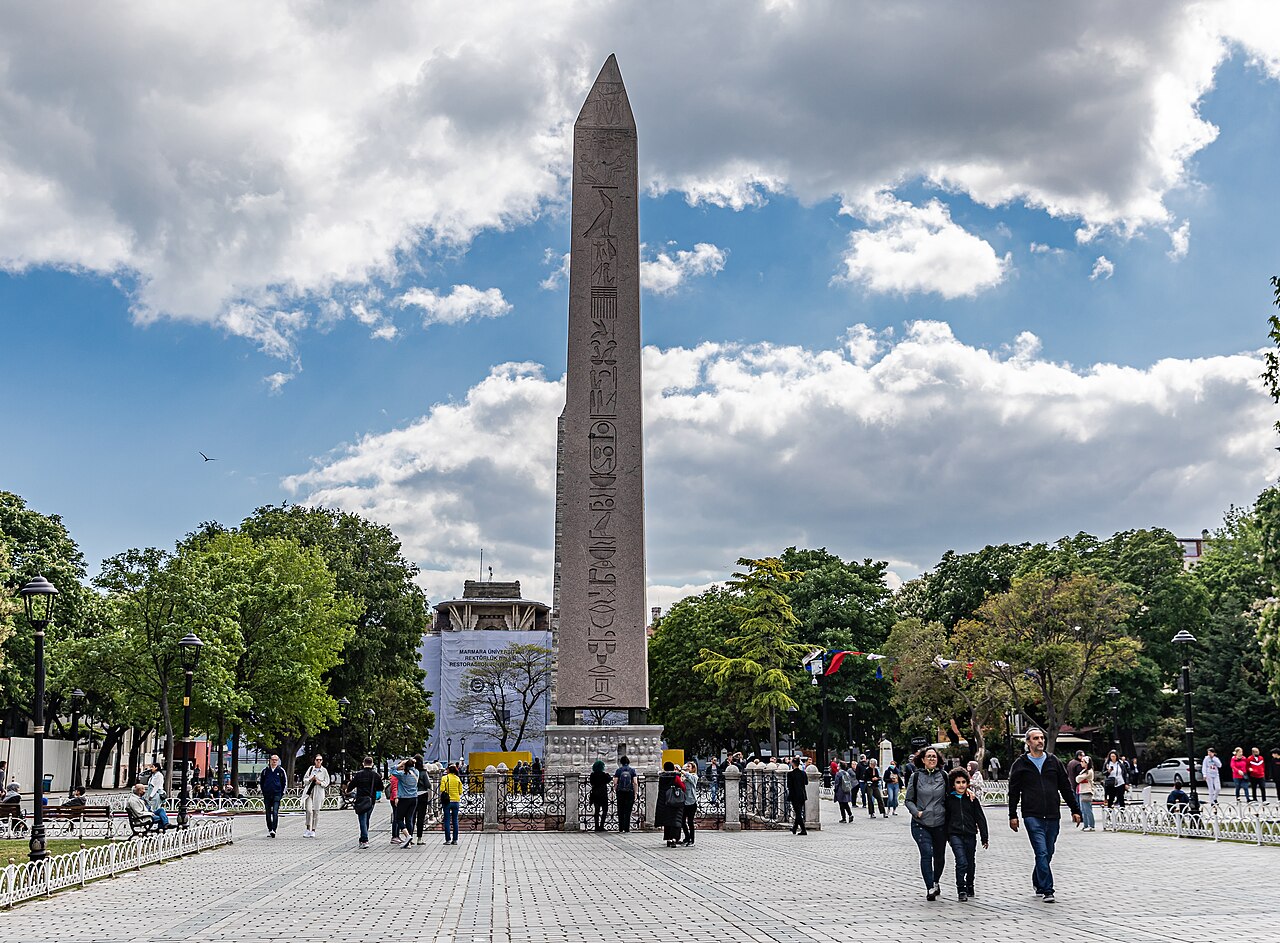
Three monuments from the spina still stand, and the oldest is astonishing. The Egyptian obelisk at the centre of the square was carved more than three thousand years ago for the pharaoh Thutmose the Third, and originally stood at the temple of Karnak. Emperor Theodosius had it shipped here and raised on a carved marble base in 390. The pink granite still shows crisp hieroglyphs praising the pharaoh. It may be the oldest human-made object standing anywhere in Istanbul.
Spend time with the marble base under the obelisk, because it is a document. Its carved panels show Theodosius and his court watching the races from the imperial box — spectators, dancers, musicians, and kneeling envoys offering tribute. One panel shows the obelisk itself being hauled upright with ropes and winches — a stone picture of its own installation. The carving is worn but readable. You are looking at the Hippodrome as its own audience saw it, sixteen centuries ago.
A few steps away stands a twisted bronze stump — the Serpent Column. It is older than the city itself. Greek cities cast it after their victory over the Persians at Plataea in 479 BC, and set it up at the sanctuary of Delphi as a thanks-offering. Three intertwined bronze serpents rose from the ground and once supported a golden vessel. Constantine brought the column to his new capital. The serpent heads survived into the Ottoman era, then were lost — a surviving fragment of one is kept in a museum in the city.
At the square's far end rises the third monument, the Walled Obelisk — a rough tower of stone blocks. It once looked entirely different. Emperor Constantine the Seventh restored it in the tenth century and sheathed it in gilded bronze plates that caught the sun. Crusaders later stripped the bronze, reportedly melting it down for coin. What remains is the bare masonry core, pitted by weather. Young Ottoman soldiers — janissaries — are said to have climbed it to show off their skill and daring.
The Hippodrome's greatest treasures left by force. In 1204, the army of the Fourth Crusade sacked Constantinople — a Christian army looting a Christian capital. Among the plunder were four gilded bronze horses that stood above the starting gates of this arena. The crusaders shipped them to Venice, where they were mounted on the facade of Saint Mark's Basilica. They remain in Venice to this day — the originals now kept indoors, with replicas outside. The finest surviving sculpture of this square lives over a thousand kilometres away.
Under the Ottomans, racing ended but the space survived. At Meydanı hosted horse exercises, ceremonies, festivals, and grand wedding celebrations for princes that ran for days, with acrobats and fireworks. The Blue Mosque rose along one side in the early seventeenth century, and stone from the ruined stands found its way into new buildings, as it had for centuries. At the north end, a domed fountain arrived in 1900 — a gift from the German Kaiser Wilhelm the Second to the Ottoman sultan, its ceiling lined with gold mosaic.
One massive piece of the original structure hides in plain sight. Walk to the southern, curved end of the square and look down the slope behind it. The huge brick substructure there is the sphendone — the vaulted platform that supported the curved end of the seating over uneven ground. Its arches are Roman engineering at full strength, still bearing weight after so many centuries. Most visitors never walk the extra hundred metres to see it. Do it — this is the closest you can get to touching the stadium itself.
Finish anywhere along the long axis of the square. The seats are gone, the marble is scattered across three empires, and grass grows where the turning posts stood. Yet the space still does its old job: it gathers people. Vendors sell roasted corn, children chase pigeons, tour groups drift between the monuments. Stand on the worn stones, look down the full length of the ancient track, and let the modern square and the vanished arena occupy the same view.
Key facts
What to look for
Practical tips
Common questions
How long do you need at Hippodrome of Constantinople?
Plan 30-45 min. That is the time most visitors spend at Hippodrome of Constantinople. The free Lokali audio guide runs 7 minutes and is made to listen to while you walk.
Is there a free audio guide to Hippodrome of Constantinople?
Yes — the Lokali app narrates Hippodrome of Constantinople free of charge in 50+ languages. No ticket, tour group or subscription, and it works offline once downloaded.
Where is Hippodrome of Constantinople?
Hippodrome of Constantinople is in Istanbul, Türkiye, at 41.0058, 28.9758. Tap the map link on this page for directions.
What should you know before visiting Hippodrome of Constantinople?
Walk behind the curved south end to see the sphendone arches
What is Hippodrome of Constantinople known for?
Egyptian obelisk raised here by Theodosius in 390
What is the best time to visit Hippodrome of Constantinople?
Visit early or late; midday brings the biggest crowds
On the map
Opens directions to Hippodrome of Constantinople from your location.
More to see in Istanbul


Hear Hippodrome of Constantinople in your language
The full story, narrated, in 50+ languages. Download it before you go and it plays offline, at your own pace, with no ticket and no tour group.