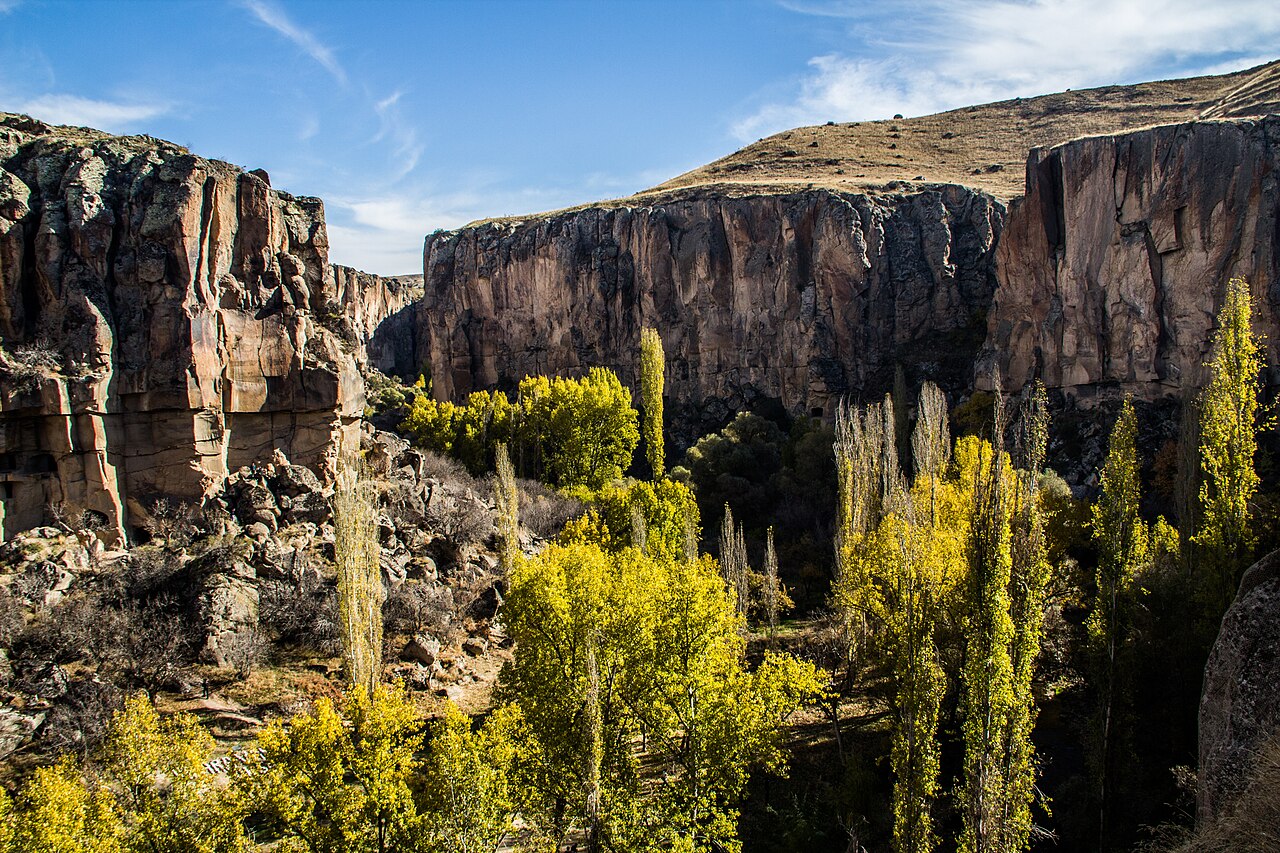
Ihlara Valley is a canyon in Aksaray, Türkiye. Gorge runs about 14 kilometres from Ihlara to Selime. Carved by the Melendiz stream through Mount Hasan's volcanic rock. Most visitors spend 3-4 hours here. The free Lokali audio guide runs 6 minutes.
✓ Verified October 2026 · how we write these guides
Visitor facts
| Time needed | 3-4 hours |
|---|---|
| Lokali audio guide | 6 min · free |
| Type | Canyon |
| Best for | Photography |
| Location | Aksaray, Türkiye |
| Coordinates | 38.25, 34.3086 |
| Languages | 45, in the Lokali app |
The story
The sound is what nobody expects: running water. After the dry plateaus of Cappadocia, you descend into Ihlara and hear a river — the Melendiz, moving quick and shallow over stones, threaded with birdsong. Poplars and willows crowd its banks. Frogs call from the reeds. The air is cooler down here, greener, damp at the edges. Above you, cliffs of grey and rose rock rise steeply on both sides, closing out the plateau entirely. This is a canyon with a garden at the bottom of it.
Ihlara Valley cuts through the plateau for roughly 14 kilometres, from the village of Ihlara to Selime, in Aksaray province at the western edge of Cappadocia. The Melendiz stream carved it, cutting down through layers of volcanic rock laid by nearby Mount Hasan, the broad volcano visible on the horizon. In places the walls rise around a hundred metres. The gorge is narrow enough that morning and evening shadows fill it quickly, and the river's sound follows you the entire way.
The classic entrance is from the rim: a long staircase — several hundred steps — descending the cliff face to the valley floor. Going down, your knees do the complaining; coming back up is the real workout. There are gentler entrances at the villages along the way. Once at the bottom, the walking is easy — flat paths, wooden footbridges crossing and recrossing the stream, and benches in the shade. Distances between sights are short, and the water keeps you company throughout.
Byzantine monks found what they needed in this gorge: water, seclusion, and soft rock, hidden from the open plateau. From roughly the seventh century onward, communities carved churches, cells, and hermitages into the cliffs. Dozens of rock-cut churches survive along the valley, and local tradition claims there were once around a hundred. The valley became a monastic corridor — you could walk its full length passing from sanctuary to sanctuary, ledge to ledge, without ever leaving the sound of the stream.
A number of churches are open, reached by short climbs from the valley floor. Their frescoes are distinctive. Some follow the polished Byzantine style of the capital; others show a rougher local hand — flat figures, bold outlines, colours from earth pigments — and scholars still debate the influences behind them. Painted angels, saints, and Gospel scenes look down from low ceilings. Many faces are damaged; many more survive. Some interiors are dim, so a phone light helps you find details.
Church names here are wonderfully domestic, given by villagers long after the painters were gone. Ağaçaltı, the Church Under the Tree, stands near the main stairway. Yılanlı, the Church of the Snakes, is named for a fresco of serpents punishing sinners. Sümbüllü, the Hyacinth Church, takes its name from the flowers growing on its slope. The names mix Turkish village life with Byzantine painting — two eras sharing one doorway, which is the valley's story in miniature.
Walking the full valley takes a comfortable half day. The route passes Belisırma, a hamlet at the midpoint where riverside restaurants set tables on wooden platforms over the water. Trout, gözleme — thin stuffed flatbread — and cold drinks arrive; ducks patrol between the table legs. It is an unhurried place. Many walkers turn back here, while the determined continue downstream toward Selime. The path stays mostly level, but summer middays get hot even beside the water. Morning is the best window.
At the valley's north end waits its grandest single monument: Selime Monastery, with halls of cathedral scale carved into a huge ridge of rock. Its spaces include a church with rock-cut columns, kitchens, stables, and chambers linked by steep tunnels. From its terraces the view runs back down the gorge. Even if you do not walk the whole valley, Selime is worth reaching by road. A persistent local story claims a famous space film was shot here. It was not — but the scenery explains why people believe it.
The valley is a wildlife corridor as much as a monument. Watch for kestrels riding the cliff updrafts, and listen for woodpeckers among the poplars. Lizards bask on fallen boulders; the stream holds fish and frogs. In spring, wildflowers crowd the banks. In autumn, the poplars turn pale gold and drop leaves into the current. Because the gorge is deep and watered, it keeps its own climate — softer, shadier, and several degrees kinder than the plateau above. The monks noticed. So will you.
People still farm the valley floor as they have for centuries. Small plots of vegetables and fruit trees line the flatter stretches, and irrigation channels split from the stream and rejoin it. This continuity is easy to miss: Ihlara is not a preserved ruin but a working landscape with ruins in its walls. The same water that carved the gorge and drew the monks still ripens the tomatoes served at Belisırma's riverside tables.
Monastic life here faded over the centuries, but it did not end the moment the region changed rulers. One church near Belisırma preserves a painted inscription naming both a Byzantine emperor and a Seljuk sultan together — evidence that Christian painters kept working here under Muslim rule, decades after the conquest. Coexistence, not collapse, is the valley's late chapter. Few places record it so plainly, in pigment, on a rock wall above a stream.
Finish beside the water. Find a bench or a flat stone and let your shoulders drop. The cliffs frame a ribbon of sky; the stream keeps up its steady noise. Somewhere above you, a painted angel holds its pose in the dark, as it has for a thousand years. Down here, the valley goes on doing what drew everyone in the first place — providing water, shade, and quiet. Drink some water yourself before the climb out. The plateau, and the present century, can wait a few more minutes.
Key facts
What to look for
Practical tips
Common questions
How long do you need at Ihlara Valley?
Plan 3-4 hours. That is the time most visitors spend at Ihlara Valley. The free Lokali audio guide runs 6 minutes and is made to listen to while you walk.
Is there a free audio guide to Ihlara Valley?
Yes — the Lokali app narrates Ihlara Valley free of charge in 50+ languages. No ticket, tour group or subscription, and it works offline once downloaded.
Where is Ihlara Valley?
Ihlara Valley is in Aksaray, Türkiye, at 38.25, 34.3086. Tap the map link on this page for directions.
What should you know before visiting Ihlara Valley?
Start early; the several hundred entrance steps get hot
What is Ihlara Valley known for?
Gorge runs about 14 kilometres from Ihlara to Selime
What is the best time to visit Ihlara Valley?
Start early; the several hundred entrance steps get hot
On the map
Opens directions to Ihlara Valley from your location.
More to see in Aksaray

Hear Ihlara Valley in your language
The full story, narrated, in 50+ languages. Download it before you go and it plays offline, at your own pace, with no ticket and no tour group.