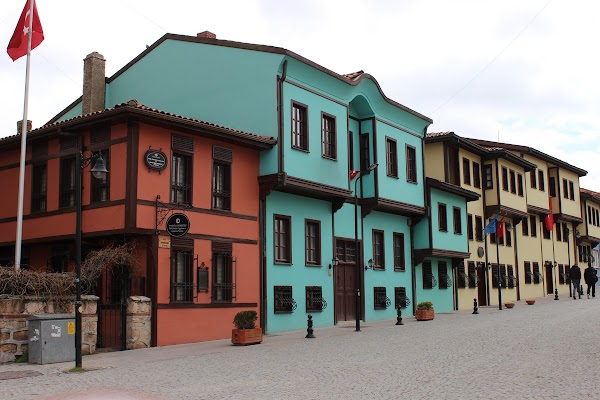
Odunpazarı Historic District
39.7644° N · 30.5231° E · Historic District
Odunpazarı Historic District is a historic district in Eskişehir, Türkiye. Odun pazarı means firewood market in Turkish. The Kurşunlu Complex is an Ottoman foundation of the sixteenth century. Most visitors spend 2-3 hours here. The free Lokali audio guide runs 6 minutes.
✓ Verified October 2026 · how we write these guides
Visitor facts
| Time needed | 2-3 hours |
|---|---|
| Lokali audio guide | 6 min · free |
| Type | Historic District |
| Best for | Authentic finds |
| Location | Eskişehir, Türkiye |
| Coordinates | 39.7644, 30.5231 |
| Languages | 45, in the Lokali app |
The story
The lanes here run downhill and the paving is uneven, so watch your feet before you look up. Then look up. The houses on both sides are timber-framed and painted in strong colours — ochre, deep red, blue, mustard. Upper floors lean out over the street until they almost meet. Somewhere close by you will hear a steady tapping, metal on soft stone. That sound is a carver at work, and it is the reason this quarter matters.
The name is literal. Odun pazarı means firewood market. This slope was where timber and firewood came into the town and changed hands. Eskişehir grew outward from here, and for a long time this was the residential heart of it. The rest of the city below is modern, flat and laid out in straight lines. Up here the plan is older and much less tidy. Nothing runs straight for more than a few dozen metres.
The building method is worth understanding before you photograph anything. A frame of timber posts and diagonal braces went up first. The gaps between were filled with sun-dried mud brick or rubble, then plastered over and painted. This kind of construction flexes in an earthquake instead of shattering. It also rots if the roof leaks. Where old plaster has fallen away you can see the wooden skeleton underneath. Whole streets of this construction survive in only a handful of Turkish towns.
The projecting upper floor has a name, the cumba. It gained floor space without taking up ground, and it shaded the street below. Windows in the cumba sit so that someone inside could see down the lane without being seen. Look at the front doors as you pass. Some carry two knockers at different heights, one heavier and one lighter, so that the sound told the household whether a man or a woman was waiting outside.
Partway down you will reach a large group of stone buildings around a courtyard. This is the Kurşunlu Complex, an Ottoman foundation of the sixteenth century. It combined a mosque, a lodge, a kitchen for the poor and lodgings for travellers. Kurşun means lead in Turkish, and the name comes from the lead sheeting laid over the domes. Today the rooms around the courtyard hold craft workshops and a small museum devoted to a mineral you may not have heard of.
The mineral is meerschaum, called lületaşı in Turkish. It is a soft, chalky white stone that forms underground in only a few places on earth, and the deposits around Eskişehir are the most important of them. Miners dig it out in lumps. Fresh from the ground it is damp and soft enough to cut with a knife. As it dries it hardens. That short window of softness is what makes the carving possible at all.
Watch a carver for a few minutes if a workshop is open. He soaks the block, scrapes off the outer crust, then cuts the shape with small hooked blades. The dust is fine and pale and gets into everything. Most of the output is smoking pipes, carved into faces, animals and ships. Here is the part people rarely expect — a meerschaum pipe changes colour with use. Tobacco oils soak into the porous stone and turn white to honey to deep amber over years.
Further along the ridge stands something entirely different. The Odunpazarı Modern Museum opened in 2019, a contemporary art gallery built from stacked timber boxes of different sizes. The Japanese architect Kengo Kuma designed it. From the street it reads as a pile of squared logs, which is a direct answer to the old timber quarter around it. Inside are white galleries and a tall shaft lit from above. Whether it belongs here is still argued about locally.
The colours are argued about too. Most of these houses were restored in recent decades, and the paint scheme was chosen for effect as much as for accuracy. Older photographs of the quarter show far more plain white and pale wash. That does not make the restoration wrong. It does mean you are looking at a decision made by a municipality, not a survival from the nineteenth century. Enjoy the effect, but know what it is.
Stop for food. The regional pastry is çiğ börek, a half-moon of thin dough filled with raw seasoned meat and fried until the surface blisters. It arrives too hot to hold. The dish came with Crimean Tatar families who settled in this part of Anatolia, and Eskişehir has one of the larger Tatar populations in the country. Ask for ayran with it, the salted yoghurt drink. The combination is standard here for good reason.
Late afternoon is the best hour on this slope. The low sun hits the painted fronts from the side and picks out every warped beam and sagging lintel. Cats sit on the walls. Tea gardens set out low stools in the courtyards. If it has rained, the cobbles darken and the colours deepen. The quarter is small enough that you can walk all of it in an hour, and good enough that most people go round twice.
Before you head back down to the modern city, find a spot on the higher lanes and turn around. From up here you can see the flat grid of Eskişehir spread out below, the river cutting through it, the tram lines. Behind you the lanes bend and double back with no logic at all. Two different ideas of how a town should work, sitting one above the other. Stand there a moment and let the tapping carry on behind you.
Key facts
What to look for
Practical tips
Common questions
How long do you need at Odunpazarı Historic District?
Plan 2-3 hours. That is the time most visitors spend at Odunpazarı Historic District. The free Lokali audio guide runs 6 minutes and is made to listen to while you walk.
Is there a free audio guide to Odunpazarı Historic District?
Yes — the Lokali app narrates Odunpazarı Historic District free of charge in 50+ languages. No ticket, tour group or subscription, and it works offline once downloaded.
Where is Odunpazarı Historic District?
Odunpazarı Historic District is in Eskişehir, Türkiye, at 39.7644, 30.5231. Tap the map link on this page for directions.
What should you know before visiting Odunpazarı Historic District?
Wear flat shoes for the steep uneven cobbles.
What is Odunpazarı Historic District known for?
Odun pazarı means firewood market in Turkish.
What is the best time to visit Odunpazarı Historic District?
Come in late afternoon for low side light.
On the map
Opens directions to Odunpazarı Historic District from your location.
Hear Odunpazarı Historic District in your language
The full story, narrated, in 50+ languages. Download it before you go and it plays offline, at your own pace, with no ticket and no tour group.