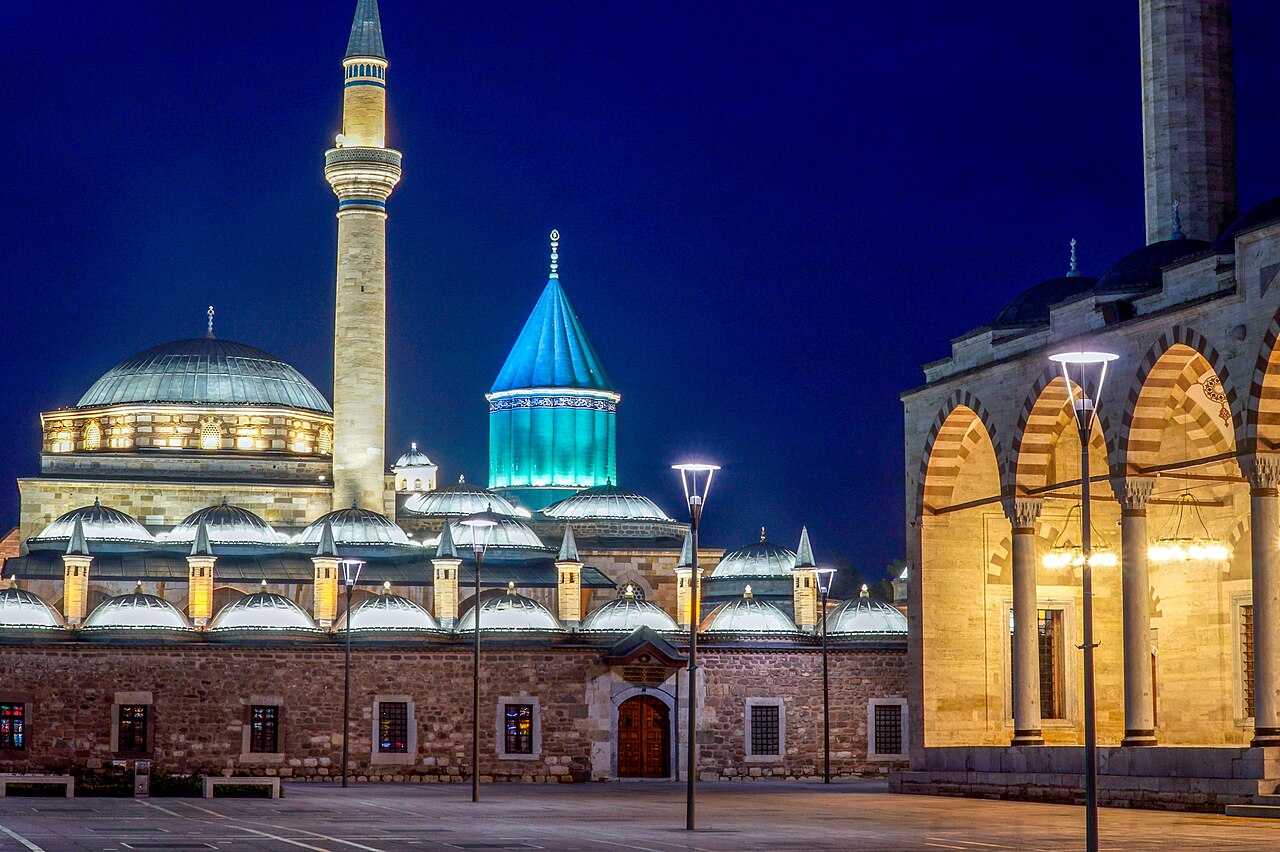
Mevlana Museum is a museum in Konya, Türkiye. Rumi died in Konya on 17 December 1273. The turquoise fluted roof is known as the Green Dome. Most visitors spend 1.5-2 hours here. The free Lokali audio guide runs 6 minutes.
✓ Verified October 2026 · how we write these guides
Visitor facts
| Time needed | 1.5-2 hours |
|---|---|
| Lokali audio guide | 6 min · free |
| Type | Museum |
| Best for | Authentic finds |
| Location | Konya, Türkiye |
| Coordinates | 37.8706, 32.5044 |
| Languages | 45, in the Lokali app |
The story
At the entrance you will be handed thin covers for your shoes. Slip them on and step through. The floor under you changes from stone to carpet, and the sound of the courtyard fades at once. The air holds a faint smell of rosewater and old wool. People move slowly here, shoulder to shoulder, many with their palms open in prayer. Some are visitors. Many are not. Stand still for a few seconds before you go further in.
Outside, above the roofline, a fluted dome rises in deep turquoise. Locals call it the Green Dome. The tiles catch the light from a long way off, and it is the shape people in Konya use when they give directions. Underneath it lies the tomb of a thirteenth-century scholar and poet whose name in Turkish is Mevlana, meaning our master. Elsewhere in the world he is usually called Rumi, and he is one of the most widely read poets in translation today.
His full name was Jalal ad-Din. His family came from the eastern Persian world and moved west, eventually settling here while the Seljuk sultans ruled from this city. Konya was then the capital of a sultanate that controlled much of Anatolia. His father was a respected preacher, and the sultan gave the family a rose garden on this spot. The father was buried in that garden. The son was buried beside him after his death in 1273. Everything around you grew outward from those two graves.
For most of his adult life Rumi was a conventional teacher of religious law. Students came to hear him lecture. Then, in his late thirties, a wandering dervish named Shams of Tabriz arrived in Konya. The two men spent months in close conversation. Rumi's students resented it. Shams left, returned, and then disappeared for good under circumstances nobody has ever established. What is certain is that Rumi came out of that friendship writing poetry, and he did not stop.
The result fills six volumes of rhyming couplets known as the Masnavi, plus thousands of shorter poems. He composed in Persian, the literary language of the region at the time. Much of it he dictated aloud while walking, and scribes wrote it down. Some of the oldest surviving manuscripts sit in glass cases in these rooms. The handwriting is small and even. Look at the margins — the decoration was added by different hands, sometimes long after the words were set down.
After his death his followers organised themselves into the Mevlevi order, one of many Sufi brotherhoods. Sufi means the mystical tradition within Islam, which puts direct experience of the divine ahead of law alone. The Mevlevi became known abroad for their turning ceremony, the sema. The turner holds the right palm upward and the left palm downward. The idea is simple. What is received from above is passed down to the earth, and the body serves only as a channel.
The tall camel-hair hat worn in the ceremony stands for a tombstone. The white skirt stands for a shroud. The black cloak dropped at the start stands for the grave, left behind. Once you know this, the ceremony reads less as a performance and more as a rehearsal for dying. Turkish dervish lodges were closed by law in 1925, in the early years of the Republic. This one reopened the following year as a museum, which is how the buildings survived.
Walk through into the tomb chamber. Under the dome stand rows of stone cenotaphs, each covered with heavy embroidered cloth. Carved turbans sit on top of many of them. The size and shape of the turban indicated the rank of the man below. Rumi's own resting place stands behind a silver screen worked with fine lattice. Tradition says his father's coffin was set upright rather than laid flat. Take that as tradition rather than as a documented fact.
The larger hall beside the tomb was built later, under Ottoman rule, as a place for the sema. A small mosque adjoins it. The collection in these rooms includes prayer rugs, illuminated manuscripts, musical instruments and relics kept in fine metal containers. Look for the reed flute, the ney. It is cut from a single length of reed. The opening lines of Rumi's long poem describe such a reed crying for the reed bed it was taken from.
Around the courtyard runs a line of small domed rooms. These were the cells where dervishes lived. Several now hold figures showing daily routine — copying manuscripts, praying, preparing food. New members of the order did not begin with music or turning. They began in the kitchen, and the training period lasted 1001 days. Much of it went on ordinary chores. Only after that did instruction in the ceremony begin. Patience was treated as the first skill, not the last.
Rumi died on 17 December 1273. His followers called that night Şeb-i Arus, the wedding night, because they understood his death as a reunion rather than a loss. Ceremonies are still held in Konya every December to mark the date. If you come in that week the city fills, hotels book out, and the queue outside this door runs down the street. At other times of year the mornings here are surprisingly quiet.
Step back out into the courtyard when you are finished. There is a fountain with running water and usually a crowd of pigeons on the paving. Look up once more at the dome, then at the people around you — some photographing, some praying, some simply sitting on the low wall. That mixture has held here for a very long time. Take a minute on the stone before the noise of the street starts again.
Key facts
What to look for
Practical tips
Common questions
How long do you need at Mevlana Museum?
Plan 1.5-2 hours. That is the time most visitors spend at Mevlana Museum. The free Lokali audio guide runs 6 minutes and is made to listen to while you walk.
Is there a free audio guide to Mevlana Museum?
Yes — the Lokali app narrates Mevlana Museum free of charge in 50+ languages. No ticket, tour group or subscription, and it works offline once downloaded.
Where is Mevlana Museum?
Mevlana Museum is in Konya, Türkiye, at 37.8706, 32.5044. Tap the map link on this page for directions.
What should you know before visiting Mevlana Museum?
Use the shoe covers handed out at the entrance.
What is Mevlana Museum known for?
Rumi died in Konya on 17 December 1273.
What is the best time to visit Mevlana Museum?
Arrive on a weekday morning to avoid the longest queues.
On the map
Opens directions to Mevlana Museum from your location.
More to see in Konya

Hear Mevlana Museum in your language
The full story, narrated, in 50+ languages. Download it before you go and it plays offline, at your own pace, with no ticket and no tour group.